Four miles north of Onoway stands a small church built in the 1940s by Ukrainian pioneers. The first immigrant families in the area were served by various missionaries or circuit priests who spoke the Ukrainian language. Services were held in private homes, schools and other denominational churches. For very special occasions, such as the blessing of the Easter bread “paska”, baptisms or marriages, many traveled to Edmonton for their church needs.
As more Ukrainians settled in the Onoway area, the leading members agreed that a parish of their own should be organized. A dedicated group was formed in 1942 and people were elected to further the church interest of Onoway and District Canadian Ukrainians. Elected were: Karpo Yaroschuk, Dennis Nemenko and Nicolia Hreneshyn. They established priorities and a decision was made that the most urgent need was the purchase of land for a cemetery and that a church would be built when sufficient funds were pledged by the membership. A committee of three, Stan Koziar, John Shabada and Andrew Wengreniuk, was elected to find and purchase suitable land.
On April 12, 1943 four acres of land north of Onoway were purchased for $40.00. Plans were quickly underway to build a church and an intensive membership drive was undertaken to support the proposed building.
There were approximately 40 Ukrainian families who either pledged labour or financial support. Some names you may recognize include: Karpo Yaroschuk, Peter Yanchar, Roman Shabada, Alex Shabada, Peter Shabada, Paul Shabada, William Shabada, Nick Shulak, John Shulak, Steve Shulak, O. Derechy, John Bakan, Dennis Nemenko, Mike Storenchuk, N. Hreneshyn, P. Lewoniuk, Anani (Emil) Borys, Bill Koziar, Sam Koziar, Alex Koziar, John Shelenko, Phillip Tyschuk, Bill Tyschuk, Jim Tyschuk, John Tyschuk, Mark Omelchuk, Fred Antoniuk, John Antoniuk, Andrew Wengreniuk, C. Rocko, Paul Yanda, Bill Melenka and Bill Sawka. (The Church organization apologizes for any names that may have been omitted.)
The construction of a very modest building was underway; however, during the actual construction, the Roman Shabada family made a very generous donation in memory of their son, Peter, who had passed away. This enabled the final addition to be built on the church, which now serves as the altar.
Bill Tyschuk donated a very large amount of lumber, which was greatly appreciated. Almost all the interior furnishings such as vestments, crosses, holy pictures, Bibles, icons, candelabras and other church artifacts were donations of numerous members of the church over the years.
On April 8, 1950 the newly elected church executive was instructed by memberships to plan for the blessing and opening of the church. Elected were Andrew Wengreniuk (president), Nick Shulak (vice president), Alex Shabada (secretary) and Peter Shabada (treasurer). The financial control committee was Alex Koziar and Peter Yanchar, white Phillip Tyschuk and John Shelenko made up the church welcome committee.
Although the church was not fully completed, the first service was celebrated on Sunday, July 14, 1950. Reverend Ambrose Chrustanka blessed the church in the names of the Patron Saints Peter and Paul. Words cannot express the joy of all present as they participated in the first service of their new church, in their native language.
For decades, yearly services were held for Ukrainian Easter, Prasnak (celebration in July for the Feast of St. Peter and St. Paul) and Thanksgiving. The celebration in July brought out many former members from Edmonton and the surrounding area. It remains a wonderful service followed by the blessing of the graves and potluck lunch & fellowship. Of course, the church has also been used over the years for weddings, funerals, vow renewals and baptisms.
For 75 years, maintenance of both the grounds and the church has been kept up by the volunteer efforts of the congregation. To this date, the church is heated by a wood stove and lit by candles.
The church bell had been missing for several years and was recovered in the Rich Valley area, discovered by a grader operator. It was refurbished and stood proudly again for decades, only to be stolen in the summer of 2022 along with the church contents. The precious bell and sentimental artifacts remain unrecovered.
This little church continues to serve as a place of worship, but also stands as a monument to the Ukrainian pioneers who, in their wisdom, saw not only a need for their own spiritual development, but also a heritage to be left for the younger generation.
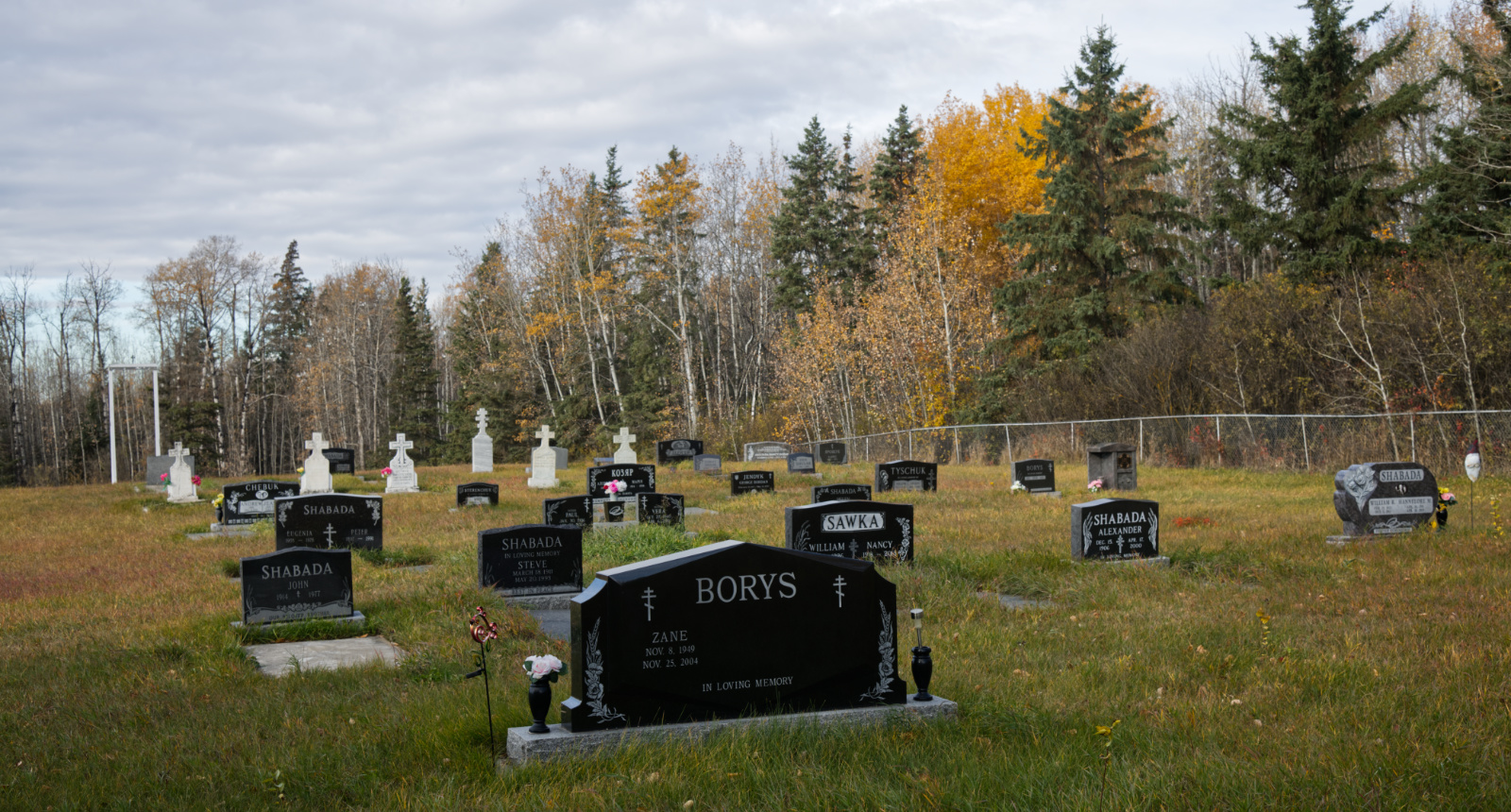
Play Memory Eternal Chant
Visit this Cemetery
GPS Co-ordinates: 53.774371, -114.199211
Affiliation: Ukrainian Orthodox Church of Canada


Sts. Peter and Paul Ukrainian Orthodox Church – Onoway, AB
The origins of congregational activity in the Thorhild area can be traced as far back as 1931 to missionary activity in the Tudor district. However, as was increasingly the case in much of rural Alberta, the focus of church activity gradually shifted over time from the countryside to the nearest town. This was Thorhild, the county seat and the leading commercial centre in the region.
Eventually, a meeting involving sixteen representatives of local families was held at the home of Anna and Evsey Kovalenko on 18 March 1945 to discuss establishing a full-fledged congregation. Until that time, the Ukrainian Orthodox faithful in the Thorhild community would worship at St. John’s Ukrainian Orthodox Church near Egremont, or occasionally hosted services in family homes, the Tudor Narodnyi Dim north of Thorhild, or in the Thorhild School.
Early pastoral care was provided by Reverends T. Horbay and E. Olendy. They would arrive in Thorhild by train and would then be transported to the place of worship by horse and buggy, sleigh, or a Model T. Ford. In this way, the seeds were sown for the initiation of congregational life in Thorhild.
Although the Ukrainian Orthodox residents of the Tudor district had previously obtained land for a cemetery and constructed a Narodnyi Dim, they decided to forgo building a church in the countryside. Instead, they joined forces with the inhabitants of Thorhild to erect a sanctuary in the village.
In April 1945, a lot was bought in the village for a church from Evsey Kovalenko for $338. Construction began in 1947. Work was completed and the church was formally blessed on 22 August of the following year. Blessing occurred during a memorable visit by Archbishop Mstyslaw Skrypnyk—who in 1991 became the first Patriarch of Kyiv.
To raise money for the project, a wide variety of fundraising events were held to supplement individual donations, including dances, bazaars, box socials, winter carnivals, masquerades and whist drives. Besides catering banquets and weddings, the members of the church also raised money by Christmas carolling.
In 1963 the church basement was developed to create a facility suitable for holding dinners, meetings, and cultural events. The following year, the sanctuary itself was refurbished. The investment in the church basement proved to be auspicious. In the 1966-1967 school year it was used to conduct an elementary class due to overcrowding in Thorhild schools. Church school and Ukrainian school classes were also held in the church basement, In 1976 Thorhild congregation held its first Harvest Ball that subsequently became a very popular annual social event in the community.
Sadly, Sts. Peter and Paul church burnt down in an electrical fire on 28 February 2015. It was being cleaned for Sunday service the following day. Although six members of the congregation were inside when the fire started, it was impossible save anything from the interior, including the iconostas by Vera Senchuk, or any chalices, banners, or interior furnishings. At the time of the sanctuary’s destruction, the congregation had 24 members.
(In 2016, the church was rebuilt on its original location in Thorhild. The photographs in the Photo Gallery were taken of the new church in 2024).
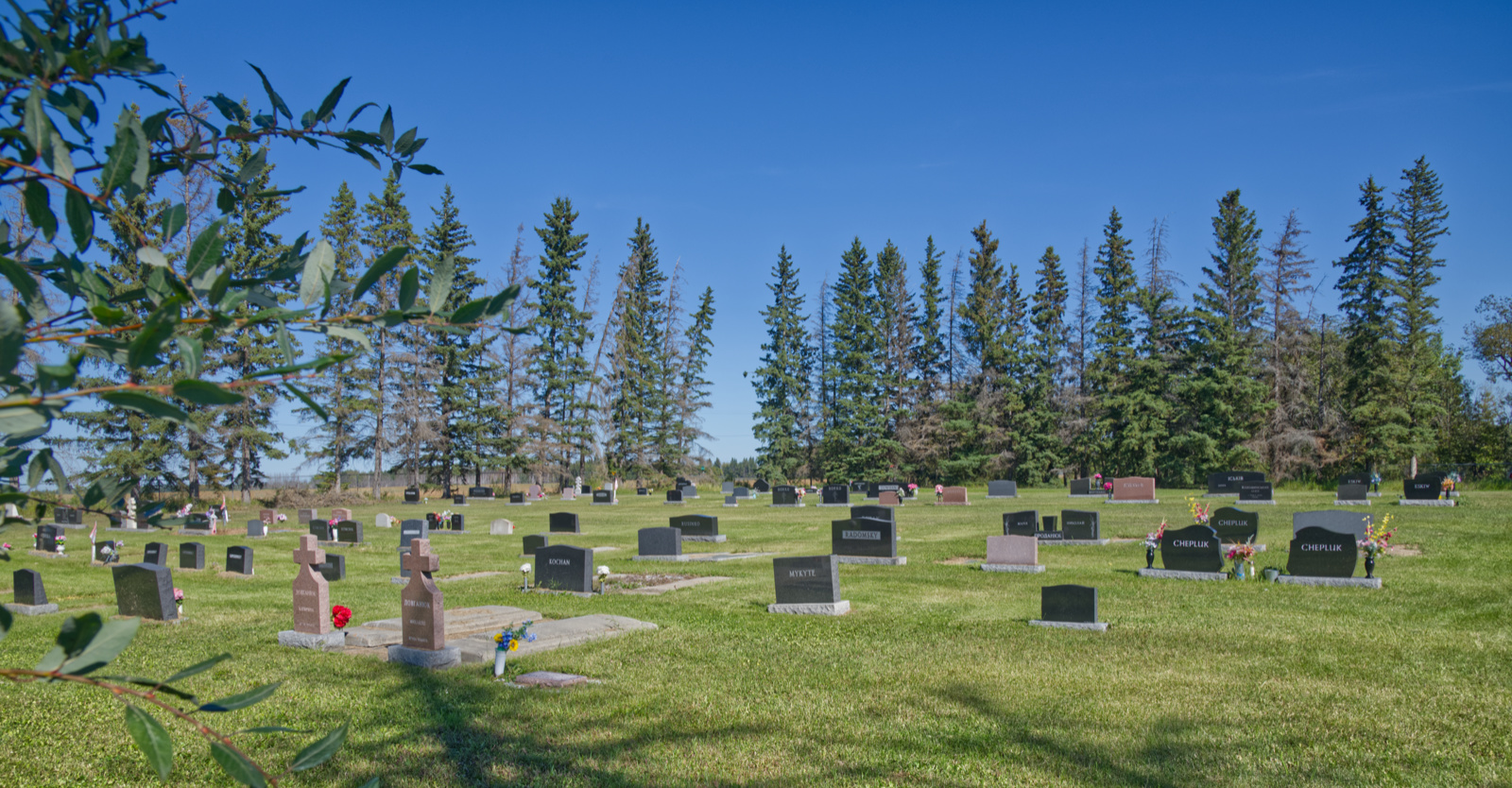
Play Memory Eternal Chant
Visit this Cemetery
GPS Co-ordinates: 54.160934, -113.125147
Cemetery GPS: 54.15877, -113.13566
Affiliation: Ukrainian Orthodox Church of Canada
Sts. Peter and Paul Ukrainian Orthodox Church – Thorhild, AB
The Westlock area in Alberta, inhabited by non-Ukrainians for over 40 years, saw the arrival of Ukrainian settlers in the 1930s. Initially, there was no Orthodox church in the area, so residents attended services in Edmonton. As the number of Orthodox Ukrainians grew, they established a parish in 1956. The first Divine Liturgy was held on February 26, 1956, in an Anglican church by Fr. E. Hrytsyna, then-administrator of the Western Eparchy. The second service took place on March 11, 1956, followed by the founding assembly, which elected the first parish council: Chairman: Yu. Seniuk, Vice-Chairman: D. Luchka, Secretary: M. Kostiv, Treasurer: S. Mahas, Audit Committee: S. Melnyk, I. Hrushka, and Mrs. Anna Kostiv, Senior Brother: O. Hobliak, Sisterhood Leader: Mrs. Maria Yaremko,
Three years later, Fr. Blazhuk became the first resident priest and helped organize the Women’s Society of St. Olga.
In 1956, the decision was made to build a church. On May 3, 1957, construction began, and the first service in the new church was held on the Feast of St. Volodymyr, Sunday, July 28, 1957, coinciding with the 39th anniversary of the revived Ukrainian Greek Orthodox Church in Canada.
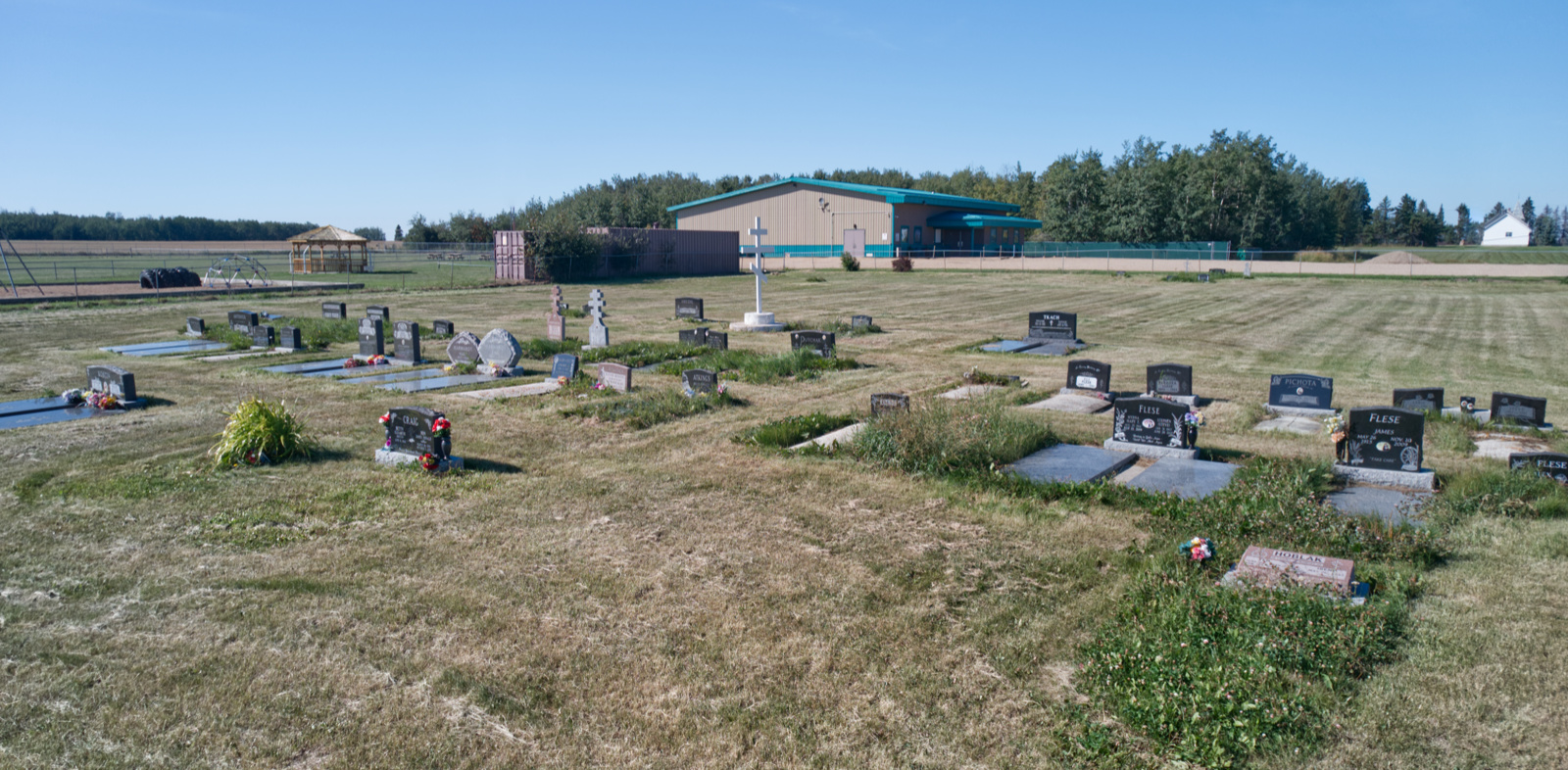
Play Memory Eternal Chant
Visit this Cemetery
GPS Co-ordinates: 54.152538, -113.840362
Cemetery GPS: 54.15168, -113.99616
Affiliation: Ukrainian Orthodox Church of Canada
St. Volodymyr Ukrainian Orthodox Church – Westlock, AB
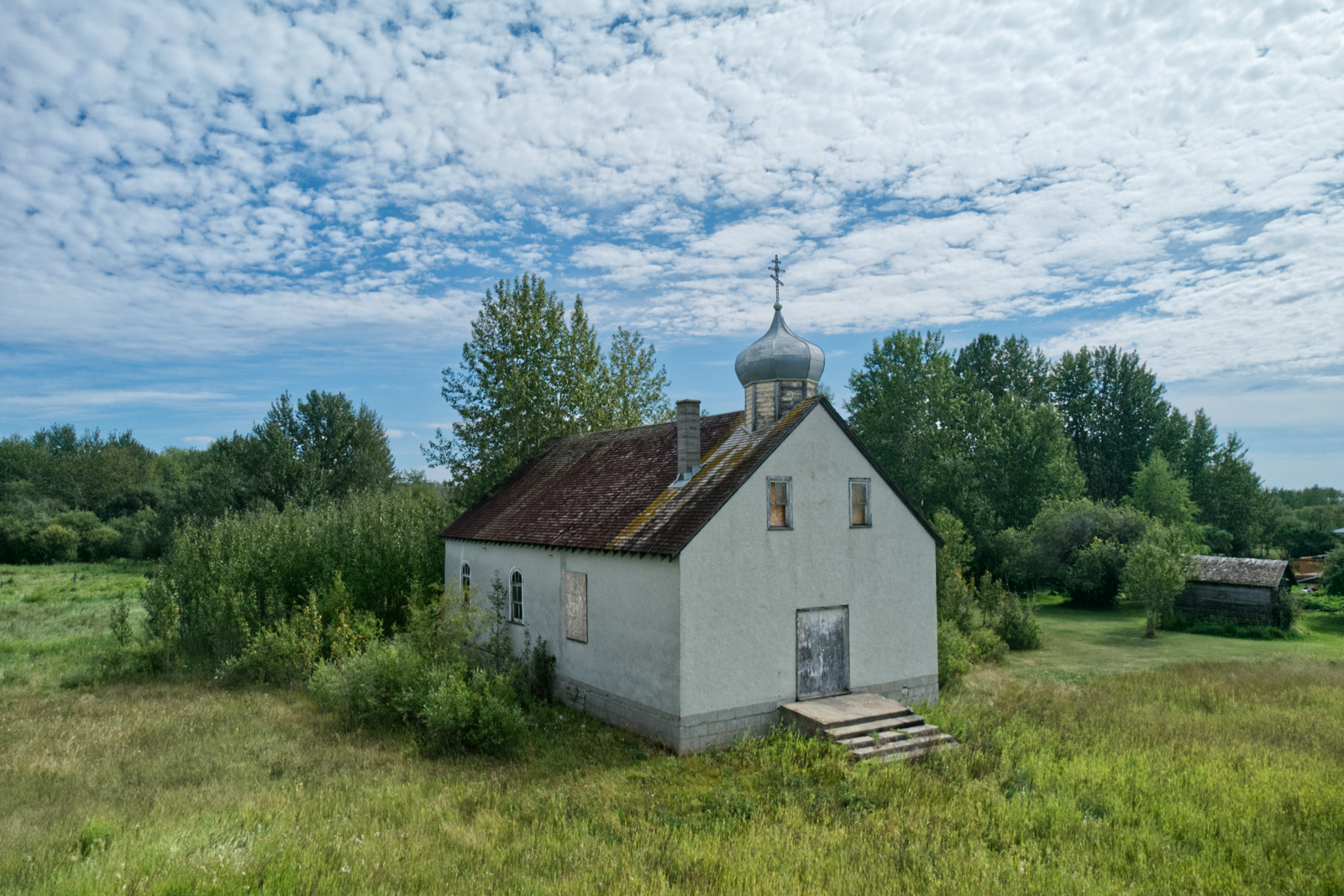
Initiated on 29 June 1952, the congregation originally adopted the name Holy Ghost Ukrainian Orthodox Church. However, when a formal application for membership in the Ukrainian Greek Orthodox Church of Canada was submitted after a meeting held on 28 February 1954, the name of the new parish was changed to that of the Dormition of the Virgin Mary. With the establishment of this parish, a congregation that had been active in the nearby community of Danube dissolved itself. Instead, they joined forces with their fellow Orthodox adherents in Newbrook. Indeed, the organization of the latter merely marked the continuation of the existence of the former in a new location.
Construction of a sanctuary began in 1956, when congregation consisted of ten families, but only three registered members. That same year eight services were held in the community by the priest resident in Radway.
Play Memory Eternal Chant
GPS Co-ordinates: 54.334349, -112.950120
Affiliation: Ukrainian Orthodox Church of Canada