U
krainians from the Smoky Lake area, originally from Bukovyna and the border regions of Belorus, first began farming in the Wandering River area in 1929. Within a year Fr. Tymofii Horbay, who was based in Smoky Lake, began providing pastoral care to this new settlement. By 24 November 1930 a meeting was held at the home of John and Annie Skoreyko with the goal of establishing a Ukrainian Orthodox church and cemetery. At this inaugural gathering, attended by representatives of six families, Harry Rosychuk was chosen to be the President, and George Strembitsky and Todor Dwernychuk were elected as the trustees. Moving quickly with Fr. Horbay’s assistance, this initiative group applied to the government for a two-acre parcel of land at NW 30-71-16 W4 even before the year was out.
How and when this application was finally processed is unclear, since several years later some confusion arose as to the technical ownership of the land when jurisdiction to it was claimed by a priest with the pro-Soviet Russian Patriarchal Orthodox Church. Be that as it may, a Ukrainian Orthodox congregation was more formally organized at Wandering River following Fr. Horbay’s last church service in the community on 23 April 1933—after which he relocated to Suchava. It seems that it was also decided at this time to adopt St. Elias as the patron of the new congregation.
Subsequently, the Wandering River faithful only received sporadic services, one of these being the 17 March 1934 wedding of William Strembitsky and Alice Ruptash. This took place at the local school. Fr. Ivan Mayba also officiated at a wedding in the community around this time, having taken over pastoral duties at Smoky Lake. In November 1934 circumstances prompted one parishioner to write Fr. Hieronim Hrycyna, pleading for him to come from Edmonton to serve at Wandering River. Fr. Kisiliuk (who was serving outlying centres from the provincial capital) seemed uninterested in doing so.
The correspondent, George Rosychuk, provided a detailed account of how local Catholics were aggressively trying to recruit members among the Ukrainians. An Anglican priest was likewise doing his best to get Orthodox believers to support the church that he was then trying to get built. Indeed, the latter was telling people that the Anglican and Orthodox Churches had an agreement whereby it was permissible for Orthodox believers to be served by Anglican clergymen if their own priests were unavailable. Furthermore, he was said to be distributing children’s clothing among Ukrainians in exchange for their labour on the Anglican church. Expressing concern that the congregation was in danger of being picked apart or that some supporters might lapse into atheism, Rosychuk urged either Fr. Hrycyna or Fr. Kisiliuk to come that December to Wandering River for a Divine Liturgy.
In response to this request, Fr. Hrycyna subsequently made the effort to celebrate a service for the congregation. H consecrated the cemetery site at the same time. During these difficult years, the congregation often gathered to worship at the home of George Strembitsky, since a National Hall was never built in the community. In 1938, Fr. George Tsukornyk also made a pastoral visit to the isolated settlement. By this time work had already begun on the construction of a small, log, house-style church that was then blessed by Fr. Tsukornyk in 1939.
Meanwhile, complications had developed in September 1938 after some members of the congregation informed the Department of Lands and Mines that they should write to Rev. M. N. Cependa of Smoky Lake to obtain the required statutory declaration that the recently completed log structure on the cemetery property “was being used for public worship.” What had happened was that that several of Fr. Cependa’s sympathizers had recently joined the St. Elias congregation because they wanted to have access to the cemetery and gain control over the church. They subsequently succeeded in taking over the executive and were attempting in this manner to get the Patriarchal Orthodox Church recognized by provincial authorities as having jurisdiction over the Wandering River sanctuary. A flurry of correspondence followed, where among other things it was revealed that the provincial government had no record for a “Ukrainian Greek Orthodox Congregation at Plamondon,” a French community 28 miles from Wandering River. This mix-up could be attributable to the fact that the original application for a land title may have been registered at the Plamondon Post Office.
Very few details are known about the life of the congregation from the 1940s to the mid-1950s, beyond the fact that the community was extremely poor and the congregation had to constantly struggle to survive. According to a report submitted to the Consistory in June 1953, until the posting of Fr. Zubrytsky to the Lac La Biche Parish District the previous year, there had only been annual services at Wandering River. However, by 1954 the number of liturgies at St. Elias church had increased to six, thanks to the presence of resident priest in nearby Lac La Biche.
Somewhat ironically given the congregation’s beginnings, in 1965 the Consistory approved a request from the St. Elias congregation that the Anglican Church be allowed to use their cemetery for burials. Of course, with the passing of time, many things were changing, and the Ukrainian community in Wandering River was simultaneously aging and shrinking.
In 1972, just two services were held at St. Elias, and in 1973 the year-end bank balance was a mere $102.40. Later in the decade services ceased altogether for a time. Fr. Kubin was able to somewhat revive the congregation with the help of a couple of younger members who assumed executive positions in 1978 following the death of the long-time president in an accident.
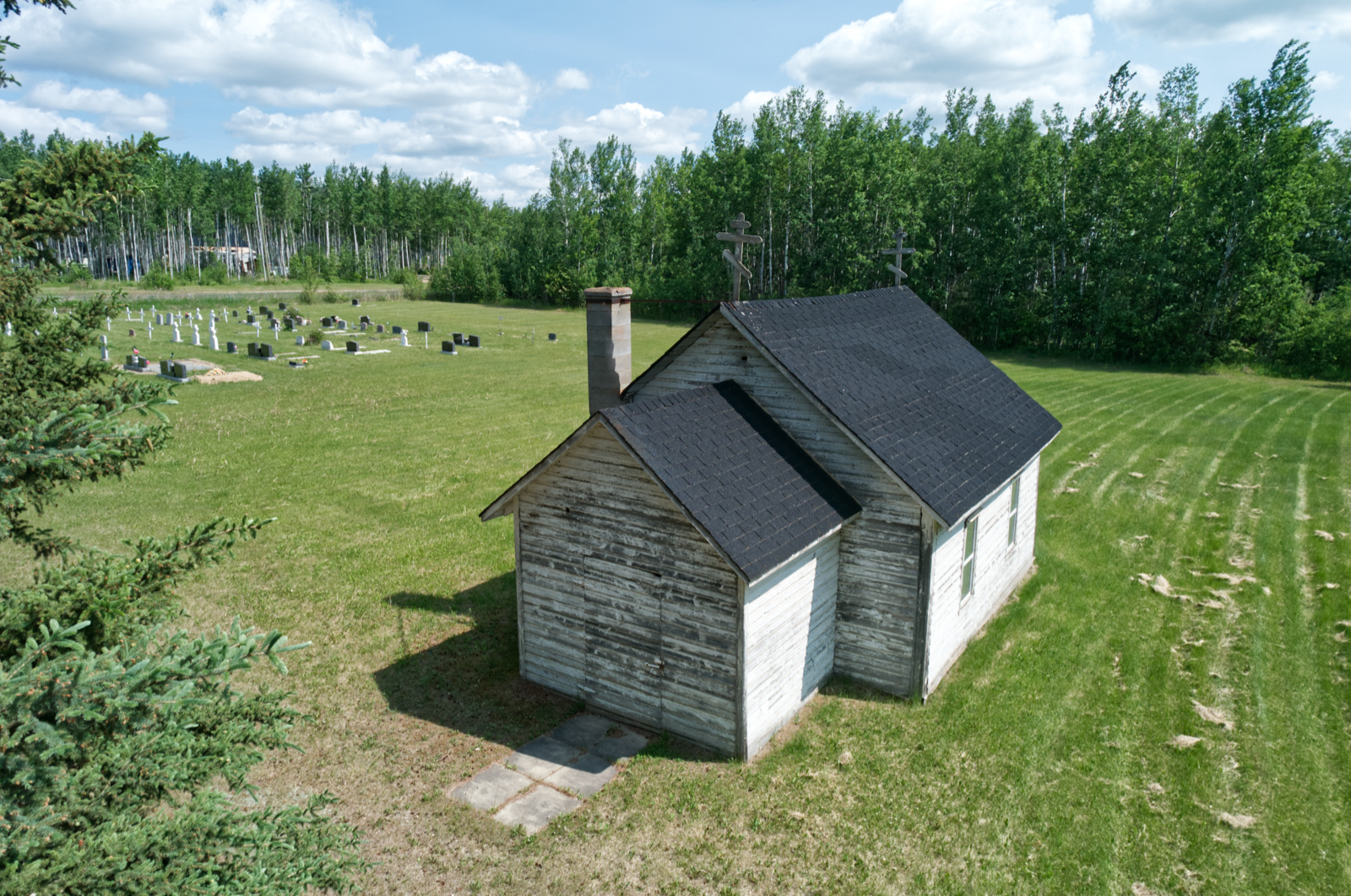
However, as more and more people moved away or died, membership in the congregation gradually declined to the point where it was not possible to properly maintain the sanctuary. The church, while still standing, is no longer used, and its front entryway has been permanently sealed with boards.
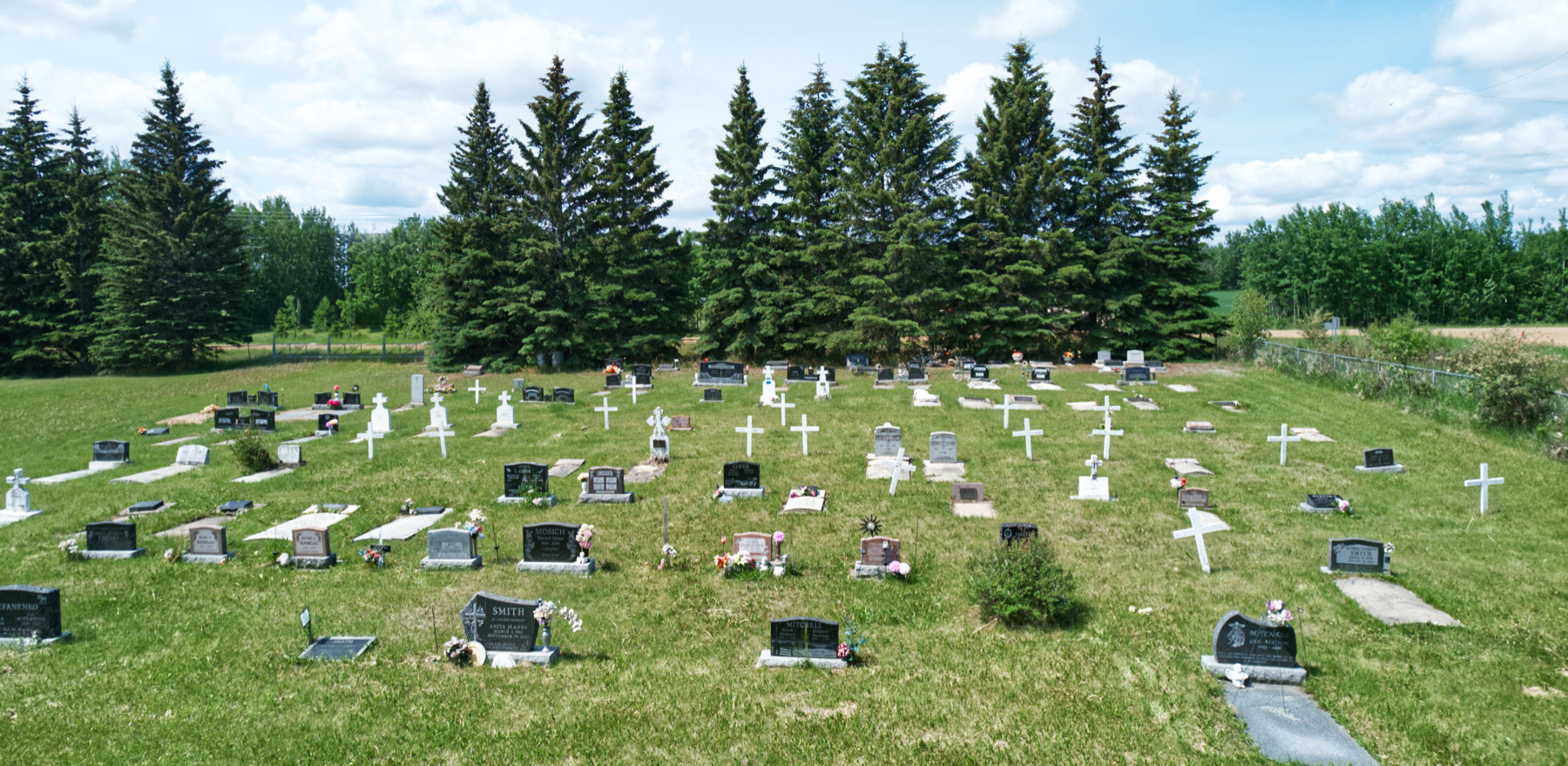
Nevertheless, a visit to the site in June 2022 revealed that the church roof had been recently re-shingled and the grass freshly mown. At the same time, when the annual Provody service is held, many families come from near and far to pray for the souls and honour the memory of their ancestors.
Play Memory Eternal Chant
Visit this Cemetery
GPS Co-ordinates: 55.177714, -112.467743
Cemetery Co-ordinates: 55.177988, -112.467547
Affiliation: Ukrainian Orthodox Church of Canada


St. Elias Ukrainian Orthodox Church – Wandering River, AB
T
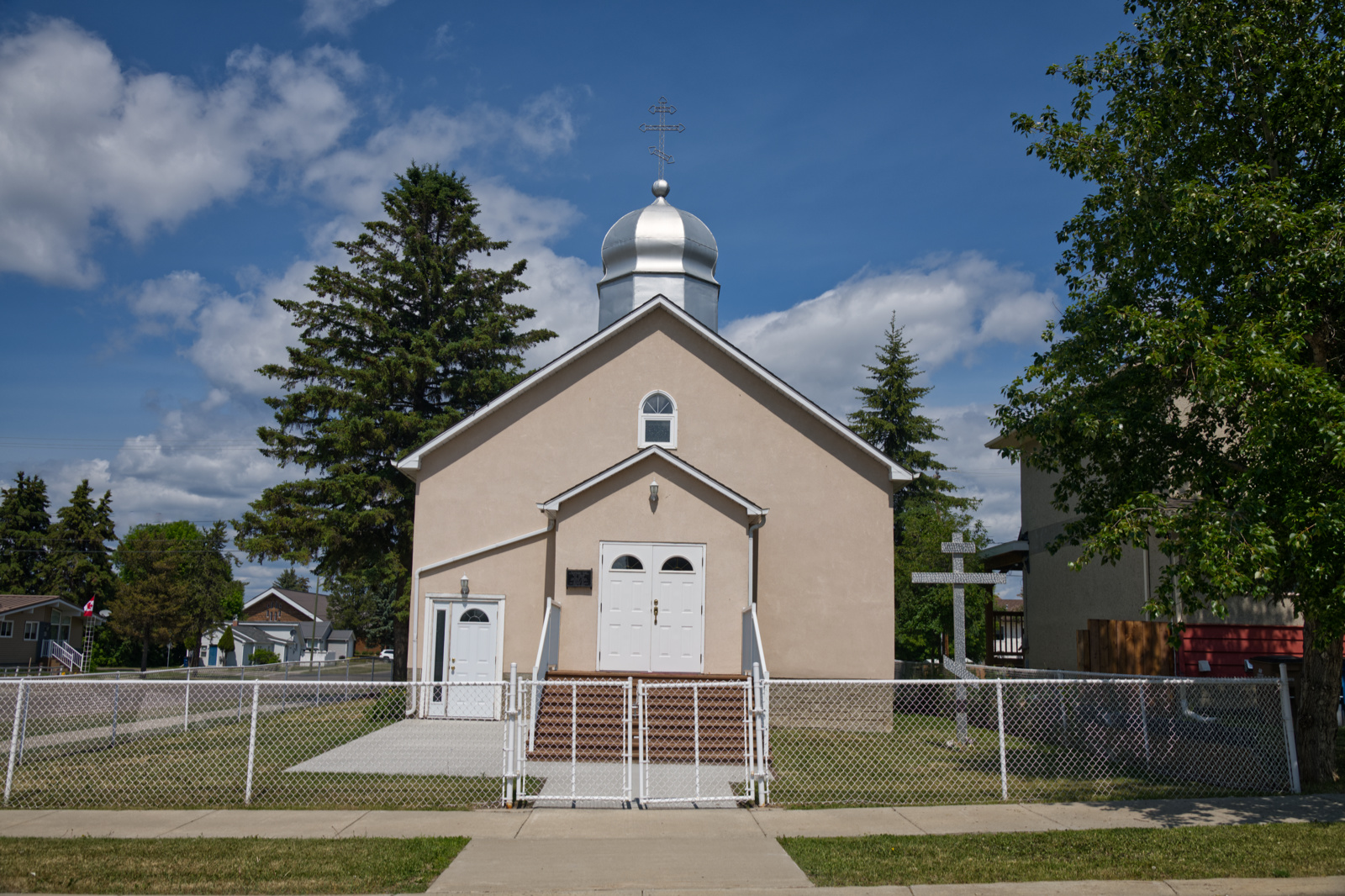
The Lac La Biche area was originally visited by Ukrainian Orthodox priests in the early 1930s, among them Fr. Semen Sawchuk in August of 1939. A few services were also held in Lac La Biche itself during the 1940s at the local Anglican Church. It was rented for the sum of $8 to host a Divine Liturgy celebrated by Fr. H. Wasyliw on 2 September 1951. It was then that the idea of building a church in town probably first took root.
A major role in mobilizing the Lac La Biche Orthodox community was played by the establishment of a branch of the Ukrainian Women’s Association on the initiative of Alice Gordichuk (who was originally from Willingdon) on 13 October 1951. On 2 March of the following year, the loosely constituted congregation elected a founding executive comprised of William Gordichuk, Fred Warawa, and Eli Tkachuk. Subsequently they began recruiting additional members to join the fledgling parish, formed originally by ten families.
These early efforts received a significant boost with the assignment of Fr. Petro Zubrytsky to serve north central Alberta in the 1952. It was decided that he would make his home in Lac La Biche, while also tending the parishes of Craigend, Boyle, Noral, Sarrail and Wandering River. Although initially it was planned to make Boyle the pastoral base for the region, at a meeting held in Lac La Biche on 3 August 1952, a resolution was passed in favour of the latter because it was better situated and unlike Boyle had a water system. A house on two acres of land was then acquired for use as a manse for $1900. Three years later it was decided to sell the house because it was poorly insulated and expensive to maintain. A second, more appropriate house was purchased afterwards by the Lac La Biche Parish District that had been created in 1952. It was used as the manse until 1986.
In 1954 Fr. Zubrytsky celebrated 11 services at the Lac La Biche Anglican Church. The congregation did not yet have its own place of worship, even though a committee had been struck in March of the previous year to find a suitable and affordable lot for a sanctuary. A piece of land was finally purchased in early 1955 for $1,200 from a man named T. Cummings. A sod-turning ceremony took place at the site on 9 June. Construction work began soon after with the excavation of a full basement. Meanwhile, at a meeting held on 7 April the congregation voted to become incorporated under the charter of the UGOC. It was officially granted admission three weeks later. The congregation registered itself as being dedicated to St. Andrew, whose feast day is commemorated on 13 December.
Fr. Zubrytsky was able to celebrate the first liturgy in the partially built church in late November of 1955. It was used again for a funeral on 2 December. Fir veneer, poplar plywood, and sky-blue paint for the ceiling were then purchased in February 1957 to finish the interior and choir loft. By the following year St. Andrew’s church was essentially completed inside and out. By this time, the congregation was celebrating monthly liturgies and consisted of some 20 families, but only a dozen of these actually paid memberships.
The furnished and decorated church was then consecrated by Archbishop Andrew at a hierarchical Divine Liturgy celebrated on 9 June 1963. This was exactly eight years from the day of the sod-turning ceremony. Four priests took part in the service, along with St. John’s Cathedral choir from Edmonton. Lunch and a program followed at the old Town Hall. By then, the church had adopted a new name, as earlier that year, on 2 January, the congregation voted to ask that Metropolitan Ilarion allow the church to be rededicated as All Saints.
Over time All Saints, along with most other rural congregations, were beginning to experience the effects of an aging and declining membership. Also, there was a concomitant reduction in those who were fluent in the Ukrainian language. In 1994, All Saints reported having a total of 27 members, comprised of 11 families and 5 individuals. By this time, only the Women’s Association maintained an active existence, though the faithful members of the congregation continued to support and look after their place of worship.
Play Memory Eternal Chant
Visit this Cemetery
GPS Co-ordinates: 54.771215,-111.981675
Affiliation: Ukrainian Orthodox Church of Canada
All Saints Ukrainian Orthodox Church – Lac La Biche, AB
No
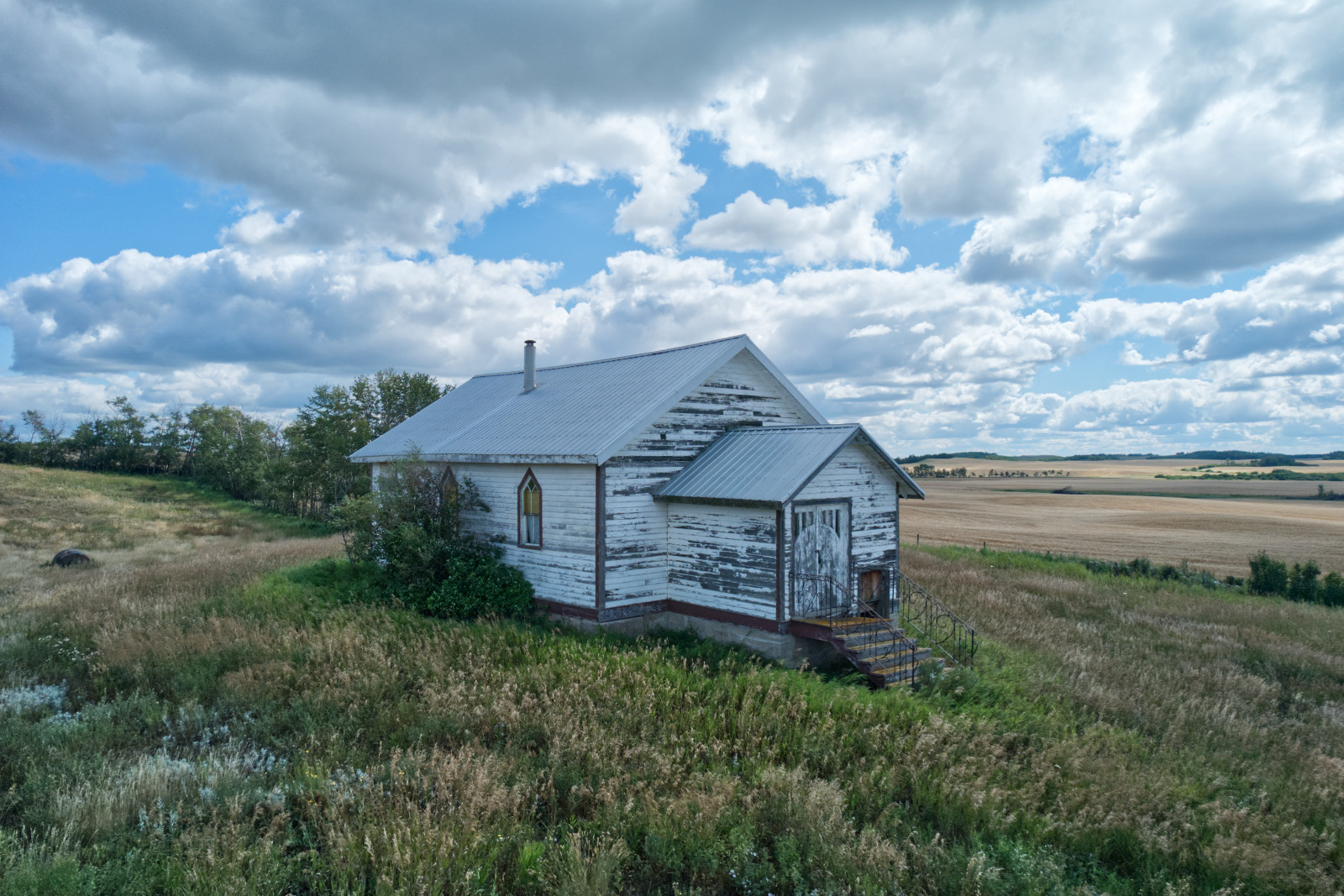
records appear to exist documenting the early years of this church. However, oral sources indicate that a congregation had formed by 1912. Construction of a log church began around that year and apparently was completed by 1915. Metro Rozko, who had donated ten acres of land from his homestead for a cemetery in 1906, acted as the master carpenter overseeing the volunteer work crew. The finished sanctuary (made of hand-hew logs) was named the Russo-Greek Orthodox Church of All Saints, formal title being obtained to the property on 10 July 1922.
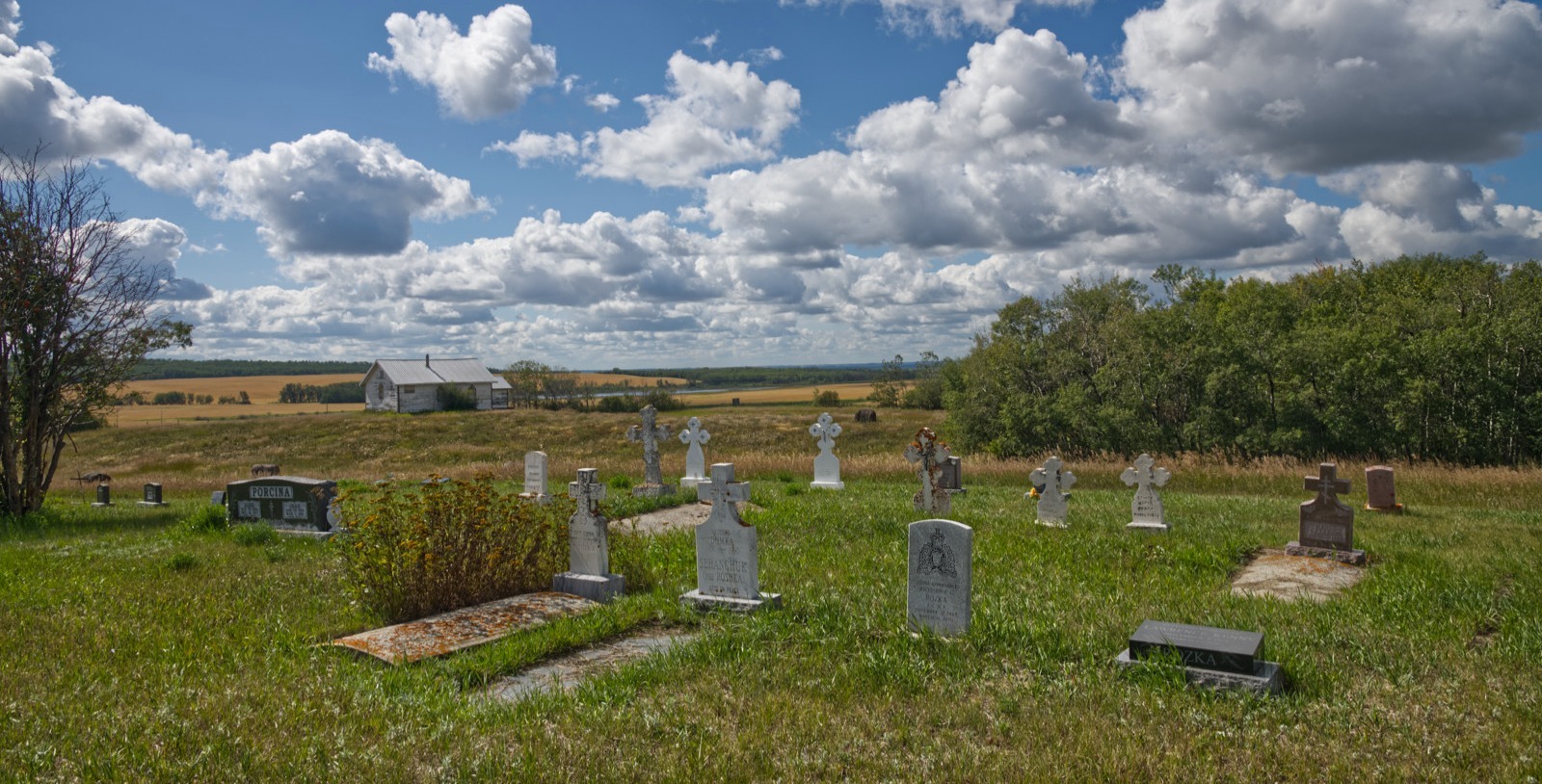
Liturgies were celebrated at North Slawa on an irregular basis, with priests from the Russo-Orthodox Church ministering to the needs of the community. The only regular service was the annual blessing of the graves. It was during a clean-up of the cemetery in July 1940 that a controlled fire flared up with unexpected ferocity, tragically consuming the original church. Although the congregation lacked a place of worship for more than a decade, Provody continued to be held at the cemetery each spring, providing a focus for religious life in the North Slawa district.
In the meantime, parishioners decided to follow their long-term pastor, Rev. A. Chrustawka, when he left the Russo-Orthodox Church for the Ukrainian Greek Orthodox Church of Canada. At a meeting held on 14 September 1941, members voted to request affiliation with the Winnipeg-based UGOC, who henceforth provided priests for the congregation.
According to a report submitted to the consistory by Rev. I. Shwetz, in 1951 the All Saints congregation consisted of 5 members. On 1 June 1956 the North Slawa parishioners, through the efforts of Isaac Lypka, purchased the former Brierfield Schoolhouse from the recently amalgamated Two Hills School Division. It was moved to the 10-acre burial ground and converted into a church.
Subsequently a free-standing enclosed belfry was erected not far from the church. The entire property was fenced with the help of a provincial grant. A cairn was also put up honouring the memory of the North Slawa pioneers. Two services are known to have been held at the church in the summer of 1966. However, by 1971 it was reported that the All Saints congregation had been defunct for several years.
Play Memory Eternal Chant
Visit this Cemetery
GPS Co-ordinates: 53.744683, -111.043186
Cemetery Co-ordinates: 53.74540, -111.04236
Affiliation: Ukrainian Orthodox Church of Canada
All Saints Ukrainian Orthodox Church – Slawa (North), AB
As in many immigrant communities, the origins of Ukrainian religious life in Waskatenau were somewhat clouded by controversy. For although a common sense of purpose prompted local residents to purchase six acres of land for a church and burial ground on 25 May 1934, it subsequently became apparent that allegiances were split between Catholic and Ukrainian Orthodox supporters. In 1937 the pro-Catholic faction invited Rev. Dzigolik of the Basilian Fathers to conduct an outdoor Mass on the commonly-held property, the same year that a Ukrainian Orthodox congregation was officially initiated in Waskatenau with the formation of a church executive comprised of Joseph Mulak, Andrew Shwetz and John Kobrinko. The following year, Rev. M. Fyk celebrated the first Orthodox liturgy in the hall above the Co-op store, which the Catholic camp also used before relocating their services to John Kobrinko's pool hall. The latter individual provides a good example of the contradictory tendencies within the Waskatenau community, for although Kobrinko was a founding member of the Orthodox executive, his wife remained a committed Catholic, and eventually determined the family's affiliation.
Initially, both groups uneasily co-existed, until finally one of the visiting Basilian Fathers announced that he would not agree to sharing a single church. This declaration set off an open competition for denominational supremacy, at stake being control over the property that had originally been obtained from the CNR for the sum of $600.00. A tense tug-of-war then ensued until the Orthodox were finally able to secure a two-thirds majority among church-goers in 1940, at which point one-third of the value of the jointly-held land ($200) was paid to the Catholics as a settlement. Afterwards the latter group secured a four-acre parcel northwest of town for a cemetery, and henceforth the two congregations went their separate ways, allowing the wounds of the division to gradually heal.
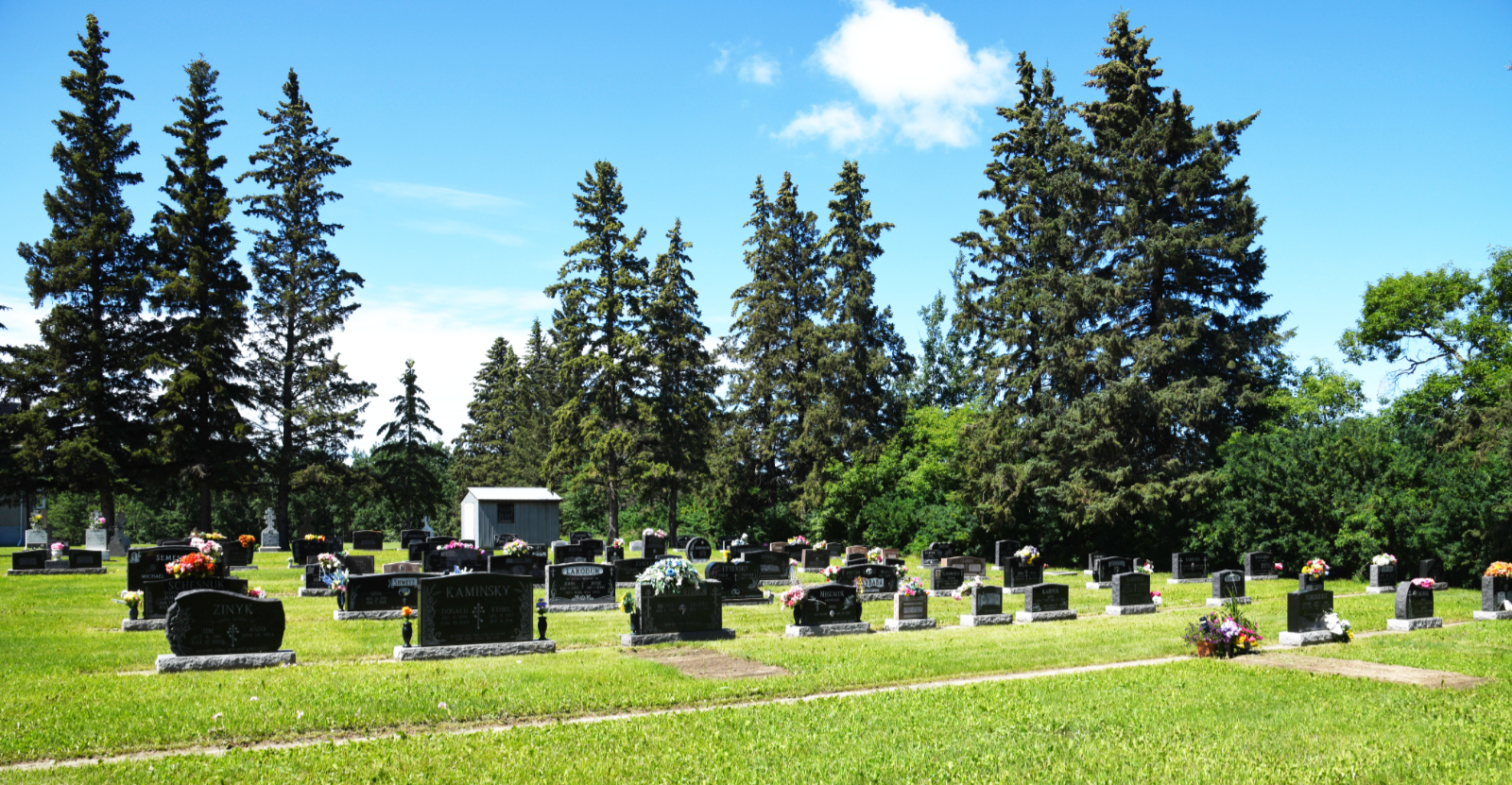
Consequently, during an episcopal visitation in the summer of 1940, Archbishop Ioan Theodorovich could bless the cemetery and a cross at the site where the church was eventually to be built, helping to inspire the fledgling congregation at a critical time in its development. It was during this second year of the war that the Orthodox faithful of Waskatenau began renting the Anglican Church for their periodic services, since the Anglicans were similarly without full-time pastoral care. This arrangement enabled the Orthodox to consolidate themselves organizationally, and to begin regularizing religious observances which in turn contributed momentum for further endeavours. Although the congregation had been legally incorporated in 1939, when it reported having a combined total of twenty-seven adherents, it only officially joined the Ukrainian Greek Orthodox Church of Canada in 1944. Two years later, the St. Volodymyr's faithful decided to purchase the Anglican church because they wanted a more permanent place of worship but could not yet afford the cost of erecting a new sanctuary. At the time of the acquisition, the congregation had twenty-two individual and family memberships, but was able to hold just six Sunday services annually, since a shortage of priests made it difficult to fulfill all of the pastoral needs of the Radway district.
Be that as it may, by 1950 it was becoming increasingly obvious that the congregation was outgrowing the Anglican Church, since the twenty-eight paid members of St. Volodymyr's were now celebrating Divine Liturgies on a monthly basis. At a meeting held on 1 March 1952, it was moved by Tekla Dehod, and seconded by Alex Bozniak, that the executive proceed with the construction of a new church. Upon the passing of this resolution, an intense fund-raising campaign was launched involving such activities as carolling, the hosting of pyrohy suppers and teas, and the staging of concerts and carnivals. The well-known church builder, Ivan Mnoholitny, of Kahwin, was contracted to oversee the project with the assistance of Opanas Denesiuk, though the resources of the entire congregation were mobilized behind the endeavour. Thus, while the women took on the difficult job of washing the rocks that were used to create the foundation, the men served as volunteer carpenters on the work crew.
Construction began on 27 May 1953, and on Easter Sunday of the following year (25 April 1954), Very Rev. H. Wasyliw celebrated the last liturgy held in the old Anglican church, which was subsequently sold and converted into a Masonic Temple. Soon after, the congregation was ready to move into their very own place of worship, an impressive cruciform structure (40' X 60') that featured four small domes, and a large central dome ringed by windows over the nave. Thanks to the volunteer labour, the building committee had been able to complete the church for the relatively modest sum of $19,200, the Waskatenau Branch of the Ukrainian Women's Association generously contributing toward the furnace, chandelier and other furnishings. The cornerstone of the new St. Volodymyr's Church was then solemnly blessed at the patron saint's day commemorations on 28 July 1954, with the Very Reverend Wasyliw officiating, joined by Very Rev. M. Fyk (who was then serving as a pastor in Oshawa), and Rev. P. Satsewich of Smoky Lake. A large crowd attended the festive gathering, which auspiciously took place on a beautiful midsummer's day.
By 1992, the congregation could look back with pride on more than half a century of progress, and to mark the centennial of Ukrainian settlement in Canada resolved to complement their church with a belltower. A committee was struck to seek out an appropriate and affordable structure, it eventually being decided to purchase a 700-pound bell from Edmonton for the sum of $5000 (one that was generously offered by St. Volodymyr's Church in Vegreville proved to be unsuitable because it was cracked). Paul Dehod designed a twenty-seven-foot-high structure made of steel to accommodate the new bell, which was hung with two smaller bells donated by Jim and Anne Zinyk. The project was completed on 13 November 1992 for a total cost of $15,000, members once again contributing their volunteer labour to this endeavour. The bells first pealed to mark the 50th wedding anniversary of long-time church activists Steve and Sophie Shwet. The tower was then formally blessed after the patron saint's day commemorations in 1993.
Play Memory Eternal Chant
Visit this Cemetery
GPS Co-ordinates: 54.093654, -112.777331
Affiliation: Ukrainian Orthodox Church of Canada