The inception of a Ukrainian Orthodox congregation in Peno can be attributed to the disenchantment of some residence with the sectarian intolerance of Basilian priests serving the community from Mundare. By refusing to give absolution to anyone who confessed to reading Ukrains'kyi holos or Vistnyk, and by maintaining that it was better to stay home and play cards rather than attend a Russo or Ukrainian Orthodox Church, the Basilian fathers only managed to promote greater interest in the "forbidden fruit" that these rival denominations represented.
Until 1924 the Christian faithful of the Peno area were largely members of the local Catholic church. However, when a Ukrainian Orthodox priest visited nearby Bruderheim around this time, a small delegation of disaffected Peno farmers went to meet with him so as to learn more about the relatively new formation. Impressed with what they heard, they resolved to continue pursuing the possibility of joining the Ukrainian Greek Orthodox Church of Canada.
The first Ukrainian Orthodox service held at Peno took place in the home of Mykhailo and Teodosia Onyschuk in 1925, with Reverend D. Seneta officiating. As in the neighbouring settlement of Jaroslaw, where former Catholics were in the process of switching their allegiance to the UGOC, the people of Peno were especially moved to hear the liturgy sung in their native language instead of Church Slavonic. Subsequently, Orthodox supporters in the Peno district would attend church in Jaroslaw, though some services were also held in area homes, chiefly the residence of Mr. and Mrs. Nykola Rudko.
In 1936 an executive committee was struck to formally organize a Ukrainian congregation in Peno. Its first goal was to establish a cemetery on one acre of land donated by Trofim Michalchuk, a quarter mile south of the future church site. The newly constituted parish held its inaugural church service on April 7, 1937, with Rev. T. Horbay celebrating Divine Liturgy at the Rudko home. The burial ground was then blessed by Fr. Horbay on Sunday July 25, 1938.
Next, members of the congregation directed their energies toward building a National Home so as to provide a meeting place and a focus for local religious and cultural activities. Starting as far back as 1934, a youth group was organized in the community on the initiative of Volodymyr Kupchenko, putting on concerts and bingos to raise money for a Narodni Dim. Work on the structure finally began in 1940, when a basement was excavated with the help of horse drawn scrapers. Wood for the frame was then donated and partly purchased from Nick Rudko, the exterior of the building being completed by 1941. That same year the still unfinished hall was incorporated as the Ivan Franko Educational Society of Peno, Alberta, several more years being required to complete the interior. The new facility was officially opened on 25 May 1942, when Rev. Stratychuk blessed the dedication by celebrating a Divine Liturgy. Henceforth, the Ivan Franko National Home was the site of numerous other religious services until a church was acquired by the Peno congregation.
In 1950 the members of St. John the Baptist parish bought the former Huwen United Church (believed to have been constructed in 1917) for the sum of $350.00. They also purchased a half-acre of land adjacent to the Ivan Franko Hall (from John O. Zazula), where they moved the sanctuary and appropriately modified its interior for its new purpose. An Orthodox cross was added to the steeple, but otherwise the exterior has retained its Protestant appearance.
The Ivan Franko National Home continued to be used for local cultural and social events, also serving as the parish hall for church-sponsored functions. In 1964, a dining and kitchen area was added to the building, other improvements being made as funds became available.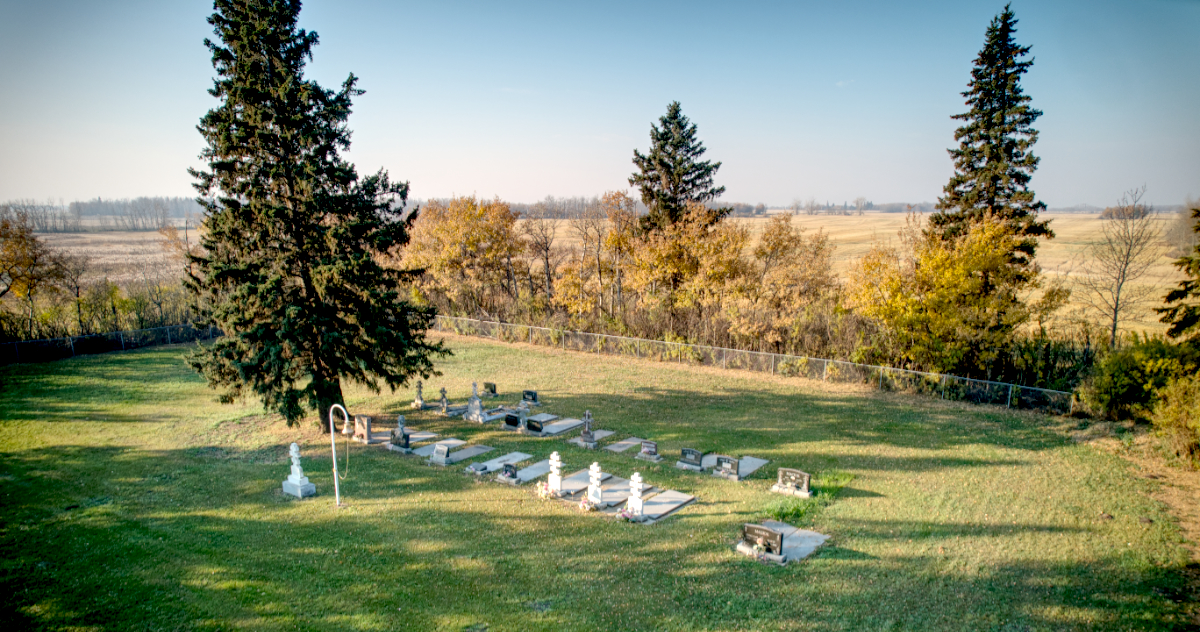

Play Memory Eternal Chant
Visit this Cemetery
GPS Co-ordinates: 53.890001, -112.677852
Cemetery Co-ordinates: 53.886559, -112.678935
Affiliation: Ukrainian Orthodox Church of Canada
St. John the Baptist Ukrainian Orthodox Church – Peno, AB
According to a report published on 7 October 1925 in Ukrains’kyi holos, the first Ukrainian Orthodox Divine Liturgy was celebrated in the Myrnam area on 6 September 1925 by Rev. I. Kusey. A Ukrainian Orthodox congregation was formally organized in Myrnam in 1930, when the town was enjoying a period of growth stimulated by the arrival of the railway three years earlier. However, because of the hardships brought on by the Great Depression, the congregation was unable to begin building a separate place of worship for more than a decade, during which time services were held in the New Myrnam School.
As the economy started to improve at the outset of the Second World War, the Orthodox faithful of Myrnam were able to increase the tempo of their activities and to take on the challenge of building a church. The congregation officially joined the ranks of the Ukrainian Greek Orthodox Church of Canada on 26 January 1941, when the necessary papers were filed with the Consistory in Winnipeg. Meanwhile, a fundraising drive had been initiated the previous year, with construction finally beginning on a sanctuary in 1943. Wasyl Dolinsky, Michael Kawich, and Philip and Dmytro Hucal were contracted to serve as the work crew on the project, while Wasyl Topolnitsky was engaged to do the wiring. Ready for use in 1944 (when Rev. L. Diachina celebrated the first liturgy), the rectangular wood frame structure with a full basement had a medium-sized dome over an entranceway tower that housed the belfry, and two smaller domes at the corners of the facade. The new edifice henceforth became the hub of Ukrainian Orthodox community life in Myrnam, which reached its peak of vitality over the next two decades.
Between 1941 and 1950, a total of 111 church services were held at Holy Trinity Church. During this decade, the congregation had approximately 150 active members, when families were counted in their entirety. In 1951, Rev. I. Shwetz – who had been the resident priest since the end of the war – reported a paid membership of forty for his Myrnam flock, a figure that remained constant for several years.
The iconostasis was painted in 1958 by the renowned artist, Wadym Dobrolige (1913-1973). A successful fundraising drive brought in $1,400 toward the cost of this project. That same year Rev. M. Kryschuk assumed pastoral duties in the Myrnam area, his first assignment after his ordination. The appointment of a brand-new priest helped to revitalize the local Orthodox community, which was then being slowly undermined by vigorous competition from other denominations. At the time, the congregation had 28 registered members, a figure that rose to 34 the following year (when twenty-four services were held at Holy Trinity), and grew to forty by 1962. However, as the sixties drew to a close the Holy Trinity congregation inevitably began shrinking in size due to the migration of many young people to the city, and the gradual passing of senior members.
A lighted cross was added to the exterior of the church in 1978, thanks to a donation by Mr. and Mrs. Zaparyniuk. In the 1980s several major and minor renovations were made to the sanctuary. The outside walls were re-stuccoed, the domes repaired and repainted, and cedar shingles were replaced by sheet metal roofing. The interior of the church and the basement hall were also repainted, while the church floor was refinished and the flooring in the basement was replaced.
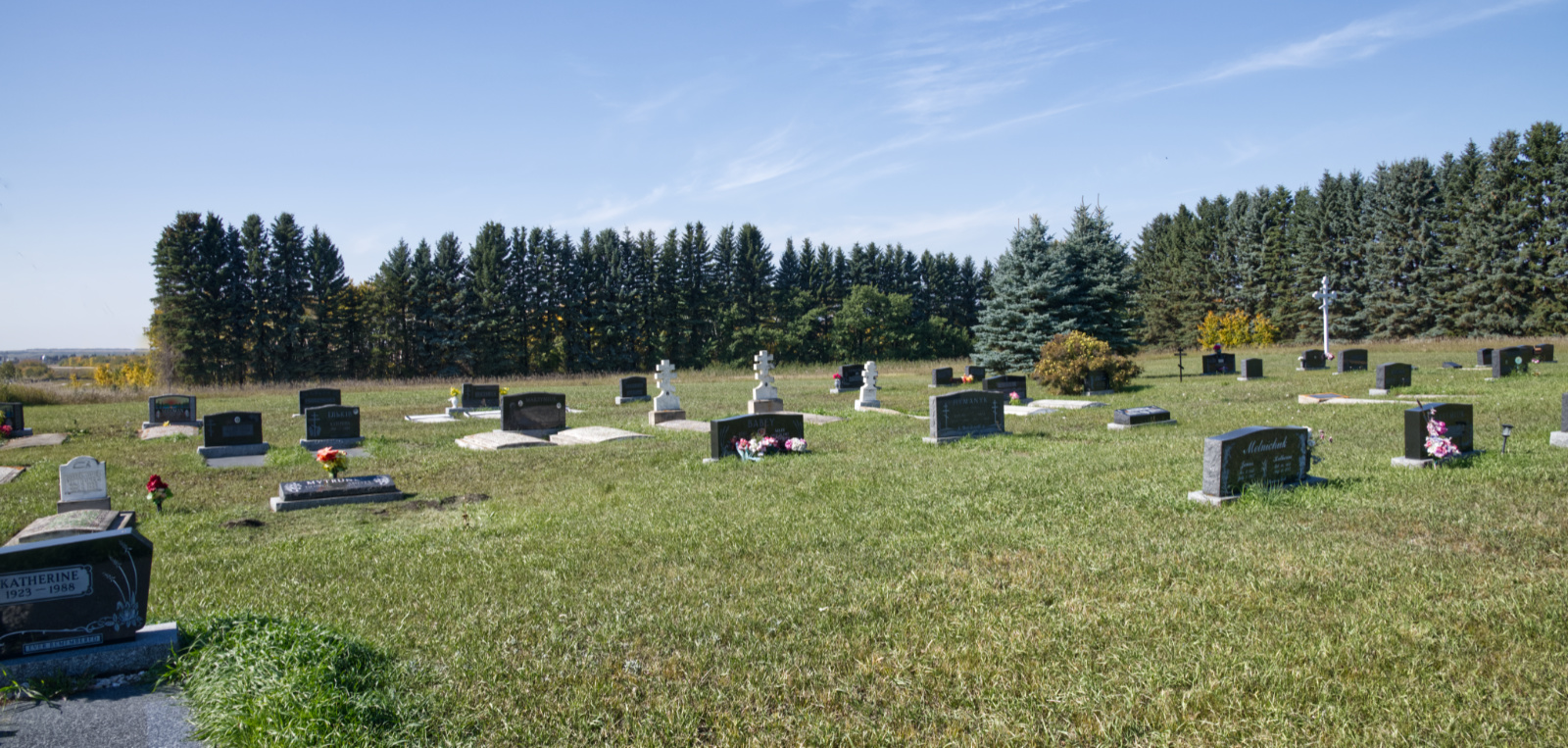
Play Memory Eternal Chant
GPS Co-ordinates: 53.662505, -111.225476
Cemetery Co-ordinates: 53.65818, -111.19265
Affiliation: Ukrainian Orthodox Church of Canada
Holy Trinity Ukrainian Orthodox Church – Myrnam, AB
The first attempts to organize a religious community in the Musidora area occurred between 1916 and 1920. Several meetings were held in an effort to establish a congregation, but activities remained informal with services occasionally being held at the homes of Safat Bikevich and Stefan Chanasyk. Apparently, local residents were divided as to their loyalties, with some preferring to be ministered to by the Basilian Fathers who were based in Mundare, others wanting to be served by clergy with the Russian Orthodox Mission. On the initiative of Reverend Kryzanowski, a Catholic church was finally built on the farm of John Kolisniak, though afterwards the majority of the Musidora faithful decided to sell this structure and instead pursue membership in the Ukrainian Greek Orthodox Church. Following this split, services were held at the residence of Wasyl Kolisniak or in the local National Hall, officiated by Reverend I. Kusey during occasional visits that he made in 1926.
In 1928-1929, a sanctuary was finally constructed by volunteers working under the supervision of a carpenter to provide a place of worship for the Orthodox faithful. Consecrated in the name of St. Mary, the church was initially served by Reverend Ivan Mayba. In early 1931 a request was made to the Consistory asking for the church to be incorporated under the charter of the UGOC, but a controversy soon erupted when some members insisted that the parish remain independent. The matter had serious implications, as there were still lingering fears in the community that the church could revert to Catholic control. Another concern was ownership of the cemetery that had been established in 1906 and blessed by Fr. Tymochko of the Ukrainian Catholic Church – which the congregation wanted to legally acquire as part of its landholdings. It took more than four decades to finally resolve the issue of incorporation, and while the cemetery continued to be shared for some time by local Orthodox and Catholic believers, title to it ultimately passed into the hands of the congregation of St. Mary’s.
From the mid-thirties to the outbreak of the Second World War there were problems getting clergy to provide pastoral care for the Musidora faithful. As the All Saints Greek Catholic church was built in nearby Morecambe around this time, the Consistory was informed that St. Mary’s could lose some of its members to the Ukrainian Catholics – no doubt to underscore the need to find a regular priest. Although, the situation seems to have stabilized by 1940, new tensions appear to have surfaced by the late 1940s, this time due to the proselytizing efforts of the Russian Orthodox Church. In 1948 a couple of Musidora members again submitted an official request to Winnipeg to have St. Mary’s congregation incorporated as part of the Ukrainian Greek Orthodox Church of Canada, probably to ensure their church’s allegiance to the Consistory. However, because the initiators of the petition also indicated that most of their fellow adherents were sympathetic to the Russian Orthodox Church, their submission was deemed legally unrepresentative of the will of the majority. Nevertheless, the congregation continued to be faithfully served throughout these difficult years by the UGOC, whose priests officiated at a dozen liturgies in the community in 1949.
In 1951, Musidora congregation was comprised of eighteen members, and in the following year fifteen Divine Liturgies were celebrated at St. Mary’s. Notwithstanding the fact that the Myrnam district constructed a manse around this time, 1952 proved to be somewhat unsettled year because of complications involving the assignment of clergy. On 20 July 1953, the St. Mary’s faithful hosted an evening prayer service with Metropolitan Ilarion, after which a reception was held at the National Hall, where the community was also addressed by the head of Consistory, Fr. Ie. Hrycyna.
The period between the mid-1950s to the early 1960s marked a high point in the history of Musidora church, which increased its membership to a peak of 28 families. Reflecting the optimism of the St. Mary’s congregation around this time, in 1959 the artist Wadym Dobrolige was commissioned by the congregation to produce original ikons for an iconostasis and to decorate the interior of the church.
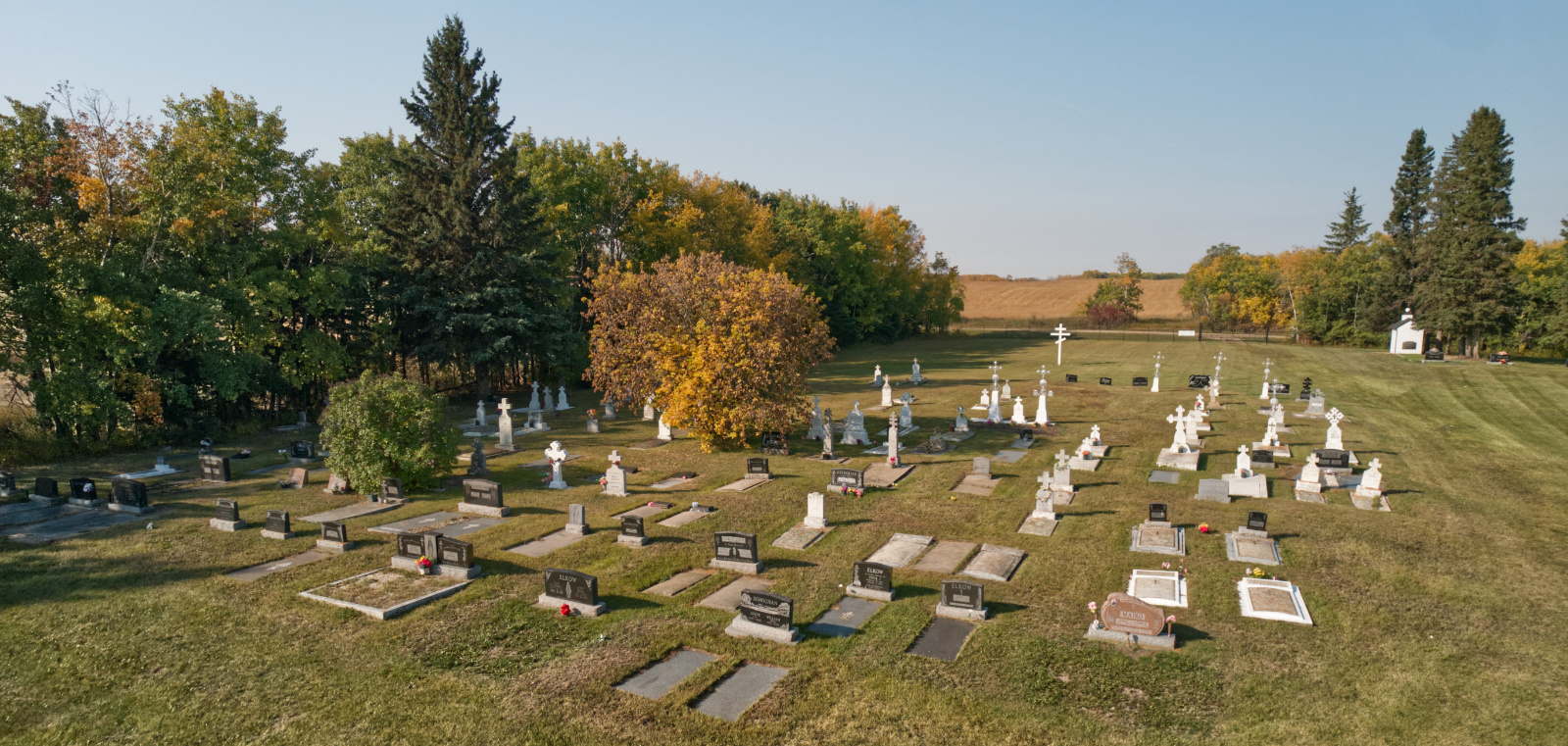
Play Memory Eternal Chant
GPS Co-ordinates: 53.688421, -111.582769
Cemetery Co-ordinates: 53.67943, -111.59861
Affiliation: Ukrainian Orthodox Church of Canada
St. Mary Ukrainian Orthodox Church – Musidora, AB
At an organizational meeting held in 1913, settlers of the Morecambe district decided to proceed with the construction of a church, after which a ten-acre site was donated for this purpose by P. Melnychuk. Clear title to this property was obtained in 1918, by which time the church had been formally registered with the government. A modest structure built by volunteers out of donated logs served as the first sanctuary for the congregation, which adopted the name "Russo Orthodox Church of Oshichlib" (Oshykhlib) after the Bukovynian village in Kitsman raion, Chernivtsi oblast, where many of Morecambe's homesteaders traced their roots.
The interior and exterior walls were mud-plastered and white-washed before being adorned with icons that had been brought from the old country by the pioneer founders; later, a porch was added, and the outside walls were sheathed, to better insulate the building from the elements. Once again parishioners donated their labour and materials to making these improvements, the women preparing and delivering meals to the work crew. The Oshichlib church became a focus for worship and community celebrations, the annual Resurrection Liturgy in particular drawing people from near and far to have their baskets blessed at Eastertime.
For many years the congregation received pastoral care on an occasional basis from priests with the Russian Orthodox Mission. When performing services in the community, the Two Hills-based priests stayed overnight on the nearby farm of the Taschuk family. In 1944, however, Fr. L. Diachina succeeded in bringing the congregation over to the UGOC, in the process attracting the support of some of the local farmers who had been active in Morecambe’s All Saints Ukrainian Catholic parish, established in 1935-36. It was sometime during the early forties that members of the Oshichlib church dedicated their sanctuary to St. John the Baptist.
Several difficult years followed, and by 1946 membership in the congregation had dwindled to a handful, and general meetings were no longer being held. A core group nevertheless persevered, and in 1951-1952 Morecambe reported to the Consistory that it had twelve members (cited as only eight by Fr. Shwetz in a 1951 letter) and was celebrating 5-6 Divine Liturgies a year. It was around this time that the congregation formally became affiliated with the UGOC, even though by then the parish was struggling because of a declining membership. By 1956 there were only three families actively supporting the church, most local residents preferring to travel to nearby towns to worship.
Sometime in the mid-1950s the original log church was destroyed by fire, said to have been a case of arson provoked by a conflict within the community. At the same time the bell also disappeared from the belltower, never to be returned. Services were subsequently held in the local Taras Shevchenko National Home, but soon after, membership fell off so dramatically that the executive of the congregation notified the consistory that parish life was no longer viable. Migration from the Morecambe district to Edmonton and elsewhere had steadily depleted the ranks of the faithful, while the close proximity to churches in neighbouring Musidora and Myrnam further eroded local support.
Nevertheless, after a period of dormancy the Morecambe hromada staged a determined revival, purchasing and remodeling a former schoolhouse in 1963 to create a new place of worship after having restored the parish cemetery the previous year. In 1966, Rev. P. Zubrytsky celebrated the patron saint's day liturgy in Morecambe, possibly one of the last such commemorations in St. John the Baptist church. By 1971 it was reported that the congregation had dwindled to the point where "...it only existed on paper..." and had not celebrated a single liturgy the entire year. Be that as it may, another major cleaning of the graveyard took place in 1986, and the burial ground is still the site of annual "provody" held in remembrance of deceased church members. The church itself stands abandoned.
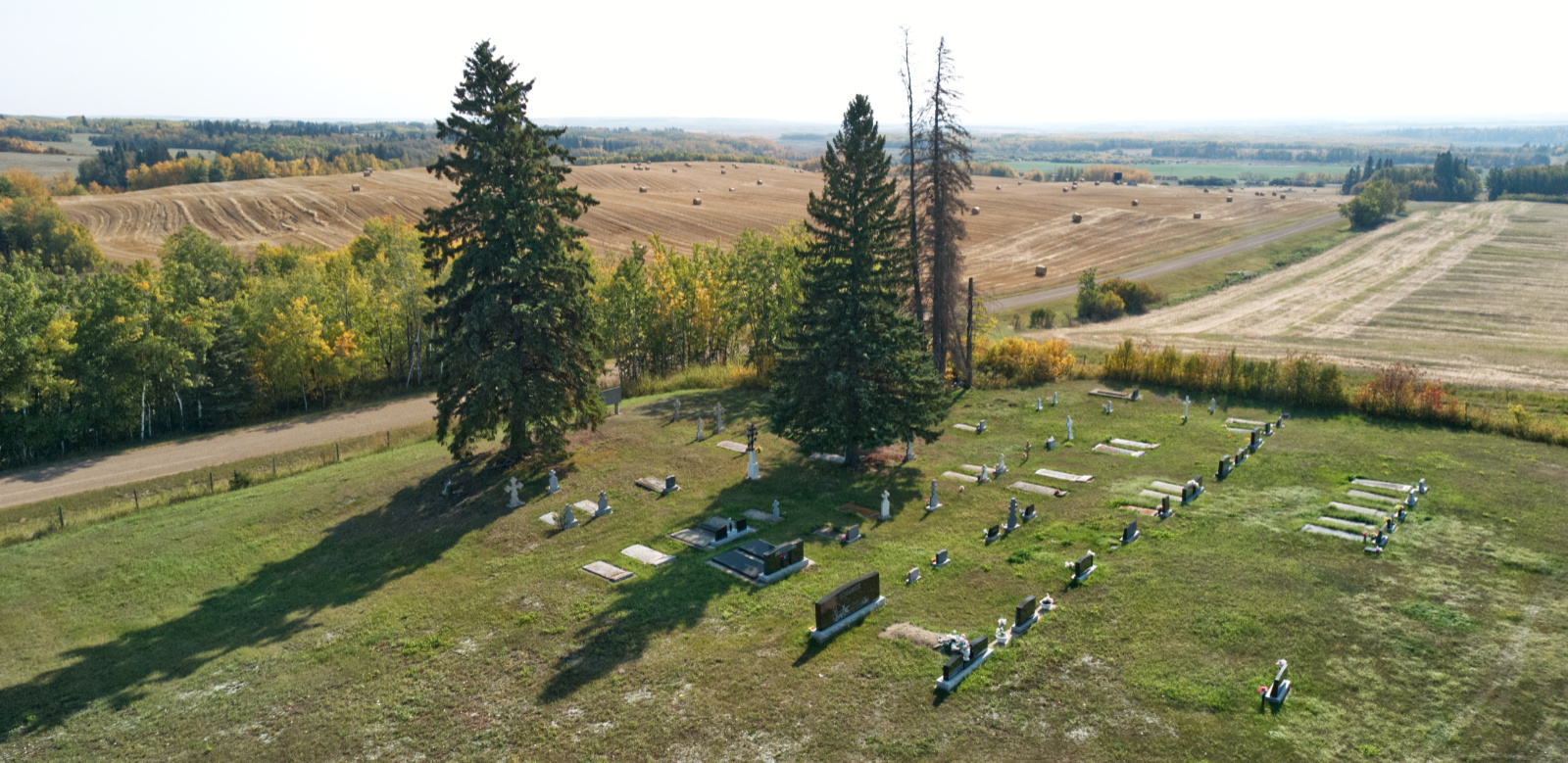
Play Memory Eternal Chant
GPS Co-ordinates: 53.680112, -111.501834
Affiliation: Ukrainian Orthodox Church of Canada