T
he oldest Orthodox congregation in the Lac la Biche-Boyle area was started at Sarrail shortly after the region was settled by Ukrainians in the latter part of the 1920s. A recent immigrant from Ukraine named Fred Holowenko is credited with having been responsible for first mobilizing area inhabitants behind the Ukrainian Greek Orthodox Church of Canada. The various Protestant churches had already begun missionary work in the settlement. Fr. Evhen Olendy, who in 1927 had been ordained by a Russian Orthodox bishop but a year later was accepted into the ranks of the UGOCC. He started organizing and serving the Orthodox faithful in Sarrail on an occasional basis in 1929.
The same year, William Nykolyn donated two acres of land from his quarter section for a church. A timber permit was obtained from the government. Fred Pysyk became the founding president of the congregation, with John Sambirsky acting as the secretary treasurer. In the meantime, services were held in the homes of local residents. Volunteers harvested the necessary trees that were then cut at Joseph Hewko’s sawmill to produce 30,000 feet of board lumber.
Next, steps were taken to acquire additional land for a burial ground. As the wife of William Nykolyn was uncomfortable having a cemetery next to their house, it was decided to establish it at a different location. Acting on behalf of the congregation the Consistory on 2 July 1932 requested that the Province of Alberta designate a two-acre parcel at NE 29-66-18 W4 for a graveyard. The Consistory also asked that the faithful of Sarrail hold a meeting to legally constitute themselves as a component part of the UGOC.
At the same time a problem arose when the wood that had been earmarked for the church was instead offered for sale. This was probably due to the delay in construction. It seems that Fr. Olendy was able to intervene and secure the necessary building material under the condition that work would begin in July 1932. This was even though the congregation lacked funds for the undertaking.
Further complicating matters was the fact that Fr. Olendy was at the same time experiencing disciplinary problems with the UGOC Consistory (he had been suspended two years earlier). He was threatening to return to the ROC if he were not allowed to continue as the Sarrail priest. Although acknowledged as having a generally positive influence on the congregation that he had helped to get started, church authorities in Winnipeg did not recognize his claim that the Sarrail community “belonged to him” and that he could decide which priests could or could not serve it.
Be that as it may, a meeting of the congregation took place on Sunday 17 July 1932 with Fr. Olendy in attendance. This was a week after Edmonton lawyer P.J. Lazarowich took part in a picnic in the community on behalf of the Ukrainian Self-Reliance League, using the opportunity (in consultation with Fr. Sametz) to prepare and deliver the agreement that the congregation needed sign to join the UGOCC. In the official minutes of the 17 July gathering, identified as the “First Meeting of the Adherents of the Ukrainian Greek Orthodox Church of Canada” in the Sarrail Postal District, 23 people passed motions formally creating a mission dedicated to Saints Peter and Paul and requesting admission into the Ukrainian Greek Orthodox Church of Canada. This document was subsequently ratified a second time by Fr. Olendy in a notarized affidavit signed in Edmonton on 22 August.
Construction of the church work appears to have begun shortly after, proceeding gradually with volunteers working under the direction of Bill Gerela and Joseph Hewko. A spacious rectangular structure with a large dome over the entryway arose on the site, providing a functional place for worship whenever priests were able to visit from Edmonton, Smoky Lake or other districts. During these years getting to the Sarrail church was no easy matter, as it was necessary to travel by foot, wagon or sleigh from the nearest railway station, which was 17 miles away.
The 1930s proved to be especially difficult for the Sarrail faithful, as they not only had to cope with the hardships of the Great Depression, they also experienced an erosion in their membership. Although almost two dozen people had participated in the founding meeting of the congregation in 1932, those truly committed soon dwindled in number when some joined the Catholic Church and others drifted away because they actually wanted to build a hall rather than a sanctuary.
Notwithstanding these and other difficulties, the dedicated faithful of the Sarrail congregation persevered. Membership in the church gradually grew. In 1943, 8 girls and 25 boys were baptized at Sts. Peter and Paul, many of them after the annual Feast Day liturgy on 12 July. This event always drew a large crowd of worshippers from near and far. By 1944 the Sarrail hromada was finally in a position to complete the interior finishing and painting of their church, contracting George Fleming to perform these tasks and also put in a chimney. Still later, an iconostas was installed for $1500 and adorned with large icons that cost an additional $500, reflecting the increasing prosperity of the farmers in the district.
The assignment of a resident priest for north central Alberta in 1950 was welcome news, at it meant that Sts. Peter and Paul congregation could enjoy much easier and more regular access to the services of a priest. In 1951 Sarrail contributed $140 toward furnishing a manse in Boyle, though it was decided the following year, when Fr. Zubrytsky was appointed to the parish district, to locate the residence in Lac La Biche. This development helped to both stabilize and strengthen the congregation. In 1959 the parish was comprised of 28 families, though only twelve of these were paid members, half of whom were said to as be truly active. Thus, the majority were merely sympathizers. Nevertheless, that same year a total of 14 Divine Liturgies were celebrated at Sts. Peter and Paul Church.
By 1962 the paid membership had shrunk to just five. Sympathizers grew to 20 and the number of services increased to 15. Deaths and rural depopulation were beginning to take their toll on the supporters of the church. It became ever more difficult for the congregation meet its budgetary assessment from the Consistory. The situation improved somewhat by 1964, when Sarrail had a paid membership of eleven despite losing one member who had moved to Boyle. A dozen services were celebrated at the church in 1965, when it was estimated that $800 would have to be raised by congregation to meet its expenses.
Despite experiencing many difficulties in the 1970s and 1980s, the Sts. Peter and Paul faithful remained a committed part of the Lac La Biche parish district. In 1993 they reported having fourteen members (4 individuals, and 10 families). This increased to 16 the following year.
In the summer of 2000, to commemorate the Second Millennium of Christianity, a special service was held attended by 175 worshippers, followed by a celebratory banquet and concert featuring Ukrainian dancers, choral numbers by the church choir, and a performance on the tsymbaly. As part of the program there was a presentation of a newly-published illustrated history of the congregation, a 142-page hardcover book titled Sviatkuvannia 2000—A Celebration of Our Faith.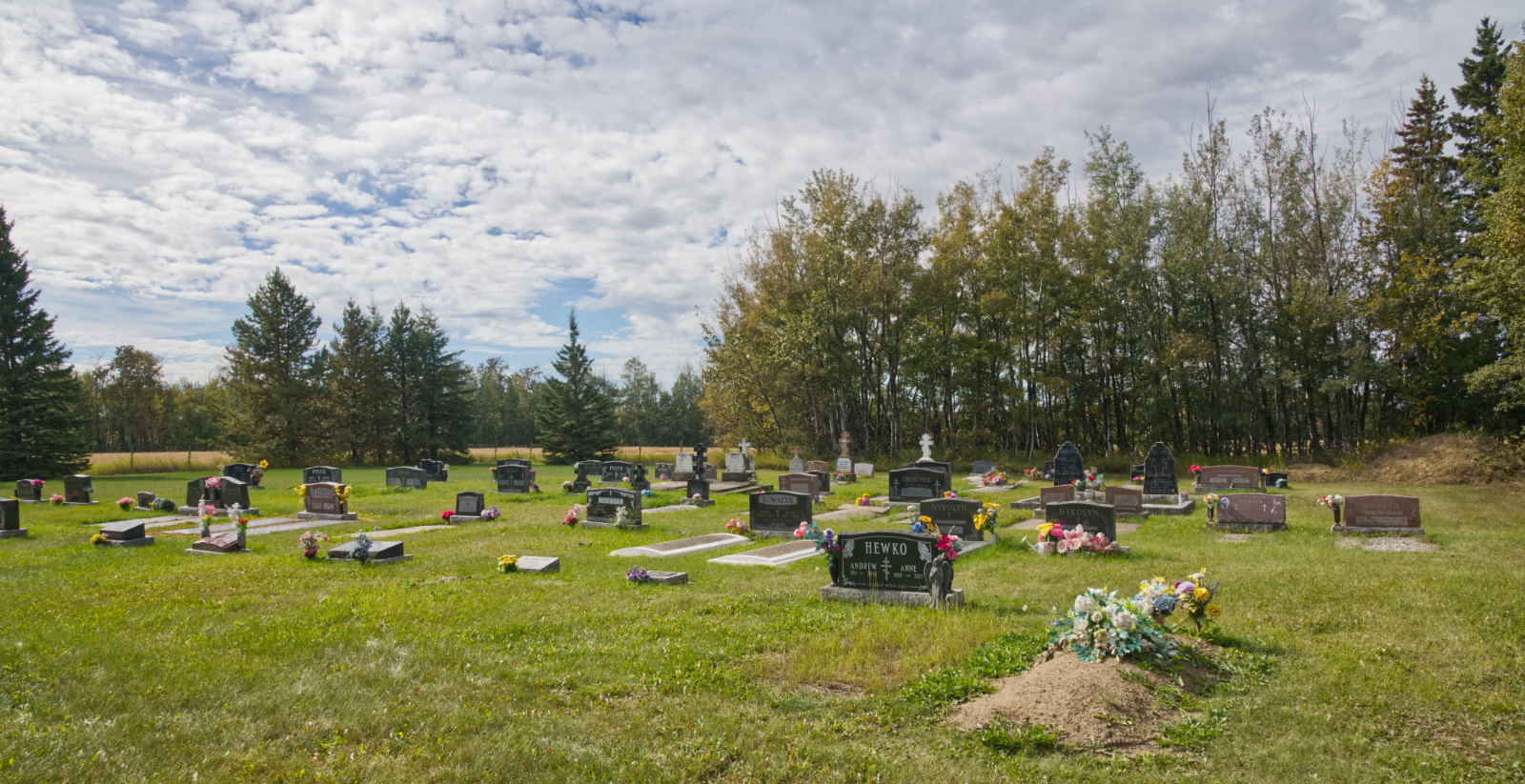
Play Memory Eternal Chant
Visit this Cemetery
GPS Co-ordinates: 54.753912, -112.703135
Cemetery Co-ordinates: 54.753469, -112.703379
Affiliation: Ukrainian Orthodox Church of Canada


Sts. Peter and Paul Ukrainian Orthodox Church – Sarrail, AB
The first Ukrainians settled in the Athabasca area beginning in 1912. However, organizational activity only started after World War One, when the major influx of Ukrainian settlers took place. Fr. W. Seneshen started visiting the community in at the end of the 1940s, giving impetus to the founding of a congregation. His liturgies were celebrated in a log chapel that had served as the first place of worship for Athabasca’s Anglican faithful. Finally, on 24 June 1951 an inaugural meeting was held after a church service. Members present contributed six dollars each toward an honorarium for the priest and the rental of the chapel.
An executive was then elected to provide leadership to the fledgling congregation (meeting at the homes of various supporters). A $1.50 fee was established for membership. On 1 November 1951 the new parish resolved at a special meeting to look for land on which to construct a church. The following month a building fund was initiated. A volunteer donation of $5.00 was requested from each family member. It was at a meeting in February 1952 that the members of the congregation unanimously agreed to adopt the name “Ukrainian Greek Orthodox Church of St. Peter and Paul.”
At a similar gathering in July 1952 a motion was passed that the congregation purchase three adjoining lots from the Town of Athabasca. These were subsequently leveled in preparation for construction. At this time, the parish was comprised of 23 families and 17 individual members. In February 1953 the executive started acquiring construction materials for the project. Henry Koffler was contracted to build a basement for a labor cost of $609.50. That same year, the congregation formally requested affiliation with the Ukrainian Greek Orthodox Church of Canada, whose statutes were accepted and passed unanimously by the membership.
Work on finishing the basement progressed in 1954, and by 1 August it was used for the first wedding, that of Olia Kowalchuk and Peter Marchuk. Congregational activity developed slowly over these years. The basement was utilized as a place of worship for more than a decade. In January 1957 it was requested of the Consistory that St. Peter and Paul church be served by the priest at Lac La Biche, since such an arrangement would be far more convenient. However, as this was denied, Athabasca continued to receive its pastoral care from clergy assigned from Westlock. Consequently, the congregation pledged $1200 towards the construction of a manse in Westlock in 1957, raising this sum through installment payments over the next two years. At this time, membership consisted of fifteen families, with 35 paid members.
Twelve liturgies were celebrated by the Athabasca faithful in 1958. That same year they donated $125 toward the building fund of Holy Trinity Church in nearby Richmond Park. Two years later, it was reported that 16 families (or 53 people in total, counting adults and children) were formal members of the church, with another seven families being described as sympathizers.
At the urging of Fr. H. Udod, the congregation started to move toward completing the upper part of the church. In February 1961 Walter Gasiorek won the tender to frame a proper Orthodox sanctuary for $900. Work began in the spring, and upon completing the exterior, Gasiorek was awarded an additional contract worth $400 for labour toward the construction of the church domes and preliminary work on the interior. In all, three domes were placed over the sanctuary, two small ones over towers flanking the main façade, and a larger one above the entryway. To save money, volunteers assisted with the process of finishing the church. Gradually over the next five years the sanctuary was completed in stages.
Meanwhile, at the 20 December 1961 annual general meeting the members once again petitioned the Consistory to include Athabasca in the Lac La Biche parish district. This time their request was eventually granted after extensive discussions concerning the fulfillment of the congregation’s outstanding financial obligations to the Westlock district. Subsequently, in June 1962, Walter Gasiorek completed construction of the front stairs, after which the first coat of stucco was applied to the outside walls. The final coat was applied two years later.
In 1969 the Athabasca congregation was incorporated under the Societies Act. In October 1971 they received their documentation under the Religious Societies Lands Act. At the 12 July 1975 Khram, St. Peter and Paul Church was formally consecrated during a visitation by Archbishop Andrew and Fr. A. Shcherban. The well-attended occasion also marked Fr. Kubin’s last Athabasca service before being reassigned to the Smoky Lake Parish District.
Together with Athabasca’s Assumption of the Blessed Virgin Mary Ukrainian Catholic Church, the St. Peter and Paul congregation also marked the Ukrainian Canadian Centennial by helping to finance a memorial cairn at the site of the Immigration Hall. The marker was unveiled and blessed on 14 June 1992 by Fr. S. Soroka and Fr. D. Bodnar from the Ukrainian Catholic Church, after which an ecumenical prayer service was held at the community centre. Over 500 people attended these celebrations, the highlights of the day’s program including a dinner and concert. Continuing with their flurry of activity, in September 1992 the members of the church commissioned Marvin Dzenkiw for the sum of $800 to write icons of the twelve apostles for the ikonostas, a job that he successfully completed in March 1993. New front doors were installed in the church the same year, and Nina Rys donated a beautiful new chalice. Other improvements were also made at this time, as part of the on-going process of maintaining the sanctuary and hall. The total number of paid members in 1994 was 38, consisting of 13 families and 12 individuals.
In 1995 the congregation joined forces with Ukrainian Catholic Church and other local denominations to erect a cairn and cross at the Town of Athabasca Cemetery—an undertaking that was spearheaded by St. Peter and Paul member, Alex Krawec. The monument was formally dedicated at a ceremony on 11 June 1995. At the same time, the tetrapod was painted and trimmed with gold, and a mortared brick sign was put up to identify the church.
By 1996 the paid membership had declined to 27, a figure that subsequently shrank further to 22 by 1999. As was happening in most other rural communities, families were getting smaller and long-time supporters were either dying or moving to other communities in retirement. However, this did not prevent the congregation from continuing with their efforts to fully furnish and finish their church. Thus as the nineties drew to a close more money was raised in donations and grants toward various smaller projects. These included the acquisition of processional icon stands, the construction of an Oblation table, and the addition of four extra pews in the sanctuary.
Play Memory Eternal Chant
Visit this Cemetery
GPS Co-ordinates: 54.721180, -113.273174
Affiliation: Ukrainian Orthodox Church of Canada
Sts. Peter and Paul Ukrainian Orthodox Church – Athabasca, AB
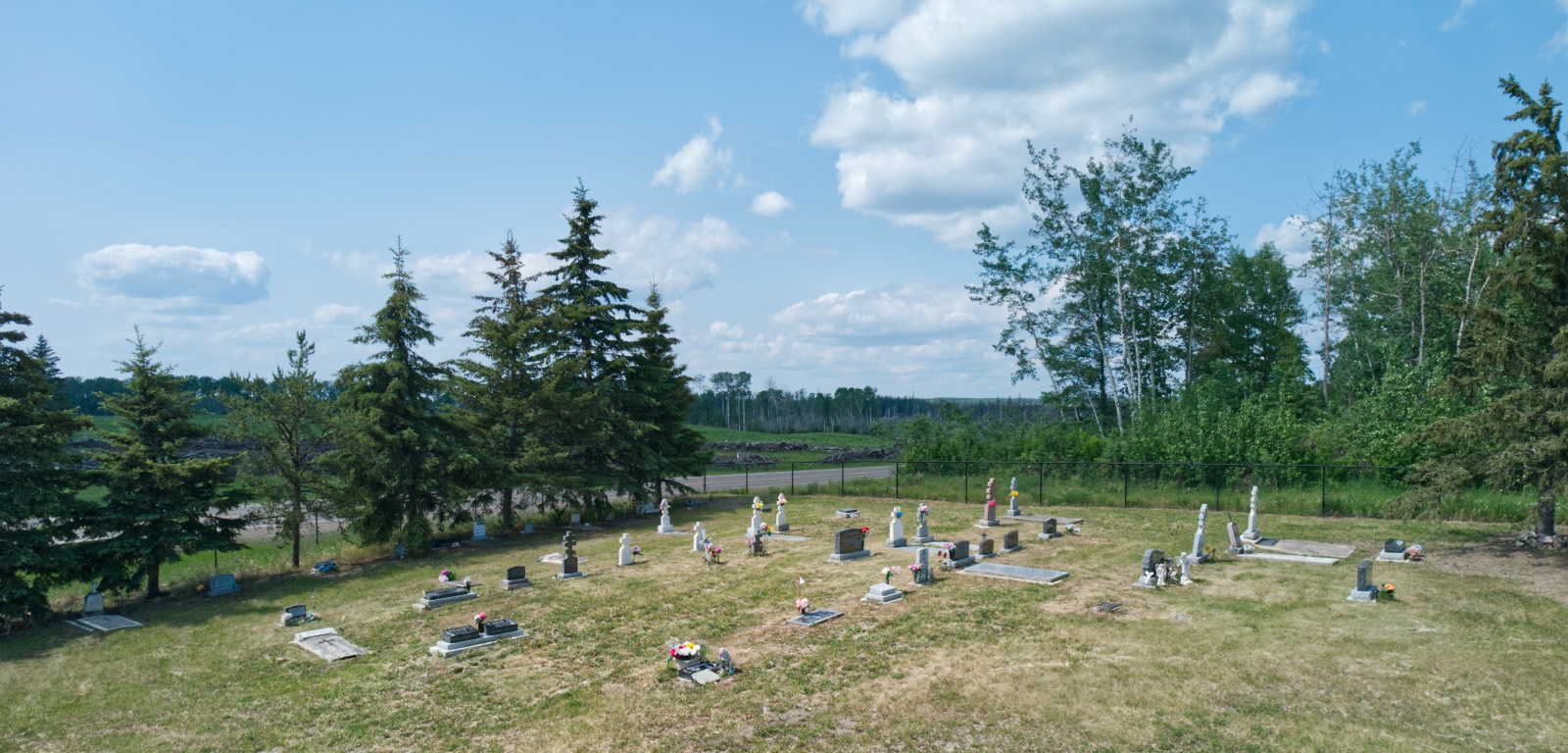
The Noral area began to be settled by Ukrainians in 1933-1934. Soon the community realized that it needed to have a graveyard. In December 1937, a meeting was held of area residents. A Ukrainian Greek Orthodox Cemetery Corporation was established with 18 members. Each contributed 5 cents towards the acquisition of a suitable parcel of land. Nick Koshman was elected president, and George Gordey, secretary. In July 1938, a 1.6-acre parcel of land (264’ x 264’) was donated by Mrs. Annie Krumpic for this purpose. An amount of $39.15 was raised to start the cemetery from among 35 farming families in the district. Most of these families subsequently became founding members of what was officially designated as Ukrainian Greek Orthodox Mission of St. Mary the Protectress.
The following year, this congregation applied to register their cemetery with the Department of Lands and Mines. It was discovered that it needed to be affiliated with a legally recognized church. Finally, at a meeting held on 5 December 1938, the congregation voted to adopt the charter and bylaws of the UGOC. The parish was officially granted admission in March of the following year. Legal title to the cemetery property was then issued by the government.
On 4-5 August 1939 the community was visited by the head of the Consistory, Fr. Semen Sawchuk, along with Ivan Danylchuk of the Ukrainian Self-Reliance League. A Divine Liturgy was held on Saturday morning (probably celebrated at the local school), after which there was a lunch with Mr. Danylchuk as the guest speaker. On the previous evening, Fr. Sawchuk had addressed the members of the congregation on Ukrainian community matters. Before leaving, he conducted a catechism class and baptized a child.
In notes taken during this visit, Fr. Sawchuk observed that the countryside was wooded and hilly but cheerful looking. He also described the congregation as being comprised of just ten families. He commented that in the district there were a couple of people with communist views. He likewise noted that the cemetery was almost entirely covered by bush. The congregation lacked money and time it would be cleared in the winter. Fr. H. Wasyliw was to come to Noral on the Feast Day of the Elevation of the Holy Cross (14 September), when the burial ground would be blessed by him. It is likely that occasional services were held in the Noral area even before this time at the Noral school, which had been built in 1934.
In October 1939 the congregation discovered that the first burials had been mistakenly made outside the legal cemetery. They consequently took steps to acquire an additional 0.40 acres next to the designated property. Their request was granted in August 1940, bringing the total area of the congregation’s holdings to two acres. At the 26 June 1941 annual meeting, the congregation had $2.45 in cash on hand. It was decided to charge $5 for the burial of non-members and to deposit the money in a Treasury Branch once it reached $10. It was also resolved to build a small place of worship on the cemetery property. This was to be made of logs, measure 14’ x 18’, and have a mudded and whitewashed interior. The grounds around the church were at same time to be ploughed and seeded with grass.
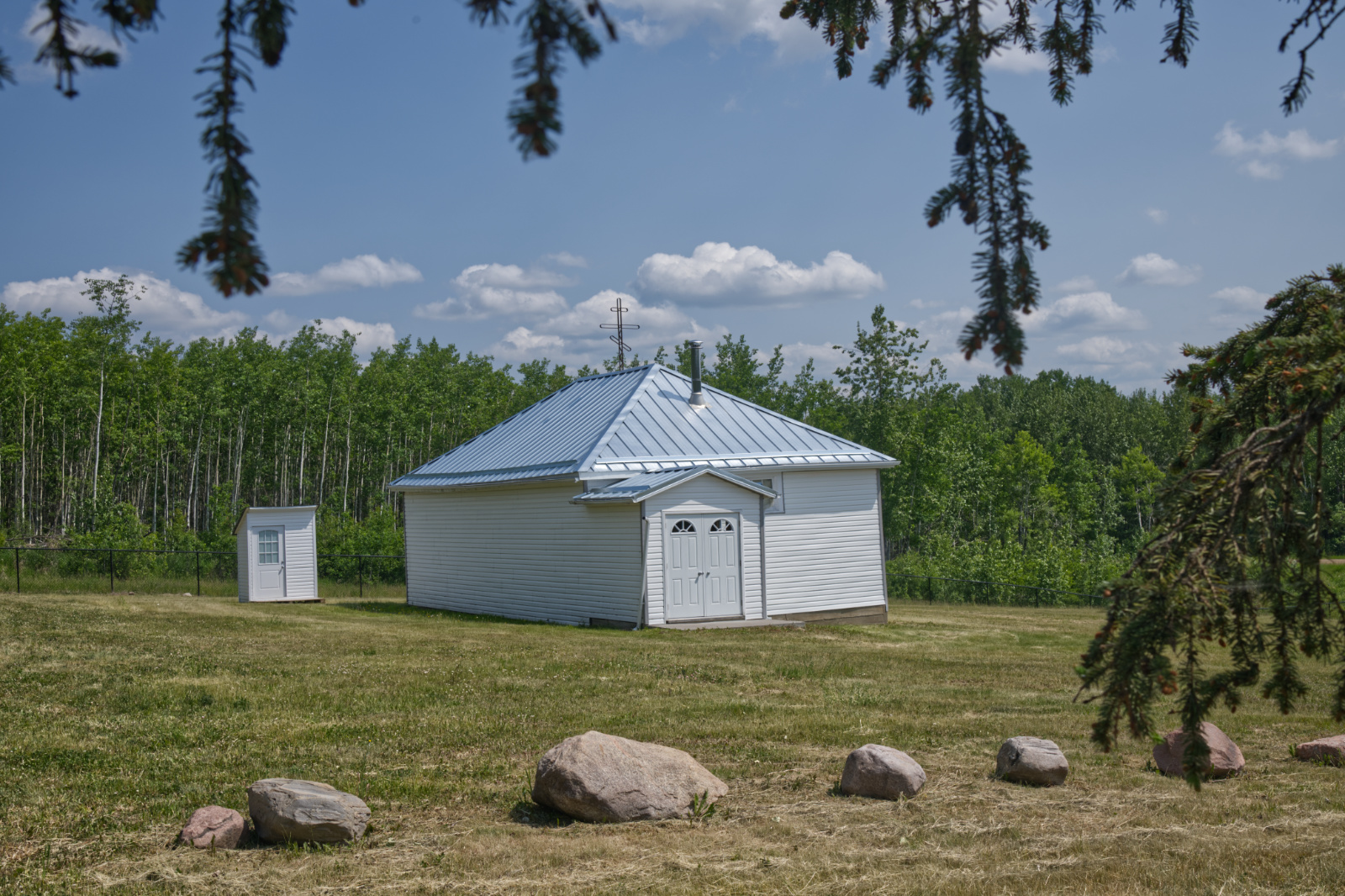
Following a Divine Liturgy celebrated in Noral on 11 September 1944, Fr. H. Wasyliw baptized a total of 9 children. The service was once again held at the local school, as the log church was still under construction. At a meeting on 20 January of the following year, 11 members donated the lumber for the church ceiling. It was resolved to pay 50 cents an hour for the labour to install it. Those who could not afford to pay the $5 annual membership fee, could work off this amount by helping with the construction or cemetery maintenance. The completed sanctuary, which had the appearance of a pioneer cabin, was then blessed at a Divine Liturgy on 19 August 1945, followed by a congregational dinner.
By 1955 it was becoming obvious that the congregation was outgrowing their little church, prompting discussions as to whether it should be enlarged or replaced with a new one. Reflecting the changing times, a new constitution was developed, a membership fees were increased to $2 per family.
Finally, at a meeting held in March 1957, it was decided to build a new sanctuary. At this time the congregation consisted of seventeen members, but only four of these were reported to have paid their dues in full. That same year, 6 services were celebrated at St. Mary’s, a number that increased to 8 in 1958. In preparation for the erection of a new church, building materials began to be assembled and the women of the parish took on the challenge of raising money to pay for construction costs. Interestingly, in November 1958 the congregation also wrote to the Consistory asking if it was possible to change the patron of the church from St. Mary the Protectress to St. John the Baptist, whose feast day is commemorated on 7 July. Henceforth, throughout the 1960s, 1970s and 1980s, the correspondence was addressed to the church as St. John’s, though around 1992 the name seems to have reverted back again to St. Mary’s.
Be that as it may, because of the centralization of rural school districts that was taking place in the 1950s, the Noral school building—which had been used by congregation for services in the early years—suddenly became available. Rather than build a new church, it was instead decided to acquire the school and adapt it for use as a place of worship. Moved in 1959 onto the church property, the first service held in the new sanctuary was the funeral of Eli Cherniwchan.
By 1990 the services at the church had been reduced to the Khram and Provody. Non-members were being charged $300 for burial plots. Around the time, the congregation once again revived the use of St. Mary the Protectress as the official name of their church.
In 1994 Noral reported having 2 families and 2 individuals as members, and the following year memberships were raised to $20 per family. Escalating insurance rates and maintenance costs were becoming a major factor to contend with, placing an even greater burden on the very limited pool of volunteer labour. Despite the many daunting challenges facing them, the small but loyal membership of St. Mary the Protectress has remained committed to keeping up its church, its cemetery, and Ukrainian Orthodox traditions.
Play Memory Eternal Chant
Visit this Cemetery
GPS Co-ordinates: 54.617176, -112.424069
Cemetery Co-ordinates: 54.617192, -112.424790
Affiliation: Ukrainian Orthodox Church of Canada
St. Mary Ukrainian Orthodox Church – Norel, AB
In
the late 1920s and early 1930s there was a major influx of Ukrainian immigrants from Volhynia and Galicia into the Richmond Park area north of the Athabasca River. Within a couple of years of occupying their homesteads, the settlers were confronted with the growing necessity of addressing their spiritual and cultural needs. Infants needed to be baptized and young people educated in the Ukrainian traditions and values of their ancestors. Among these pioneers was a dynamic and nationally conscious individual named Fedor (Fred) Chrusch. In 1930 he was responsible for spearheading the founding of a local enlightenment society, or Prosvita, with a choir and amateur drama group.
In all, there were about 20 Orthodox families in the region, 8 of which were sympathetic to the Ukrainian Greek Orthodox Church, the others having a Russian Orthodox orientation. There were also Ukrainian Catholics in the community. On behalf of the Ukrainian Orthodox families in the district, in 1931 Mr. Chrusch wrote to the Consistory of the UGOC asking them to send a priest to the hard-to-reach settlement. His request was re-directed to Fr. Peter Sametz in Edmonton, after which Fr. Ivan Dmytriw was dispatched to the community. He was then tending to congregations in several outlying districts surrounding the provincial capital.
On 12 July 1931 Fr. Dmytriw celebrated Richmond Park’s first Divine Liturgy in commemoration of the Feast Day of Sts. Peter and Paul. He used this opportunity to christen several children and making a very positive impression on everyone. Although Fr. Dmytriw subsequently returned to officiate at two other services, the following summer he was transferred to Saskatchewan, creating a vacuum that was then filled by clergy with other churches.
In 1933 a situation occurred whereby a Russian Orthodox priest named Fr. Andrew Kokolsky filed for a homestead at SW 35-68-21 in the nearby Laura Park district. He came to work on several times a year with the intention of earning legal title to this property. During these visits, Fr. Kokolsky used the opportunity to hold services for the Orthodox faithful in region. Afterwards he walked to Athabasca and then travelled back to Edmonton to fulfill his pastoral duties with Russian Mission. Because he was too busy working as a priest, in March 1936 Fr. Kokolsky cancelled his application for the homestead. Nevertheless, he continued to come to the north Athabasca settlement on the invitation of local Russian Orthodox adherents to the end of the 1940s. He used the Richmond Park school for services until 1937. After that the services generally took place in the non-denominational Narodnyi Dim that had been built in the community thanks in no small part to the efforts of Fedor Chrusch.
Because of the widespread poverty caused by the Depression, the relatively small number of Ukrainian Orthodox supporters, and the shortage of Ukrainian Orthodox priests during this period, Mr. Chrusch suspended contact with the UGOC for almost two decades. It would have been extremely difficult to establish or maintain a church at Richmond Park. Indeed, although Fr. Kokolsky had established and blessed a common cemetery that was divided into Orthodox and Catholic sections, he was never able to mobilize his followers to build a separate place of worship.
Finally, in 1950 on the initiative of Mr. Chrusch the Ukrainian Orthodox residents invited Fr. Wasyl Melnychuk to begin serving Richmond Park from Boyle. The following year, Fr. Wasyl Senishen, who was then the rector of St. John’s Institute, was asked to come to the community. He did on several occasions in 1951, and 6 times in 1952. Of course, whereas the liturgy had always been sung by Fr. Kokolsky in Church Slavonic, the faithful could now hear it in the Ukrainian language. This meant nothing to those who clung to traditional Russian Orthodox convictions. After a Divine Liturgy that he celebrated on 8 February 1953, Fr. Senishen convened a meeting of everyone who was interested in officially forming a congregation of the Ukrainian Greek Orthodox Church of Canada. At this gathering an executive was elected under the leadership of Paul Krawec, with Fedor Chrusch becoming the secretary-treasurer. It was also decided to charge a membership fee of $2.00 and to pay Fr. Senishen a $20 honorarium for each service.
In 1953 8 liturgies were celebrated by Fr. Senishen at Richmond Park. This number dropped to 5 in 1954, then increased to six in 1955 when Fr. Zubrytsky from Lac La Biche and Fr. Blazuk from Westlock, took over responsibility for the still unnamed congregation. Then, at a general meeting held on 11 November 1956 a discussion took place about the desirability of building even a modest place of worship. Although the Narodni Dim was functional, it was not really an appropriate setting for Divine Liturgies, weddings and funerals. A decision was made to investigate whether or not a timber permit could be obtained from the government for $1, or what it would cost to buy 1,000 feet of board lumber.
Just fourteen days later, a special meeting was held to discuss the mechanics of obtaining a land donation from the Prosvita Association to the Church congregation. Also discussed was what would be involved in purchasing an additional acre from the Bodnar property on the east side of the National Hall’s parcel of land – which was being proposed as the site for the church. The congregation was still comprised of only 8 families and had just $93 in their bank account at this time. They had celebrated fourteen services over the course of 1956 and were obviously feeling confident about the future.
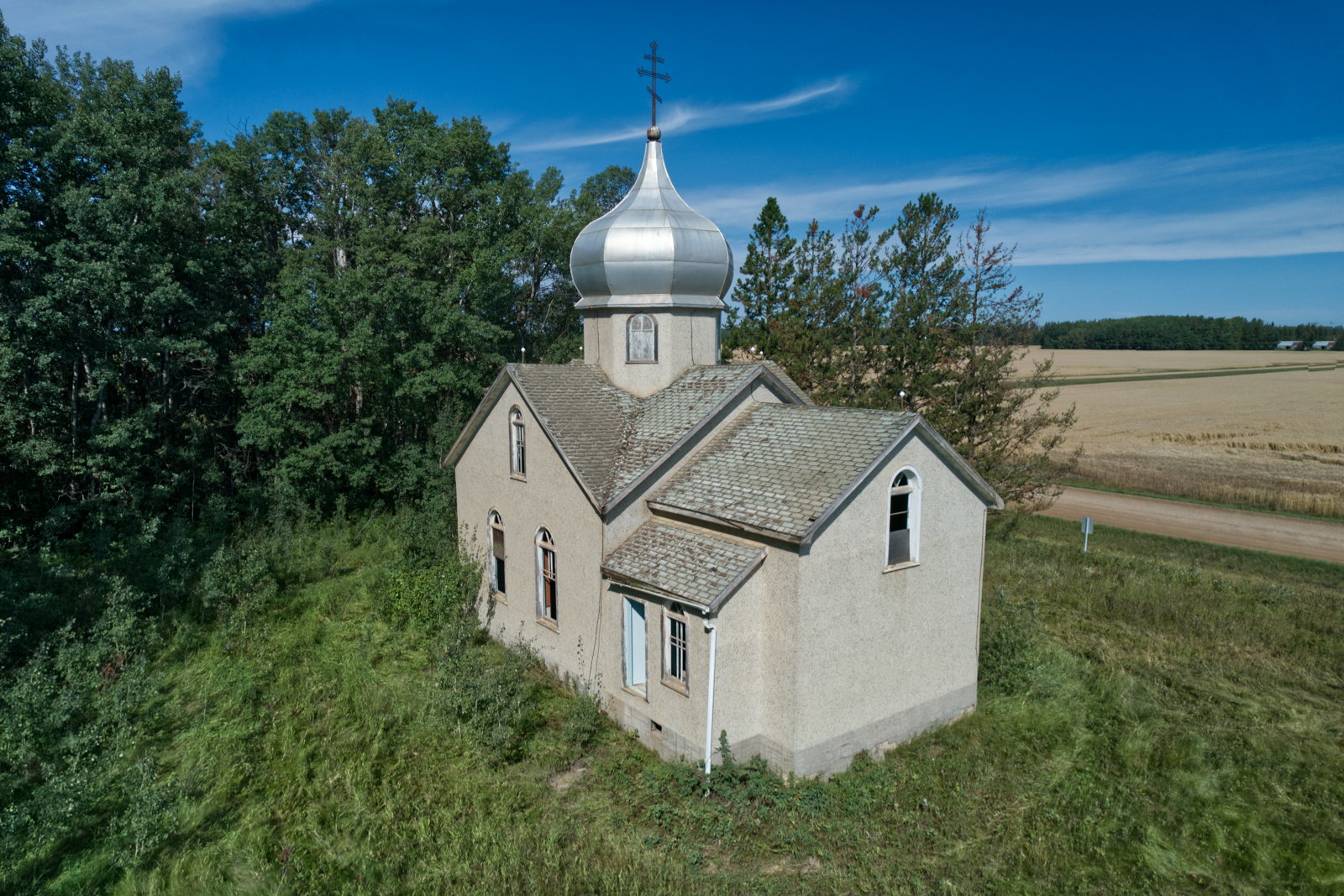
Next, at a meeting on 20 February 1957, it was resolved to proceed with the construction of a church using timber obtained with a government permit. A month later, members helped to harvest the wood, sawed the logs at two local mills, and then hauled the wood to the building site. The dry timber was taken from a forest ravaged by fire in the vicinity of McCullogh Lake. Then, on 15 April the Prosvita Association transferred one acre of land from the northern half of the hall property to the Ukrainian Greek Orthodox congregation. Another acre was bought at the same time from Mike Bodnar for $10. On 20 May the membership assembled yet again and decided to begin erecting the church as soon everyone had finished with their seeding. It was also agreed to adopt the Holy Trinity as the patron of the new sanctuary, though it seems that the Elevation of the Holy Cross might have earlier been given serious consideration.
Construction began at the beginning of June and proceeded throughout the summer, financed with donations and done with the voluntary labour of members. Work progressed on a gradual basis determined by the availability of help and money, continuing through the summer of 1958 when weather conditions and circumstances permitted.
The first six services in 1962 still took place in the Narodnyi Dim, but on 12 August a Divine Liturgy was at last celebrated in Holy Trinity church by Rev. Dr. Sass, appropriately followed by a wedding ceremony. On 2 June 1963 the congregation commemorated their first khram in the new sanctuary. The church was officially consecrated at a Hierarchical Divine Liturgy. This joyous event was officiated by Bishop Andrew on 17 June with the participation of Fr. A. Chomiak from Edmonton, the parish priest, Rev. E. Stefaniuk, as well as with three sub-deacons from St. Andrew’s College in Winnipeg.
Meanwhile, in November 1966 Holy Trinity had been transferred from the Westlock Parish District to the territory of Lac La Biche, having been preceded a short while earlier by Sts. Peter and Paul Church in Athabasca. Although not everyone initially welcomed this move, the congregation quickly adapted to the change.
As the years went by, Holy Trinity experienced many of the same joys and sorrows as other congregations, and had to cope with an aging and declining membership while concomitantly facing the challenges of keeping up their lovingly built sanctuary. The number of services generally ranged between 7-8 annually right until 1987. But as some older members moved into town and young people were became scarce, it was getting difficult to meet the demands made on the congregation. Consequently, in 1988 it was essentially decided to wind down the operations of Holy Trinity and place it under the care of Sts. Peter and Paul church in Athabasca, where many members now belonged after moving from their farms.
Play Memory Eternal Chant
GPS Co-ordinates: 54.907273, -113.207698
Affiliation: Ukrainian Orthodox Church of Canada