The origins of this historic church are linked with the simultaneous formation of the congregation that founded the Assumption of the Blessed Virgin Mary Ukrainian Catholic Church at Star-Peno.
In 1897 the Edna-Star colony, northeast of the present day town of Lamont, was visited by a Ukrainian Catholic priest, Fr. Nestor Dmytriw. He held the first Eastern Rite services in the fledgling colony. At that time, he called upon the settlers to undertake the construction of a church and manse. Ten weeks later, two Russian Orthodox missionaries arrived from Seattle and likewise encouraged the newcomers to build a place of worship. This was an endeavour which the entire community enthusiastically supported. Everyone worked together to construct the original Star church, though some intended for it to be served by Catholic priests, while others wanted it to be served by Orthodox clerics.
The sanctuary was completed in September 1899, and consecrated by a Ukrainian Catholic missionary priest, Fr. Ivan Zaklynsky, in August of the following year. However, the church was subsequently also used by Orthodox priests sent to minister in the Star colony. This uneasy and ultimately untenable situation continued until both groups wanted to use the church at the same time to celebrate Easter in 1901, resulting in a protracted court battle. The disagreement was only resolved in 1907, when the Privy Council in London finally gave possession of the church to the Orthodox.
The Catholic followers left the congregation and built their own church nearby. By 1913 the original log structure had been outgrown by the Holy Transfiguration Orthodox congregation. It was dismantled and its logs were cut into timber that was then used to construct the present church. An early cruciform structure, this sanctuary has a large central dome on an octagonal base and round headed windows, features common to Ukrainian Canadian churches.
A tower was put up to house the church bells, and in recent years a finished basement was added beneath the church. The richly decorated interior features an ornate, three-tiered iconostasis.
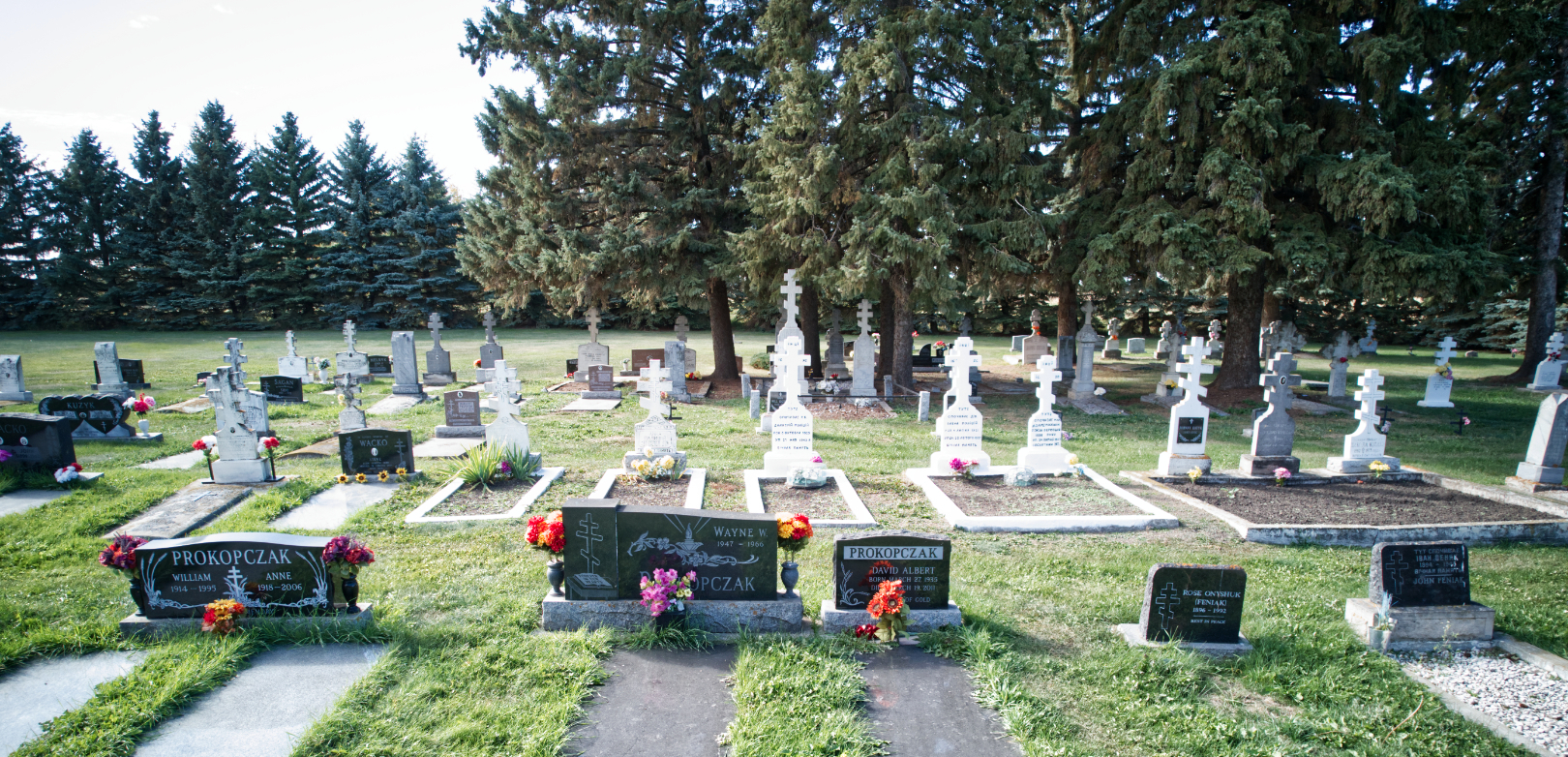
Of interest is the cemetery behind the church, which is the burial place of the four founding families of the Star colony, including that of Ivan Pylypiw, one of the two initiators of Ukrainian emigration to Canada.
Also noteworthy is the shrine built in the form of a small church by the Pullishy family in 1998 to commemorate the 100th anniversary of the Star church. The church was registered as a historic resource in 1991.
See HERE for more information and detailed history of this parish.
See HERE for more information on Ivan Pylypiw.
Play Memory Eternal Chants
Visit this Cemetery
GPS Co-ordinates: 53.862288, -112.729075
Affiliation: Orthodox Church in America

Holy Transfiguration Orthodox Church – Star-Edna, AB
This Holy Trinity Orthodox Church was constructed in 1928. It follows the building traditions of the prairie Byzantine church style. It is a wood frame church on a cruciform plan. It has two small onion domes on octagonal drums flanking the west facade and a prominent central dome over the crossing on a large octagonal drum. It is surrounded by an open octagonal cupola resting on a small onion dome with a ball above supporting a wrought iron cross. A special feature of the interior is the iconostatis with wood moldings and traditionally painted icons.
in 1903, a parish was being organized by settlers from Bukovyna, Ukraine. The government granted the parish 30 acres of land. Divine Liturgy was held, without a church building, beginning in 1905. This is the same year Alberta became a province. The first church was hewn from local logs and completed in 1909 with much assistance from the parishioners.
In 1912, a thatched-roof manse was built for the priest. A well, hand dug in 1912, and updated with concrete cribbing, still serves the parish today. A bell tower that houses four bells was added to the site in 1916. It still stands today complete with the original cross and bells.
In 1928, the first church burned down on Holy Saturday. Construction immediately began for a new church. Holy Trinity Orthodox Church, as it now stands, was completed in the same year.
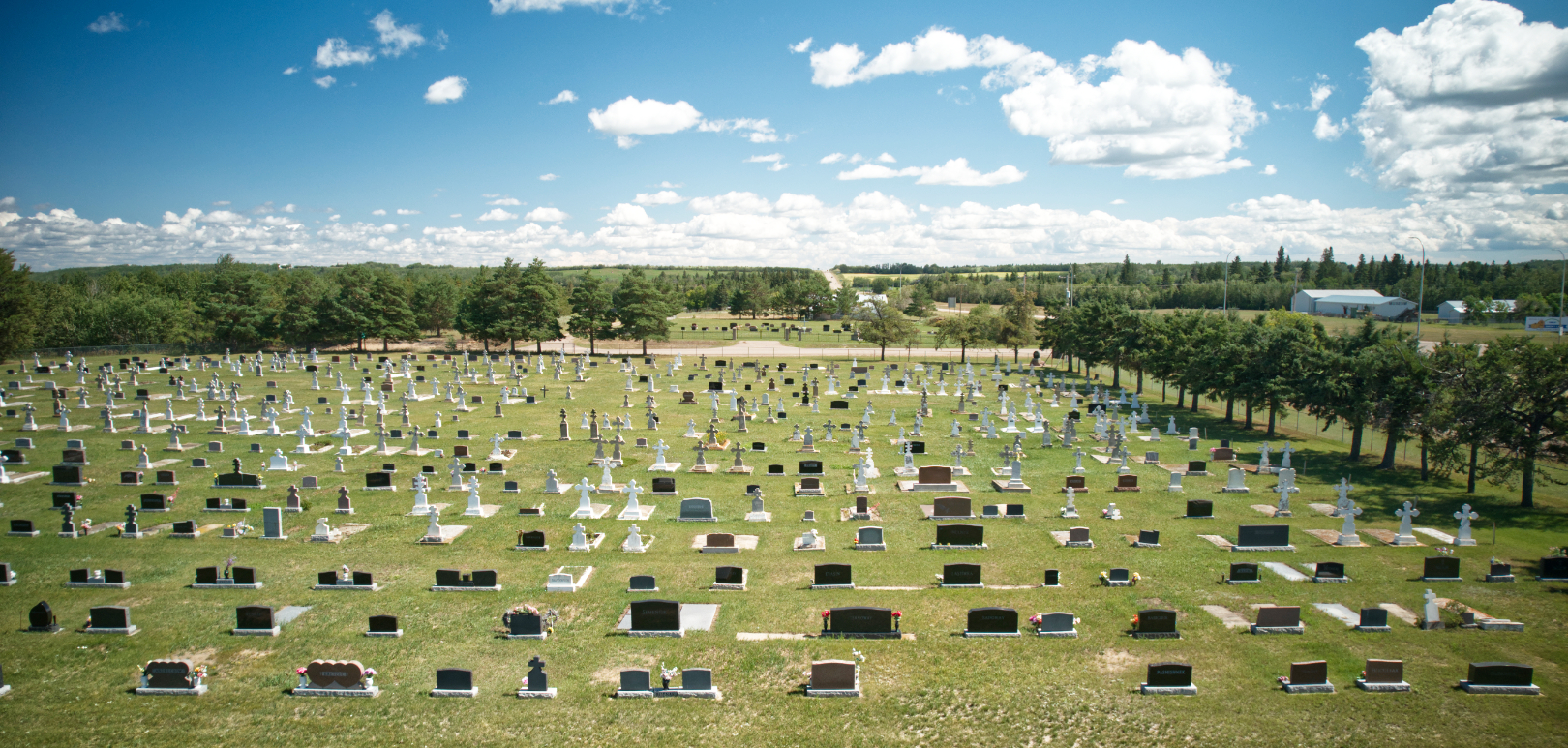
The Holy Trinity Orthodox Church is a landmark and an important symbol of religious and ethnic identity in the Smoky Lake region. It represents the early settlement period, an is an important element to the county's cultural landscape. Holy Trinity is still in regular use with an active congregation. The church is part of the larger religious complex that includes the priest's house, cemetery, community hall and the bell tower. The cemetery is the largest Orthodox parish cemetery of its kind in Canada.
This church as designated as a Municipal Historic Resource on My 26, 2011 by Smoky Lake County.
Play Memory Eternal Chants
GPS Co-ordinates: 54.123388, -112.477964
Affiliation: Orthodox Church in America
Holy Trinity Orthodox Church – Smoky Lake, AB
During the summer of 1899, Stephan and Nikon Shandro and Semion Hawrelak and their wives selected what they thought would be a good site for the church and cemetery. That autumn, more settlers emigrated from neighbouring villages in Bucovina also of the Orthodox Faith. The Priest Alexander Antoniev came to bless the site of the future Temple.
On 7 January, 1900, the community met after they had celebrated the Feast of the Nativity of Christ, and by the Feast of Pascha (Easter) of 1900, they had approved the site for the new Temple. To obtain the necessary government approvals, Nikon Shandro, Jacob Matichuk and George Ostashek then made the 129 km (80 mi) journey to Edmonton. Through an interpreter (they could not yet speak English), they presented their case to the government officials, and their requests were granted. The standard allotment for a church was 40 acres.
In June, 1900, the cemetery was blessed and sanctified by the Priest Jacob Korchinsky, a travelling missionary priest in this region. He visited the community for 3 days and served the first Divine Liturgy on the site. Thirty-three children were baptised and chrismated that day. Their families had travelled from many miles away by horse and oxen.
In the winter of 1901-1902, trees were cut and timbers milled from them for the new Temple, and construction began that summer. Under the leadership of head carpenter Stefan Rosychuk (the only one who was paid for his work), a crew of volunteer labour completed the main body of the structure by the spring of 1904. The interior, completed by Stefan Gudzowaty, was finished several years later.
Saint Mary’s Russo-Greek Orthodox Church at Shandro is a traditional wooden Bucovinian “tripartite”, or 3-sectioned design plan with angular roofs and gables, topped by 3 small onion-shaped domes or cupolas (some affectionately call them “banyaks”, that is, “pots”). The exterior walls are wood-sided and the roof is cedar-shingled. The designer and head carpenter was Stephan Rosychuk, who could neither read nor write; his amazingly accurate designs came from his memory of Ukraine. Mr. Rosychuk’s style of architecture is unmistakable, as it combined more than one element of different regions in Ukraine and Eastern Europe into one harmonious design. Saint Mary’s Temple at Shandro is structurally noteworthy for this reason.
On 28 August, 1904, Bishop Tikhon of North America and the Aleutians (later Patriarch of Moscow and All Russia and then Saint Tikhon), accompanied by 2 priests of the Faith, celebrated the first Divine Liturgy at the new Temple. At the same time, the Temple was sanctified and named in honour of the Dormition of the Mother of God.
In 1913, a belfry (bell-house) was added as an integral part of the Temple building, at the western entrance, which was rather unusual for this period, and characteristic of Mr. Rosychuk’s distinctive architectural style. The belfry is of Ukrainian Carpathian design: square, topped with an octagonal drum featuring flared overhangs. What is most unique is that on top of this structure is an amazing 16-sided drum, capped with a modified Greek-Byzantine (rather than Slavic) dome.
The work was completed in 1915. Saint Mary’s Church is truly a landmark for the surrounding region. Due to the scarcity of original Rosychuk churches, its completely unique design, unusually blended elements, and long history, Saint Mary’s Russo-Greek Orthodox Church at Shandro is a prominent, rare jewel in Two Hills County, and indeed in Canada. With its rich history, continued use, unusual artifacts, and its outstanding Ukrainian-Canadian vernacular architectural features, it is considered to be a precious legacy for Two Hills County.
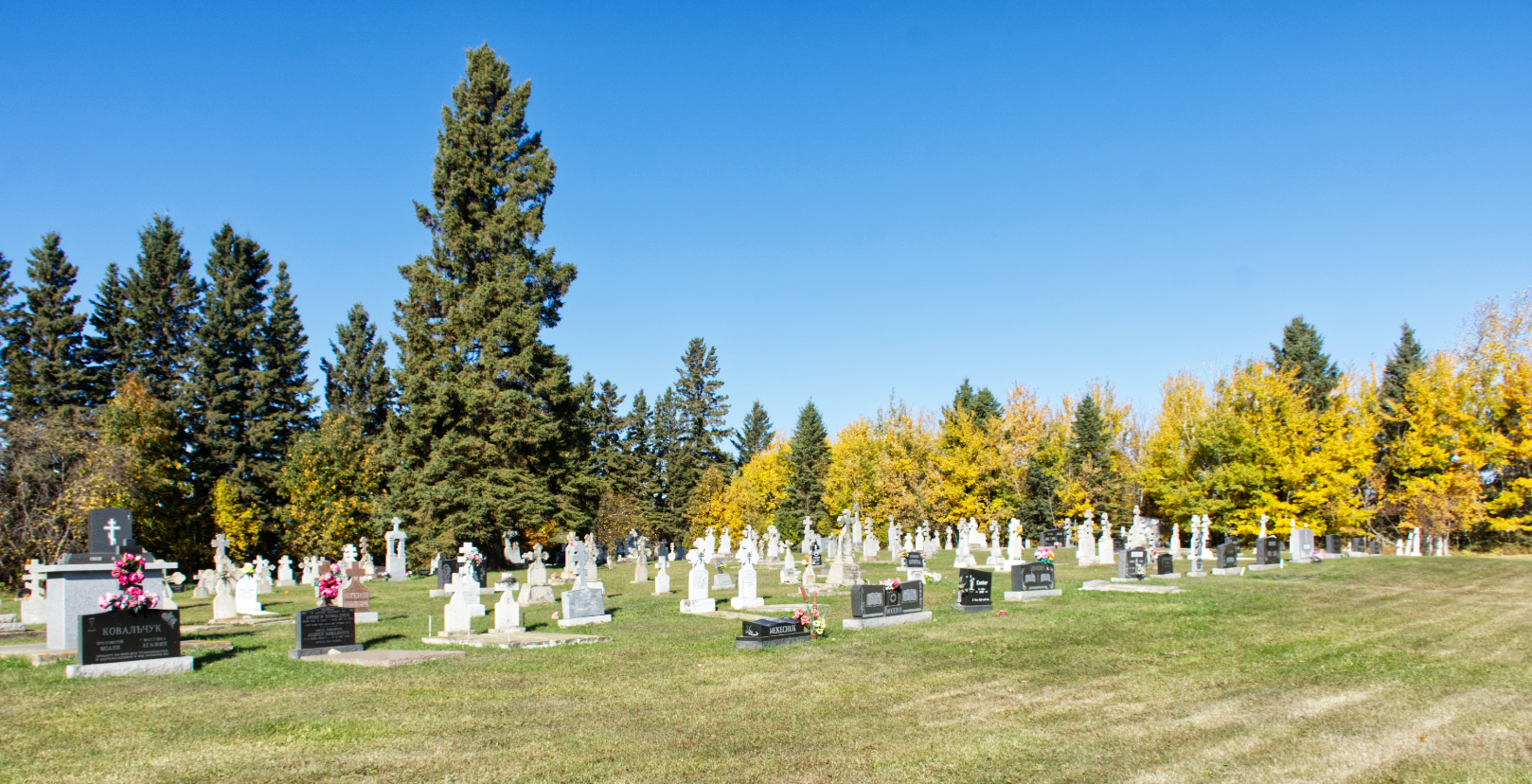
The cemetery is located on the same property, to the south of the Temple. It was established at the time of the beginning of the parish, and it is accessed by a gate which is separate from the main gate entry to the Temple.
Go HERE for more information and history of this parish.
Play Memory Eternal Chants
Visit this Cemetery
GPS Co-ordinates: 53.951261, -112.157254
Cemetery Co-ordinates: 53.948615, -112.158219
Affiliation: Orthodox Church in America
Holy Assumption Russo Orthodox Church – Shandro, AB
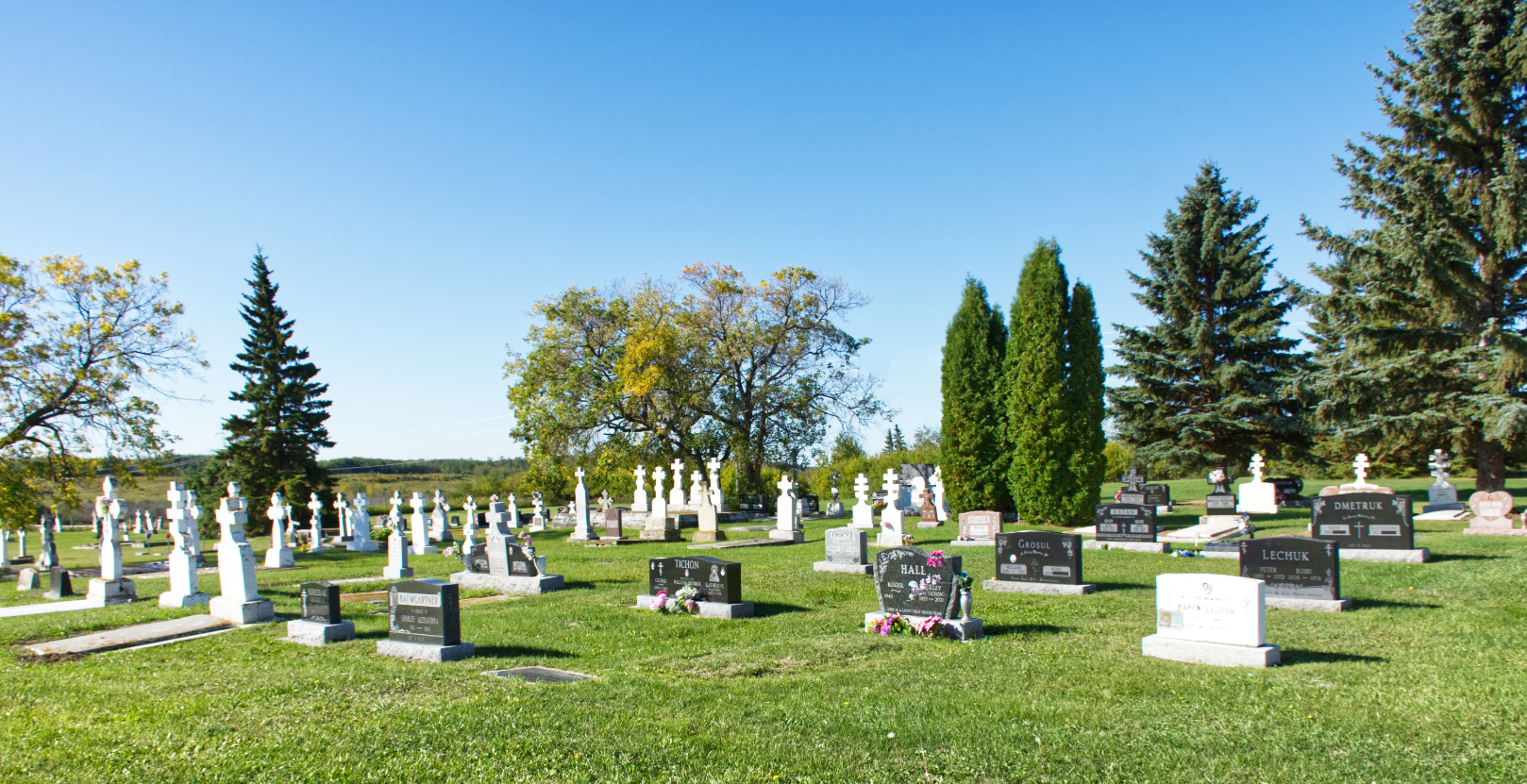
The origins of the Sachava district Orthodox community can be traced back to the beginning of the twentieth century, when priests attached to the Russian Mission in nearby Wostok began providing pastoral care to local settlers. In 1904 title was obtained to forty acres of land at the site of the present church. A simple log sanctuary was subsequently erected and dedicated to St. Michael. This church was destroyed by fire in 1914. The congregation quickly rallied and, with some financial help from the American Diocese of the Russian Orthodox Church, was able to construct a much more luxurious edifice. The new church featured a majestically carved iconostasis that had woodwork and pillars of stained mahogany and was trimmed with gold leaf.
A large residence was also built at this time in the hopes of accommodating a permanent priest. In 1916 a hermitage was opened and consecrated in honour of the Great Martyr, St. John of Suceava (Sachava or Suchava), the patron saint of Bukowina – where most of the local homesteaders had immigrated from in the late 1890s. However, the war and revolution in Eastern Europe shook the foundations of the Russian Orthodox Church overseas and severely undermined its missionary efforts in North America. The congregation found itself without the regular services of a priest. The concomitant establishment of the Ukrainian Greek Orthodox Church in Saskatoon also had serious repercussions at St. Michael’s. The new formation attracted support from those members who were more conscious of their Ukrainian heritage and regarded Russian spiritual leadership as oppressive.
From late March 1920 to February 1924 the congregation was served by Ukrainian Orthodox priests, despite several attempts by Russian clerics and their supporters to regain control over the church. This struggle, which divided families and friends, finally ended when the Ukrainian Orthodox proponents withdrew from the congregation, and eventually built their own church across the road from St. Michael’s. Unfortunately, tragedy later befell the second St. Michael’s church when it was struck by lightning and consumed by fire in June 1978. The present sanctuary was constructed in 1980–81.
See HERE for more information and a detailed history of this parish.
Play Memory Eternal Chants
Visit this Cemetery
GPS Co-ordinates: 53.830908, -112.331224
Affiliation: Orthodox Church in America