From about 1899 to 1903, the area of the Peno settlement was populated by immigrating newcomers from the Halychyna (Galicia) area of Western Ukraine. This area had been part of the Austro-Hungarian Empire before World War I, and it was known as Galicia. Within that empire, it was called the Kingdom of Galicia and Ludomeria until World War I. It was, therefore, in the general political orbit of Poland. That those who settled in Peno came from Halychyna is something that they had in common with the founders of several other parishes in this region.
The parish was founded in 1904, and then for some time, people gathered as they were able in order to pray and worship together. A more formal establishment occurred in about 1909 (because it took a long time for homesteaders to be allowed formally to register ownership of properties), after which the Temple was constructed. Under the direction of a local carpenter, Mr. Korpan, parish volunteers assisted in the work of construction.
This Temple is one of the earliest examples of an open-dome cruciform construction in the settlement area. Oriented (as is usual for any Orthodox Temple) on the east-west axis, the Temple is designed on a central longitudinal cruciform plan following “Byzantine” customs. There is a single large central dome on an octagonal base. In addition, the Temple has a cross-gable roof. The church site is surrounded by flat arable land, with second or third generation trees.
In 1918, Philip Pawliuk constructed the 3-tiered iconostas and other interior furnishings. At the same time, Peter Lipinski painted the walls, ceilings and icons in the Church. The dome was originally painted sky blue and adorned with angels and stars. The dome and stars have since been repainted, but the angels have not been altered.
One can say that this Temple of the Archangel Michael in Peno is one of Peter Lipinski's earlier works. There is a variety of styles and materials in his icon paintings. One can see a variety of colours ranging from his darkish-brown (the Apostles) wall icons to the brightly-coloured icons on the iconostas. For the 3-tiered iconostas, Peter Lipinski painted the icons on the top-tier and the Royal Doors. The remaining icons found on the iconostas are reproduction lithographs.
An open bell-house built from split fieldstone stands in front of the Temple.
As is the case with many other rural communities, the region around Peno became steadily depopulated after the 1940s. Farms were consolidated in the formation of agricultural businesses, and people generally moved into urban environments.
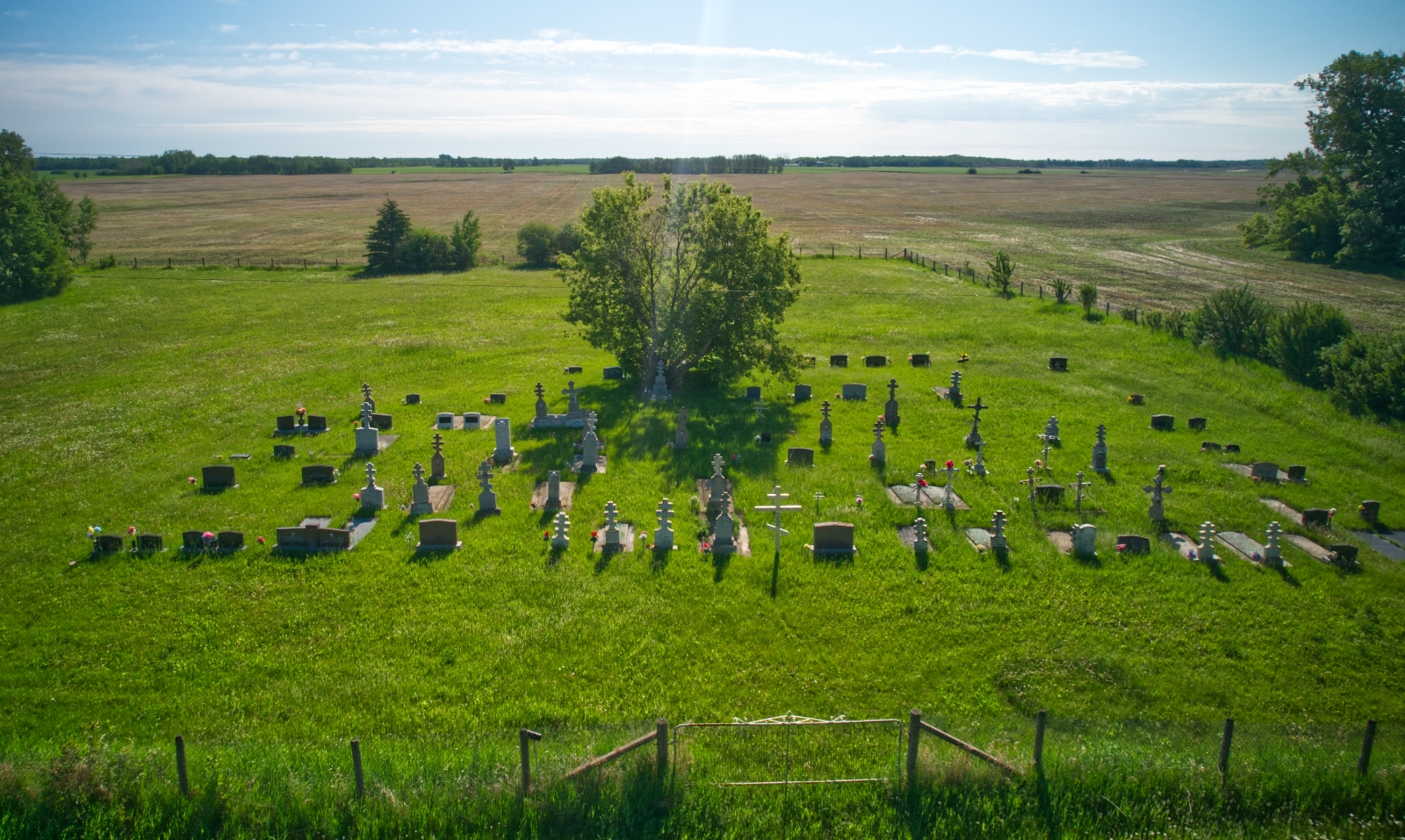
The Saint Michael Orthodox Cemetery of Peno is located less than a kilometre south from the Temple, south of Township Road #572, on the east side of Peno Road, which is Range Road #190.
Go HERE for more information and history of this parish.
Play Memory Eternal Chants
Visit this Cemetery
GPS Co-ordinates: 53.922314, -112.677791
Cemetery Co-ordinates: 53.916659, -112.678061
Affiliation: Orthodox Church in America


St. Michael Orthodox Church – Peno, AB
Orthodox congregational life was initiated at Kysylew in 1898–1899 by Ukrainian settlers from the village of Kyseliv, Bukowina who had only recently homesteaded the district. Work on a church was begun in 1902 and two years later the completed sanctuary was formally dedicated to the Nativity of St. Mary by priests from the Russian Orthodox Mission.
Church bells were donated in 1911 and an extension to the sanctuary was constructed in 1921. This church served the Kysylew faithful until it was destroyed by fire at the end of the 1940s. In 1950 the congregation embarked on the construction of the present church, a more elaborate cruciform structure that was erected about 100 feet east of the original sanctuary and adorned with two large domes and three smaller cupolas.
Most of the iconography in the church was done by Father John Wasil, the icon of St. Nicholas being especially notable because its inscription is in both Old Church Slavonic and Hungarian. Also noteworthy is the bridge over the small creek that separates the church from its cemetery at the back of the congregational property. The original bridge at this location was put up by the government to serve the traffic along the South Victoria Trail.
See HERE for more information and a detailed history of this parish.
Play Memory Eternal Chants
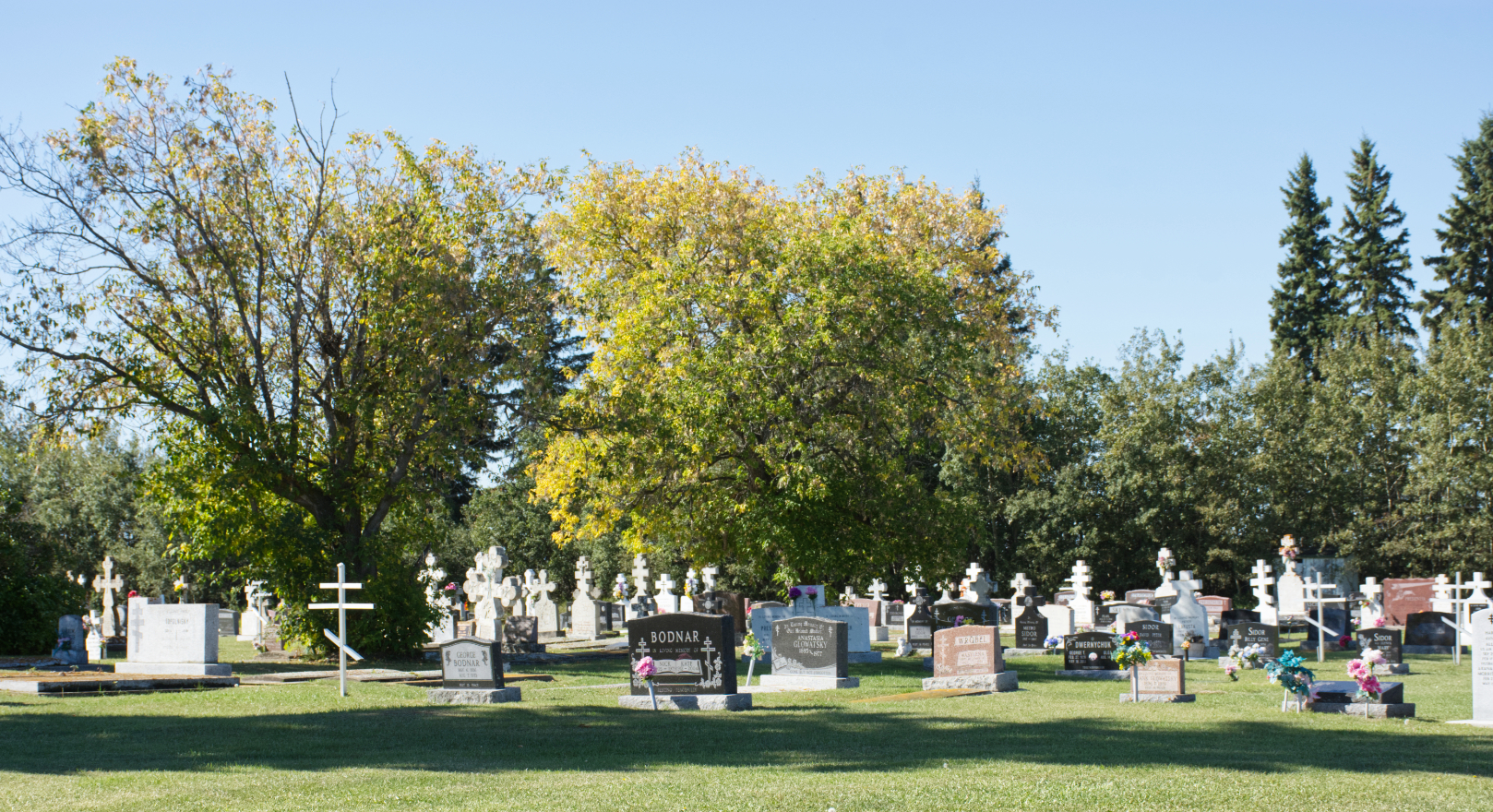
Visit this Cemetery
GPS Co-ordinates: 53.914551, -112.358137
Cemetery Co-ordinates: 53.914324, -112.361635
Affiliation: Orthodox Church in America
Nativity of the Holy Virgin Orthodox Church – Kysylew, AB
The Temple of Saints Peter and Paul is situated on the far north bank of the North Saskatchewan River, not very far from Smoky Lake. Built by Bucovinian immigrants, this Temple has served a large flock of believers, including those of smaller nearby farm-site Temples. The community first organised itself in 1906, and then prepared to build a suitable Temple for worship.
The construction itself took several years. The whole project was led by Stephan Rosychuk, who was hired to lead the work. Mr. Rosychuk had earlier led in the building of the Temple of the Dormition of the Theotokos (Saint Mary's) in Shandro, on the south side of the North Saskatchewan River. Although he was illiterate, he was nevertheless able to make plans for this and other Temples based on his recollection of architecture in his homeland.
Constructed from logs, it is one of the region's first cruciform Temples. Siding was first applied in 1915. It is also one of the first to have a completely open dome on an open drum. As well, the dome was not a cautious, small-scale experiment. The ceiling extends to a full 20 metres above the floor-level. There are other distinctive features. As with the Temple of the Dormition in Shandro, the belfry is positioned on top of the narthex, and it forms an integral part of the structure. Unlike most other cruciform Temples, the arms of the Cross (the north and south wings) are apsidal rather than rectangular in shape. This shape emphasises the height of the building; however, in Romania, this shape is not uncommon. It is in these 2 north-and-south apses that the choir might normally stand and sing.
As were other communities, this one was registered under the incorporation of the Orthodox Bishop in the Statutes of the North-West Territories. The incorporation of the bishop-and-parishes had been accomplished in 1903 by Bishop Tikhon (Belavin). Thus, the beginning of the history of this parish was within the “Russian Mission”. This was the popular name for what was at that time called the Diocese of the Aleutians and North America. It was Saint Tikhon who began using the term “Russo-Greek Orthodox” to describe the majority of Canadian parishes under his omophor.
The Temple building itself was constructed from logs, without blueprints, and by local farmers. It is a recognized, historical site nowadays, and it can be seen from a great distance, because of its position on the elevated bank.
Historically, this community has been a central focus for other farm communities nearby (such as Holy Ascension, Wasel), and some monastic communities were long ago established on and near the present Temple site.
In 1924, the Priest Nicholas Lewko painted the interior and the exterior of the Temple. Since then, the congregation has maintained the appearance faithfully. The 2-tiered iconostas is itself a demonstration of the love and care taken by the faithful parishioners in adorning the worship of the Lord. As with other Temples, there are no pews. There are, however, benches along the sides for the elderly and others who may need them.
In more recent years, a parish hall was constructed to the north of the Temple.
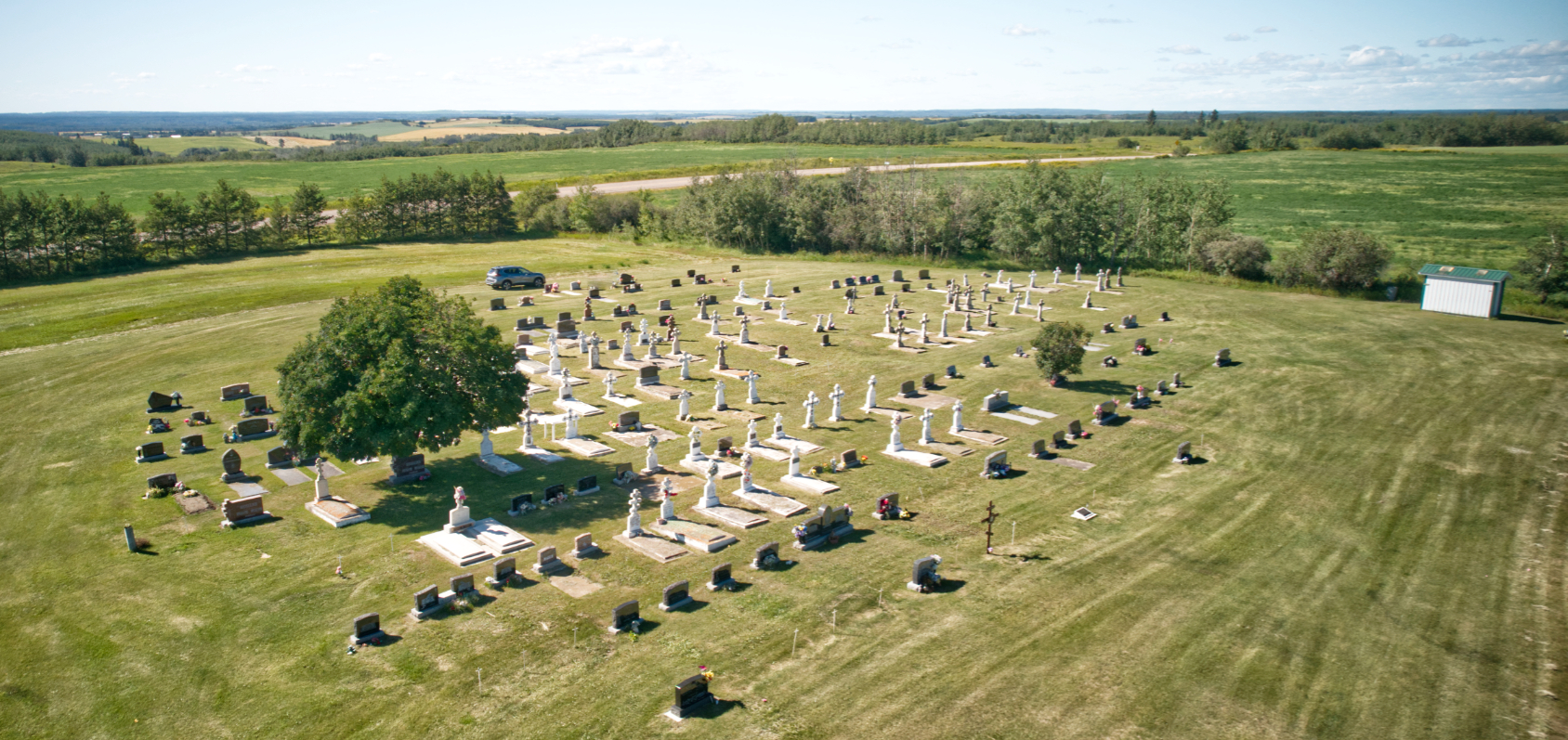
The Saints Peter and Paul Cemetery is located on Township Road #584 and Highway #587, Bellis, Alberta. In fact, the cemetery is on a portion of the property which is just to the northwest of the Temple.
Go HERE for more information and history of this parish.
Play Memory Eternal Chants
Visit this Cemetery
GPS Co-ordinates: 54.042953, -112.134379
Cemetery Co-ordinates: 54.043847, -112.135773
Affiliation: Orthodox Church in America
Sts. Peter and Paul Orthodox Church – Dickie Bush, AB
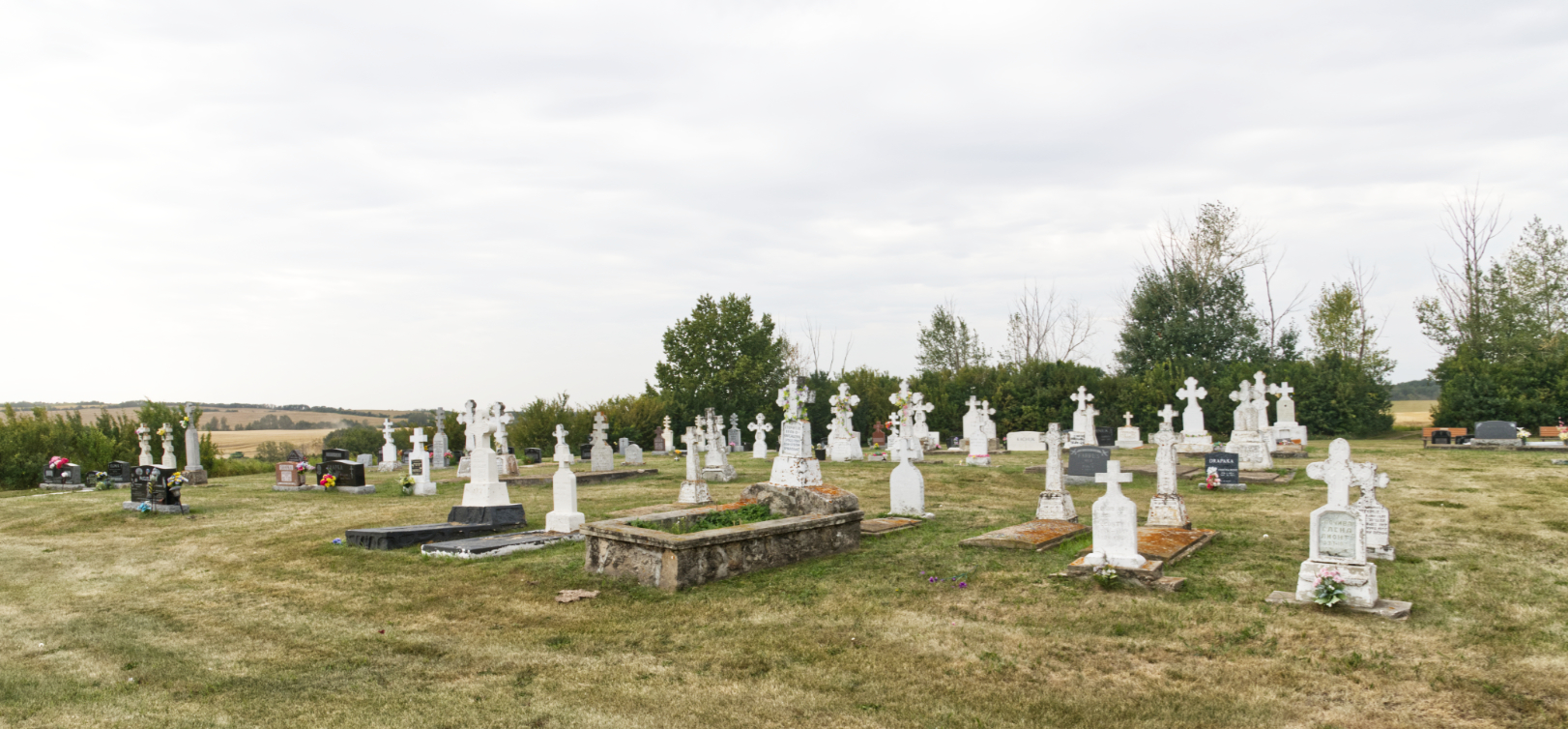
S imeon Menzak was one of the founding members of the parish of Saint Nicholas in Desjarlais. Simeon came to Canada from Ukraine with his wife and daughters in 1908, and he settled in this region. Shortly after their arrival, one of the young daughters died. She was buried on a plot of land that would eventually become the Desjarlais Cemetery. Simeon was strongly concerned that a Temple be built there.
Although there were other established Temples in the area (Shandro, Old Wostok, Boian), the Desjarlais community felt the need for their own Temple nearby. Besides, “in the area” at that time nevertheless a meant a long journey by horse. The first meeting was held on 1 March, 1917, which resulted in the foundation of the parish community.
Soon afterwards, in the spring of 1917, construction began. Stephen Gudzowaty was contracted to build the Temple. The Greek domes style of architecture was chosen. The parishioners cut, squared and hauled logs with teams of horses. With teams of horses and wagons, rocks were brought in to the site for making the foundation. The ladies of the community spun yarn and they embroidered cloths and they wove tapestries to adorn the interior of the Temple.
In early 1918, the construction of the Temple was completed. Then, on the spring Feast-day of Saint Nicholas, on 22 May, 1918, Father Gregory Soroka sanctified the Temple. The parish was incorporated on 10 December, 1918, as : “St. Nicholas Greek Orthodox Church of Desjarlais”. It was on 31 July, 1919, that the parish received the title to the 40 acres of land at the land description site NE 1/4 9-57-14-W4. It was registered under : “An Ordinance Respecting the Holding of Lands in Trust for Religious Societies and Congregations”.
n 1975, the Archpriest Michael Andruchow suddenly fell asleep in the Lord. Because the Archdiocese of Canada suffered from a shortage of available priests at that time, and because the Parishes of the Moscow Patriarchate had available priests who were brought from the Soviet Union to serve, the parishioners accepted services from this administration from 1975 until 1984. It was by 1984 that Archpriest Stephen Keaschuk in Edmonton was available to care for several rural parishes by driving from the city. After that, the Archdiocese of Canada (OCA) was able to provide the necessary clergy.
In 1980, the Temple was designated as a “Local Historical Site” by the Alberta Government’s Department of Culture and the County of Two Hills. Grants were received in order to repair the Temple and to restore it to its original condition.
Go HERE for more information and history of this parish.
Play Memory Eternal Chants
GPS Co-ordinates: 53.914042,-112.033236
Cemetery Co-ordinates: 53.912970, -112.031530
Affiliation: Orthodox Church in America