
Fr.Meroslaw Kryschuk first began holding services at St. Paul while he was the pastor of the Myrnam district. It was probably on his initiative that at a meeting was held in St. Paul on 17 September 1960 to adopt the charter and bylaws of the Ukrainian Greek Orthodox Church of Canada. This marked the formal incorporation of the All Saints parish.
In 1961, the congregation was attached to the Glendon Parish District, which was then being served by Fr. P. Dorosh-Zmiyiwsky, though he was succeeded the following year by Archmandrite J. Vitenko. Although these early years were trying, by 1962 the congregation reported celebrating ten Divine Liturgies over the course of the year. Although scant information is available about parish life during these early years, a letter from 1968 indicates that there were just eight active members, who were finding it difficult paying the money that they owed to the Consistory and asked to have several years’ debt written off. Communication from the parish remained sporadic into the 1970s, but it was obvious that financial difficulties were continuing to challenge the St. Paul faithful. Finally, in 1973 the situation stabilized to the point where the executive was able to finally provide figures for its paid membership during the previous years: 1965 – 5; 1966 – 13; 1967 – 12; 1968-1969 – 9; 1970 – 7; and 1972 – 12. The fluctuations were largely attributable to the fact that some people who were members of neighbouring congregations, occasionally also paid memberships at All Saints. Regardless, by 1973-1974, when membership stood at 11, All Saints was finally able to settle its outstanding account with the Consistory.
Within a year, however, the situation took a turn for the worse after St. Paul was briefly left without the regular services of a priest. At this time, the congregation considered discontinuing paying membership to the Consistory. Perhaps instead helping neighbouring congregations by attending their services. Fortunately this crisis quickly passed, and such drastic action was successfully averted. And despite these early difficulties, the congregation gradually gained strength, undoubtedly benefiting in no small measure from the fact that it was based in a growing town that was a regional hub and a county centre.
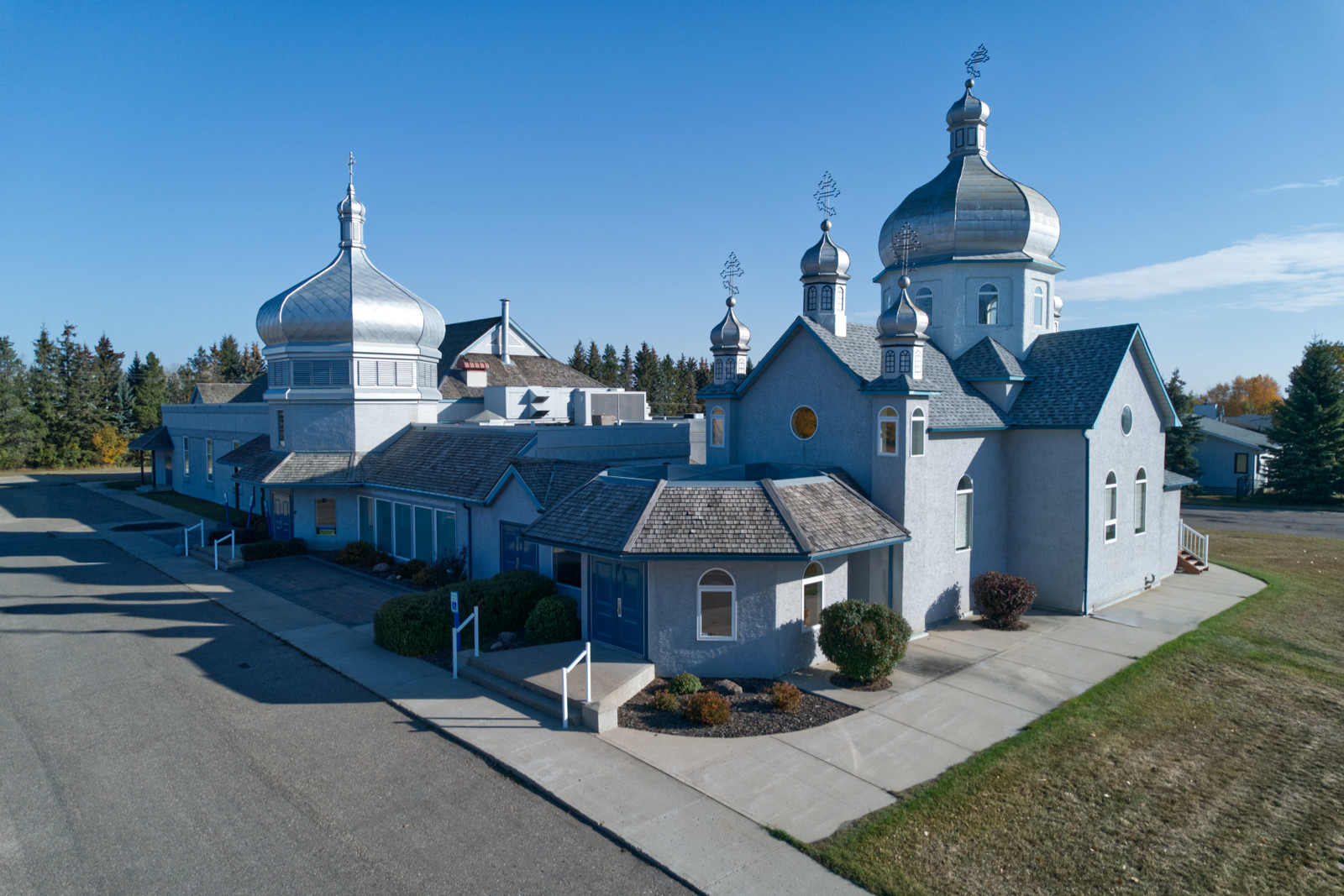
Thus, as the 1988 millennium of Ukrainian Christianity approached, All Saints Church began to think boldly about its future. Writing to the Consistory in December 1986, the executive requested Winnipeg’s support for its ambitious plans to build a major multi-use facility that would have “…the potential to serve the cultural and social needs of Canadians of Ukrainian ancestry, not only in the town of St. Paul, but also its surrounding communities, counties, and municipal districts.” Incorporated in the centre’s design would be a “…library, meeting rooms, dance training facilities, offices, theatre, hall, kitchen, and kiosk for the retail centre of Ukrainian arts and crafts.” Obviously, part of the intention was to use the centre to generate income and support for the congregation, by making it available for rent by outside groups. Although considered a risky move by some in the parish, the majority decided to proceed with the plan to construct the state of the art structure, which also included a domed area that could serve temporarily as a place of worship. Until this time, the congregation had been using an old church which had been outgrown and was in a dilapidated state.
After the centre was completed, it became a very difficult task to find sufficient volunteers to staff functions held at it and to raise money to pay off the large mortgage. A few individuals even quit the congregation because they had opposed the decision to build the facility and felt vindicated by the struggles to operate and pay for it. Nevertheless, a stalwart core of parishioners soldiered on in their efforts, though it eventually became obvious that the centre was not going to attract a large group of new church members capable of building a modern new sanctuary on the same property.
Consequently, it was decided instead to purchase the no-longer used Holy Ghost church in Willingdon and move it to St. Paul for restoration and use as the All Saints parish sanctuary. This was done over a two-day period on 26-27 March 2002, when the church was carefully lifted from its foundations and transported slowly by truck more than eighty kilometres to the north side of the Saskatchewan River and its new home beside the All Saints Ukrainian Cultural Centre. Originally built in 1938 under the direction of the talented Ivan Mnoholitnay, the five-domed cruciform structure was placed on a foundation adjacent to the centre, where it was subsequently restored and attached to the cultural complex through a vestibule and walkway. The first liturgy was celebrated in the rededicated church by Fr. J. Lipinski on Palm Sunday, 4 April 2004. It was formally blessed at a hierarchical service officiated by Archbishop John on 18 September 2004.
Visit this Cemetery
GPS Co-ordinates: 53.998436, -111.298967
Affiliation: Ukrainian Orthodox Church of Canada


All Saints Ukrainian Orthodox Church – St. Paul, AB


The first liturgies were celebrated at Spedden in the late 1920s at the homes of local supporters of the Ukrainian Greek Orthodox Church of Canada, and at the Spedden Narodnyi Dim. Rev. T. Horbay began visiting the settlement in 1927, sowing the seeds that eventually flowered with the construction of Holy Trinity Church. However, the founding meeting of the congregation was only held on April 17, 1932, when sixteen members joined the ranks of the faithful petitioning the Consistory in Winnipeg for formal acceptance. Lots were subsequently purchased from the CNR in 1934, though eight years would pass before the congregation was ready to erect a place of worship. Construction of a sanctuary began in 1942, with volunteers working under the direction of John Krusckow and Nick Nickolywich. In 1943 Mike Muzyka assumed the role of head carpenter, overseeing congregation members as they gradually completed the church and then finished off its interior over the course of several years. However, by July 1943 the crosses and domes for the church were ready to be blessed, indicating that the building was ready for occupancy around that time.
From its inception the Spedden congregation was always served by priests who were based in Smoky Lake, and thus a close bond developed between the two communities. These bonds were further strengthened by the many family relationships linking the UGOC congregations in each. In the fall of 1950, when an attempt was made by the Consistory to transfer Spedden to the Glendon district so as to bolster the size of the latter, the move immediately provoked a revolt among the members of the former and a protest from the Smoky Lake leader, Nick Gavinchuk. After the Spedden faithful threatened to suspend their activities and to prevent the Glendon priest from using their church for services (though they bore no ill-feeling towards him personally), the Consistory apparently thought better of this idea and wisely restored the status quo.
Unfortunately, the original structure was destroyed by fire on Easter Sunday, 21 April 1957. It is believed that the fire started as a result of the kadylo, or incensory, being emptied outside the church, where the embers subsequently set the grass ablaze. The resulting fire consumed the sanctuary as village members looked on helplessly, since no fire department was able to come to the rescue. The original kadylo was saved. Undaunted by this painful blow, parishioners set about rebuilding the church the following year, when head carpenter Mike Panas, assisted by John and Metro Bodnar, began the task of once again mobilizing volunteers into a construction crew. A cruciform structure, surmounted with a large central dome and with two smaller domes over towers flanking the façade was subsequently erected on the church property. The new sanctuary was formally consecrated at hierarchical service celebrated in 1962 by Bishop Andrew of the Western Diocese.
In 1981 Father Lorne Kubin, with some creative help from Larry Wowk, decorated the interior of Holy Trinity Church with traditional rospys designs. The rose motif was inspired by the mission church at Saddle Lake First Nation’s Reserve; Larry Wowk was responsible for painting the six-winged cherubim. Fundraising to purchase an iconostasis began in 2000, with Deacon Nazari Polataiko (who was then running the UOCC church store at the Consistory) and his father Yaremi in Chernivtsi winning the contract to produce an icon screen. The beautiful and elaborate iconostas, featuring icons by Tatiana Polotaiko and decorated with gold leaf, was made in Chernivtsi, then shipped to Spedden.
In the late summer of 2015, the Spedden faithful narrowly escaped having their church burnt down a second time. Friday August 27, 2015, the Ukrainian Catholic Church a short distance away on Highway 28 was struck by lighting and completely destroyed. The following evening, at around midnight, an arsonist attempted to set fire to Holy Trinity church as well. Fortunately, miraculously, his efforts failed, as the back windows of the sanctuary were scorched but the church failed to catch fire.
In 2016 the congregation hosted 8 liturgies a year.

Play Memory Eternal Chant
GPS Co-ordinates: 54.140118, -111.725308
Cemetery Co-ordinates: 54.151921, -111.766923
Affiliation: Ukrainian Orthodox Church of Canada
Holy Trinity Ukrainian Orthodox Church – Spedden, AB
The origins of South Slawa church extend as far back as 1909, two years after the district was settled by immigrants from Galicia, Western Ukraine. At a meeting in the home of M. Hymanyk, a group of residents decided to build a church to serve the needs of the new community. Completed in 1910, the sanctuary was initially used by ministers from the Presbyterian-backed Independent Greek Church, popularly known as the "Seraphimite" formation after its founding bishop. Although the Independent clergy at first retained most of the features of the Byzantine liturgy, the church leaders planned to gradually discard these and to introduce a Protestant form of worship. (See, for instance, “Misiinyi rukh v okolytsy Slava, Al’ta.,” Ranok, 28 March 1917, p. 6, which announces that a service was to be held there by Rev. I. Danylczuk on 8 April.) When one Independent pastor, I. Danylczuk, openly declared that vestments, candles, and incensories were unnecessary, the parishioners protested and barred him from serving in their place of worship. Afterwards, a priest from the Russian Orthodox mission appeared in the community, but when he roundly castigated the congregation members for having accepted “Seraphimite” ministers—claiming that a devil had thereby nested himself in their midst and would have to be driven out—the batiushka himself was forced to depart. Apparently, the first South Slawa church was then either abandoned or destroyed, as no other mention is made of it in extant sources.
Regardless, in 1923 devout members of the original South Slawa congregation learned of the activities of Rev. Ivan Kusey on behalf of the Ukrainian Orthodox Church in the vicinity of Willingdon, west of Two Hills. When they invited him to celebrate a liturgy at South Slawa, the service drew a large number of people who were moved to hear the Gospels for the first time in their native Ukrainian tongue. On September 17, 1923 a meeting was held to formally bring into existence a Ukrainian Greek Orthodox parish. The newly formed executive was immediately authorized to proceed with the construction of a church, and $102.15 was gathered in donations for the building fund. (Another $40 was also collected to cover the costs of obtaining clerical services.) Soon after, a log structure was erected by volunteers for the sum of $119.85 in materials, vestments and candle holders being purchased in 1924. On September 27, 1925 a liturgy was celebrated at the new church by Archbishop Ioan Theodorovich, $40.00 being collected from the large crowd in attendance.
At the annual meeting held on 19 December of the same year, bylaws were drafted for the congregation and land was acquired for $20.00 from John Hymanyk to establish a parish cemetery. The next important development in the life of the South Slawa congregation was the decision made at a special meeting (held on January 3, 1931) to build a new church that would better accommodate the growing ranks of the Ukrainian Orthodox faithful in the north Myrnam area. Logs were subsequently obtained from an island on the North Saskatchewan River, five miles to the north (the former site of Fort D'Isle, where the Northwest Company operated a trading post from c. 1801-1804) and squared at John Zalaski's sawmill. Andrew Sakowsky and Metro Nahorniak served as supervisors over the project, which was undertaken by volunteers working under the direction of a hired chief carpenter. When the first rafter was raised on the east wall of the new structure, a wreath of flowers (gathered by 12- year-old Nick Zalaski) was tied to it to symbolically represent the hope that the church would enjoy a long and happy life.
After the new Slawa Church – given the name "Dormition of St. Mary", or Uspenia – was completed in 1933, it was officially consecrated by Archbishop Ioan Theodorovich. Situated on a knoll with a commanding view of the surrounding countryside, the cruciform structure was crowned with a large central dome, two smaller domes gracing the narthex and sanctuary. In 1938 a belltower was constructed adjacent to the southwest corner of the church and fitted with a bell. Subsequently, an iconostasis was installed (apparently purchased through the consistory), a chandelier acquired, and other refinements made to the church interior and its furnishings.
It was from the mid-1930s to the early 1950s, that South Slawa congregation enjoyed its peak years of activity. In 1939 ten liturgies were celebrated at the church, a figure that dropped to eight in 1946, but increased to twelve the next two years, and thirteen in 1949. Throughout this time, Slawa was served by priests based in Myrnam, five miles to the south, a situation that on occasion resulted in some friction. Thus, with the appointment of Rev. M. Flak to the Myrnam district in late 1951, tensions arose between the two communities because of apparent political differences in the make-ups of the two congregations. Whereas Myrnam residents were sympathetic to the unabashed anti-Communism of Rev. Flak, who had recently arrived from war-torn Eastern Europe, Slawa supporters were said to be more left-wing, and noticeably cool toward their new minister.
In 1953, when twelve Divine liturgies were held, the congregation had 28 members, a figure that dropped to 20 by 1955, when thirteen Sunday services were held. After that, rural depopulation and the aging of the membership slowly whittled away at the vitality and viability of the St. Mary's parish. The church was always plagued by the shortage of available priests in the UGOC, and frequent letters to the consistory attest to the fact that Slawa parishioners were often frustrated with their level of pastoral care.
In 1982 South Slawa church was designated an historic site by the Province of Alberta. Three years later, the exterior of the church was repainted, and the doors and windows were replaced. The well-maintained sanctuary is still used for regular services, as well as weddings, funerals and the annual commemoration of the Feast of the Dormition of the Virgin Mary.
The Slawa congregation also owns the T. Shevchenko Ukrainian National Hall, half a mile west of the church, where parish functions, concerts, and plays have been held over the years. Completely refurbished in 1989, its stage contains a beautiful backdrop painted by artist P.W. Romaniuk in 1942.
Play Memory Eternal Chant
GPS Co-ordinates: 53.715864, -111.092719
Affiliation: Ukrainian Orthodox Church of Canada
St. Mary Ukrainian Orthodox Church – Slawa, AB
When Rev. Dmytro Stratychuk began his missionary work in late March 1920 on behalf of the newly established Ukrainian Greek Orthodox Church of Canada, Sich-Kolomea became the second Alberta congregation to invite him to celebrate a liturgy in their community. This happy event took place in the modest church that had originally been built as an Independent sanctuary, Rev. Stratychuk having earlier commemorated Palm Sunday at Suchava, south of Andrew.
The re-organization of the Sich-Kolomea congregation Ukrainian Orthodoxy was initiated around the same time at a meeting that drew thirty-two members and which again was held in the home of Timofei Worobets. Significantly, Michael Cherniawsky, a son of Wasyl and Anna's, became a staunch promoter of the UGOC in Sich-Kolomea, as did almost all of the other founders of the Independent congregation years earlier. Although the change in affiliation does not seem to have provoked a major rift within the community, the fact that the original church was destroyed by fire around 1924-1925 may have been attributable to an act of arson by someone who wanted the church to remain in the Independent fold.
Regardless, the first Hierarchical liturgy was celebrated at Sich-Kolomea by Archbishop Ioan Theodorovich on 19 February 1925, after which a meeting was held at the home of Tymofei Worobec to discuss how the congregation could be enlarged. Another service was held in the district on the feast day of Sts. Peter and Paul, at which Rev. Dmytro Seneta officiated.
On 20 January 1926, at the congregation’s annual meeting held in the Worobec home, it was resolved to proceed with the construction of a new church under a building committee comprised of N. Charuk, N. Semotiuk, A. Zaparniuk, S. Gregory and M. Cherniawsky. The latter and F. Kostash were delegated to visit The Nativity of the Mother of God Ukrainian Catholic Church in nearby Chipman, which had been built in 1916 by Joseph (Jarema) Janishewski of Edmonton, as the congregation was thinking of hiring him as their contractor.
In the meantime, a suitable site was to be chosen for the new sanctuary by 31 January, when the next meeting was scheduled to take place, and everyone was urged to participate in the building of the church. At the gathering held on the last day of January, the 32 members in attendance adopted a formal constitution for their now officially Orthodox congregation, “Pursuant to the Religious Societies Lands Act.” Of particular note in the document is the following implied reference to the Autocephalous Church in Soviet Ukraine: “The said Congregation belongs to the Ukrainian Greek Orthodox Church of and is in communion with [the] Ukrainian Greek Orthodox Church of or in Canada which is under the supervision of the Ukrainian Greek Orthodox Bishop or who may hereafter or from time to time be appointed by the Kiev-Ukrainian Archbishop Metropolitan or Patriarch for the Territory in which the said Congregation is situated and shall be under the jurisdiction of the Ukrainian Greek Orthodox Bishop appointed as aforesaid.” Obviously, Sich-Kolomea members were anticipating the possibility that one day their church might become a constituent part of the Mother Church in an independent Ukraine. The constitution also indicated that the church was to be registered in the name of “The Ukrainian Greek Orthodox Church of the Vozneseniia at Royal Park in the Province of Alberta, Canada.”
Next, on 1 February 1926, the congregation signed a contract with Joseph Janishewski (who in 1915 had also attended the “First Ruthenian Presbyterian Convention” in Vegreville) to construct a church a mile east and half a mile south of the original Cherniawsky homestead. The sanctuary was to cost $7,500, and it was to be completed by 31 July of that year.
This new sanctuary was then blessed by Archbishop Ioan Theodorovich at a service held on Saturday 4 September 1926, the feast day of the Dormition of the Virgin Mary. Also participating were Fr. Dmytro Seneta, assisted by Reverends Ivan. Kusey and Timothy Horbay. According to a brief account of the event in the newspaper, Nash postup, the dedication of the church was attended by approximately one thousand people from the surrounding countryside. Afterwards there was a lunch provided at the large parish hall beside the church, where guests were addressed by speakers and entertained by singing. Archbishop Theodorovich subsequently visited the church again on 7 July the following year.
It is worth noting that until 1928, when a congregation was organized in Vegreville, supporters of the Ukrainian Orthodox Church living in town belonged to the Sich-Kolomea congregation. However, even after St. Vladimir’s Church was constructed in Vegreville in the early thirties, some of its members continued to frequently attend services at St. Mary’s because of family connections to the Kolomea district or because they simply enjoyed the experience of worshipping in a country church. An integral part of the Vegreville parish district, Sich-Kolomea has nevertheless retained a distinct identity that is rooted in the congregation’s unique beginnings.
In 1937, the executive of St. Mary’s church reported having a total of twelve registered members, undoubtedly comprised of families. Two years later the figure given had grown to 22, after which the numbers remained fairly stable throughout the 1940s into the early 1950s – reaching a high of 38 members in 1951 before deaths, assimilation and rural depopulation gradually began to take their toll. During the same period, 12 to 15 services were celebrated annually at Sich-Kolomea. In 1954 the congregation was comprised of 24 members, and an apologetic note to the Consistory in response to a fundraising drive revealed: “We cannot send a larger sum. The issue is that the older people are going to town, the young people are indifferent. Very few are going to church; those who give for caroling for the Consistory then don’t want to give to the church, saying they have already given. And so what are we to do? I am writing the absolute truth to you so that you don’t think that I am attacking the Consistory. With respect, sec[retary] T. Todoriv.” (Letter dated 20 November 1954.)
Despite difficulties and dwindling numbers, a dedicated core of Orthodox believers continued to regularly worship at St. Mary’s Church. By 1968 the congregation had been reduced to 18 members, but the following year they were able to rejoice when one of their own, Stephan Semotiuk, completed theological studies at St. Andrew’s College. At the request of the congregation, his consecration into the priesthood took place in his home church on 13 July 1969 with Archbishop Andrew (Metiuk) officiating and his proud family looking on.
With the passing of time, and because of the congregation’s limited financial and volunteer resources, the Dormition of the Virgin Mary church inevitably began to show its age. A new generation of committed members then took it upon themselves to ensure the preservation of the sanctuary, first by getting it officially designated as a Registered Historic Resource of the Province of Alberta in 2001. A major, cross-Canada fundraising campaign followed, after which A.W. Slemko Builders of Edmonton began restoration work on St. Mary’s in the fall of 2002. Not only was the church re-shingled and repainted in its original colour scheme, but many windows also needed to be rebuilt or replaced and each of the five crosses on the domes had to be removed to be properly restored. Today, the church is both a functional place of worship, and a monument to the dedication and hard work of the pioneers of Sich-Kolomea congregation as well as their descendants.
One of the unusual features of St. Mary’s Church is that the congregation never got around to installing an iconostasis, undoubtedly because of the great expense that such an undertaking would involve. Now that the sanctuary has been recognized as a landmark of historical significance, this distinctive “quirk” for an Orthodox church will henceforth have to remain unchanged.
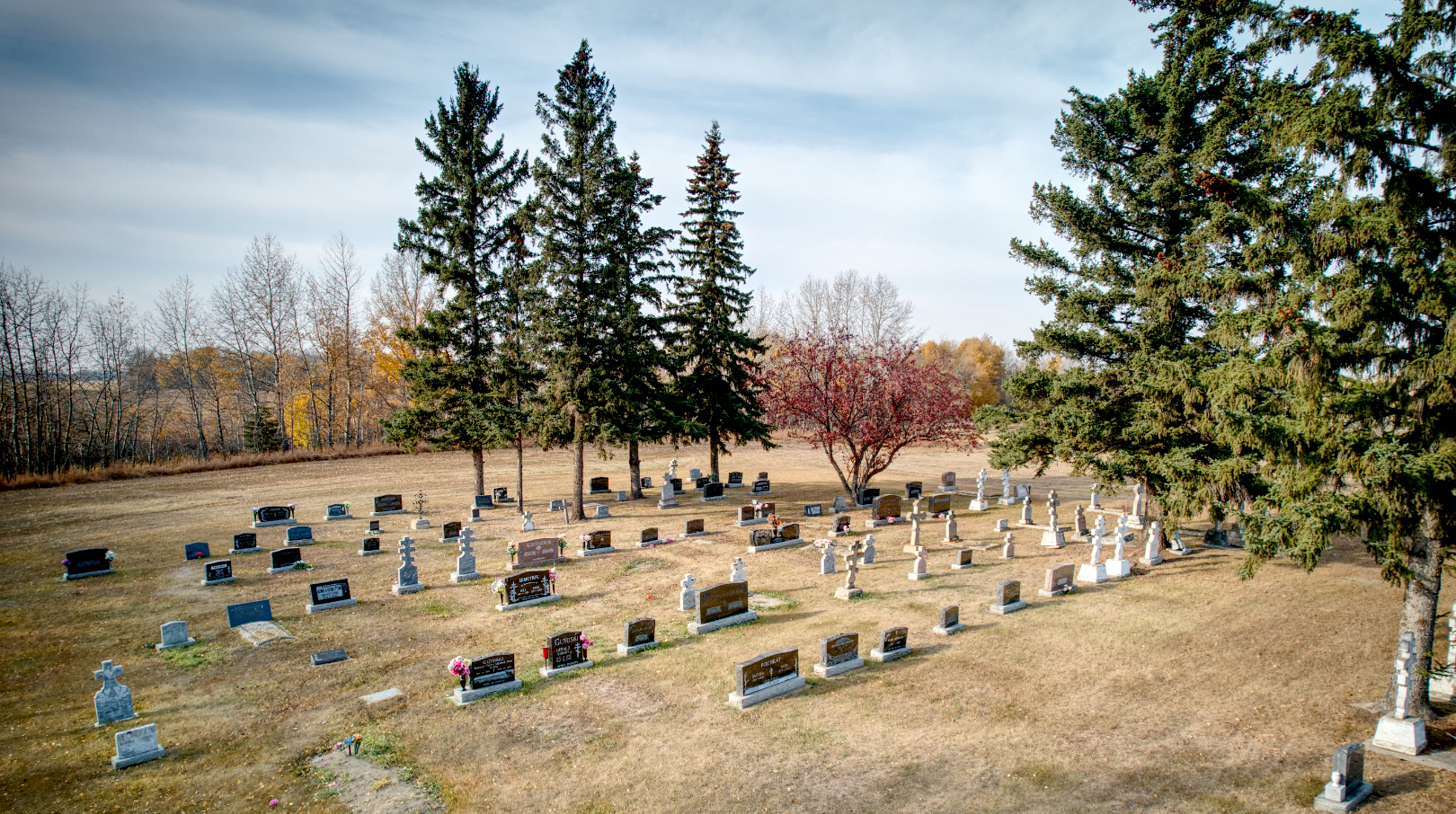
Play Memory Eternal Chant
GPS Co-ordinates: 53.629311, -112.188451
Cemetery Co-ordinates: 53.634326, -112.212720
Affiliation: Ukrainian Orthodox Church of Canada