The history of this church is intertwined with that of St. Michael’s Russo-Greek Orthodox Church, located across the road on the east side of Secondary Highway 855. It is at that church that several “firsts” for the Ukrainian Greek Orthodox Church (“UGOC”) were celebrated. After the inauguration of the Ukrainian Greek Orthodox Church of Canada in 1918, some of the members of the St. Michael’s congregation took it upon themselves to invite the new formation to supply a priest to the Orthodox faithful of the Suchava community. The proponents of Ukrainian Orthodox affiliation were inspired by patriotic sentiment and emboldened by the fact that the Russian Orthodox Mission was unable to provide regular pastoral care to St. Michael’s.
In anticipation of the imminent arrival of the first missionary cleric from the UGOC in the spring of 1920, the initiative group formally organized themselves as the Ukrainian Greek Orthodox Church of St. John of Suchava. This became first organized Ukrainian Greek Orthodox Church in Alberta. One week later, on March 29, 1920, Rev. Dmytro Stratychuk arrived from Saskatoon and officiated at the first Divine Liturgy celebrated by the Ukrainian Greek Orthodox Church in Alberta in St. Michael’s Church. Following the emotionally-charged service attended by a large number of area inhabitants, Rev. Stratychuk visited two other nearby districts and settled into the manse attached to St. Michael’s, which henceforth became the early missionary base of the UGOC in the province.
However, staunch supporters of the Russian Mission were not won over to the new church. In 1924 they successfully pressured the Ukrainian Orthodox followers to vacate St. Michael’s and to instead undertake the construction of a separate church. Four acres of land were subsequently donated for this purpose across the road from St. Michael’s. But financial constraints prevented the UGOC congregation from starting work on their sanctuary until 1934. The present St. John’s Church, an impressive cruciform structure, with a large central dome, two cupolas and two smaller domes over the towers flanking the façade, was completed the following year.
See HERE for more information and a detailed history of this parish.
The Cemetery
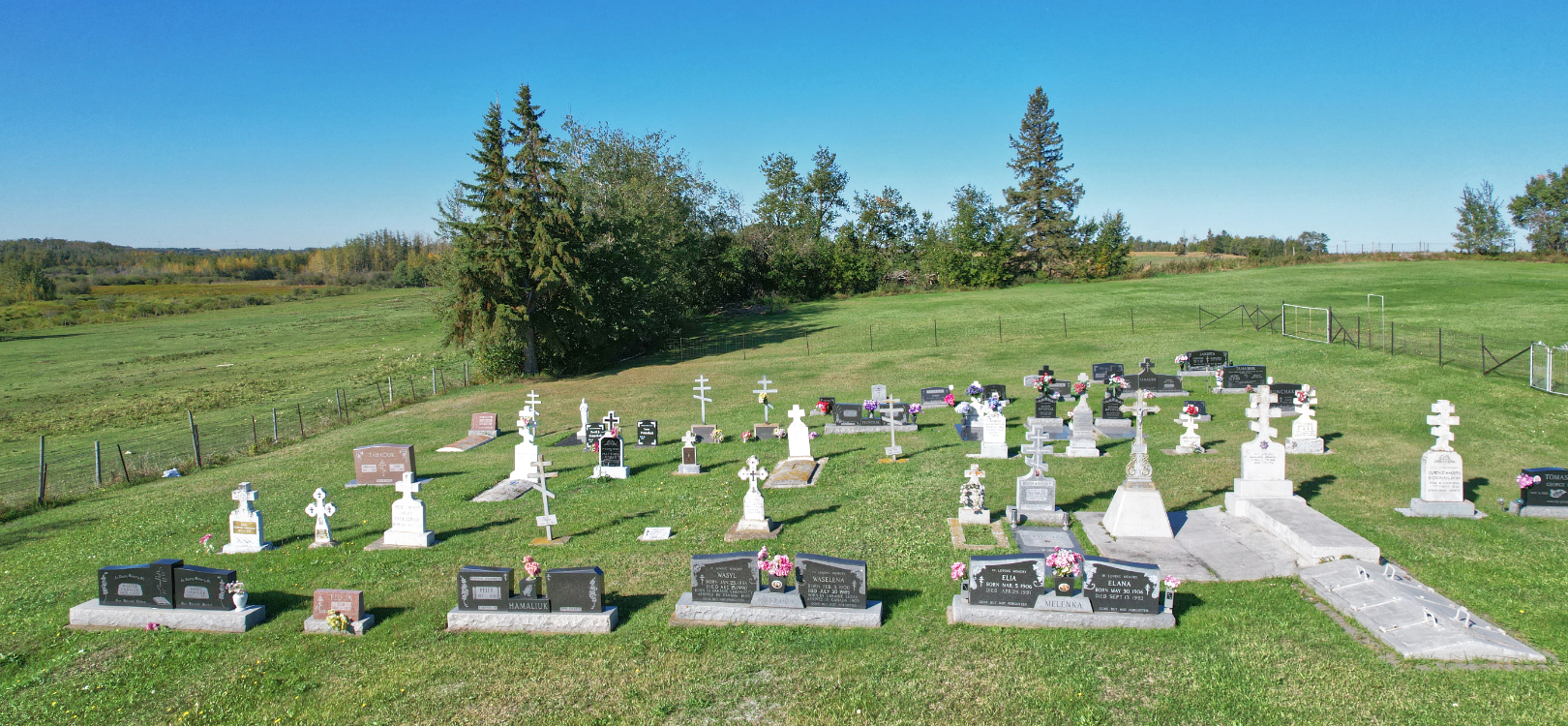
The church cemetery is located in the churchyard, south of the sanctuary, on two acres of land donated in 1925 by the local Free Ukraine Association, affiliated with the Sachava Ukrainian National Home. The first burial was that of Vasyl Bochanesky, 31 January 1928.
Play Memory Eternal Chant
Visit this Cemetery
GPS Co-ordinates: 53.830292, -112.332104
Affiliation: Ukrainian Orthodox Church of Canada


St. John Ukrainian Orthodox Church – Sachava, AB
The first Ukrainian Orthodox liturgy in Redwater was celebrated by Rev. Ivan Kusey in 1923, after which Rev. Dmytro Seneta tended to the spiritual needs of the fledgling community on an irregular basis. The early services took place in the Narodnyi Dim, or occasionally in the home of Mr. Mykhailo Popil, and helped to stimulate the founding of a congregation.
In March 1925 the Ukrainian Orthodox faithful in the community decided to purchase two acres of land from William Skolney for $25, for a church and cemetery. Then, at a meeting held on December 26, 1926, sixteen members of the congregation committed themselves to financing the construction of a place of worship by signing individual promissory notes for $25. Subsequently, John Lemisko dug a basement for the sanctuary, and logs were dragged from the North Saskatchewan River to a sawmill operated by Mr. Serink to be cut into lumber and taken to the church property. There, volunteers working under the supervision of a Polish carpenter, Frank Sega, who was assisted by John Danko from Ukraine, built a modest cruciform structure with a large central dome. Nick Bodnarchuk was responsible for carving the cross that eventually adorned the church. The exterior of the sanctuary was completed in 1927, after which Rev. Seneta officiated at the first service. A propane furnace originally installed to heat the building was later converted to natural gas.
In 1932 the congregation commissioned the cabinetmaker, Philip Pawliuk, to build a two-tiered iconostasis, tetrapod, main altar and tabernacle. Icons for the church were obtained from Volodmyr Zaluski and the renowned church painter, Peter Lipinski. Among the highlights of the church’s artwork are the depictions over the deacon’s doors, one of which features St. George slaying the dragon, the other, an image of the Archangel Michael casting down a devil with the aid of his fiery sword. A beautiful candle chandelier, donated by Mr. and Mrs. Fred Myroon, illuminated the interior of the brightly painted sanctuary.
In 1936, Redwater became part of the Radway Central Parish along with Egremont and Fedorah, and two years later a manse was built in Radway. Holy Trinity was finally formally blessed during a hierarchal visitation by Archbishop Ioan Theodorich in 1944. Another memorable occasion was the first visit by Metropolitan Ilarion on August 23, 1953, which was advertised as commemorating the thirtieth year of the congregation’s history, obviously in reference to Fr. Kusey’s groundbreaking 1923 liturgy in the community.
In the course of its history, the church has been remodeled several times. Pews and rugs were eventually installed, the windows repaired, and a tiled ceiling covered over the interior of dome (obscuring its icons) so as to conserve energy and reduce heating costs. When the candle chandelier was replaced by an electric one, the former was donated to the Redwater Museum.
The congregation acquired a movie theatre for use as a parish hall, but it burned down one January in the late 1960s or early 1970s. The congregation then built a replacement facility at 4719-48 Avenue (in town on the south side of Highway 38), which they named Deric Hall.
Go HERE for more information and history of this parish.
The Cemetery
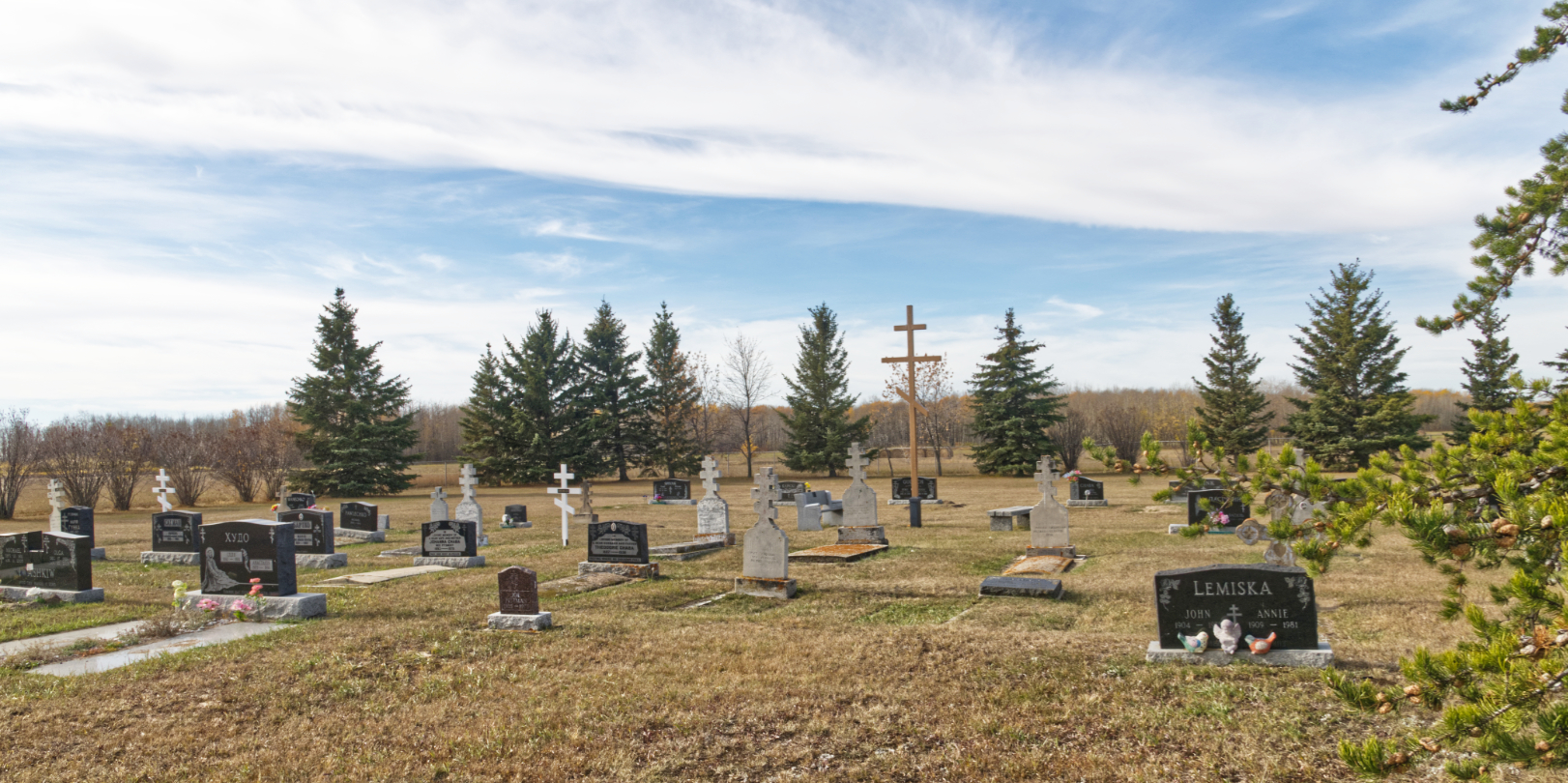
Situated adjacent to the church, the first burial was that of William Sadlak in the fall of 1925. Rev. and Dobrodiika Kulish, as well as their son, Rusticovich, are buried in the graveyard.
Play Memory Eternal Chant
GPS Co-ordinates: 53.946575, -113.100594
Affiliation: Ukrainian Orthodox Church of Canada
Holy Trinity Ukrainian Orthodox Church – Redwater, AB
The first stirrings of religious life in the Radway district began after the establishment of a Ukrainian National Home in 1917, as it provided a focus and forum for discussing community affairs. Catholic, Protestant, Orthodox, and Communist orientations all had their adherents among the Ukrainians who had begun settling in and around Radway from 1907 onward. Early visits by missionary priests with the Redemptorist Order only succeeded in alienating some of the Ukrainian faithful, as the “foreign” clerics often had a poor command of Ukrainian that was heavily accented and hard to understand, and they reminded many immigrants of the Polish clergy in Galicia. The situation was further aggravated after a Polish Catholic priest appeared and celebrated Mass in Latin for the Poles among Radway's inhabitants, in the process insulting the Ukrainians who were in attendance with some tactless remarks during his sermon.
Regardless, pro-Orthodox sentiment was already growing because of the recent establishment of the Ukrainian Greek Orthodox Church of Canada, which at the beginning of 1920 prompted sympathizers of the new formation to get the Radway burial ground named the "Ukrainian Greek Orthodox Cemetery".
The Orthodox cause received its first boost on 19 December 1920, when Reverend Ivan Kusey celebrated a St. Nicholas Day liturgy at the newly built Mazepa school. A large number of area residents attended the service, despite efforts by Father Philip Ruh (a French Oblate priest trained in Galicia for work among Ukrainian Canadians) to prevent it from taking place. Church activities subsequently became more formalized with the organization of a Brotherhood of Orthodox Ukrainians the following year. All of these developments stirred considerable tensions among Radway Ukrainians, since Belgian Redemptorist priests were also attempting to establish a Catholic church in the town. The appearance of a pro-Orthodox faction provoked controversy and heated debate, some of which was conducted on the pages of Ukrains'kyi holos.
Initially services were held at the homes of local supporters, the residence of Andrew Kowal being a frequent site for religious gatherings, including numerous weddings. Later, the Mazepa school was used for ritual observances. Priests would typically arrive by train and stay overnight with a member of the community. Construction of a sanctuary started in 1924, and although it was not yet finished, Archbishop Ioan Theodorovich was able to conduct a service there on September 21 of the same year while on a fall tour of Alberta congregations. (Another article says the service was held at Mazepa school). Theodorovich made a follow-up visitation on October 25, 1925, further inspiring the congregation in its efforts. The completed church was a tripartite structure, with a large central dome on an octagonal base.
In 1937 the congregation had a dozen members and celebrated nine liturgies in their church. In 1938, a manse was constructed for a resident priest, who served the Radway district.
A two-tiered iconostas, painted by Wadym Dobrolige (1913-1973) after his emigration to Canada, was installed in the church sometime in the 1950s or early 1960s.
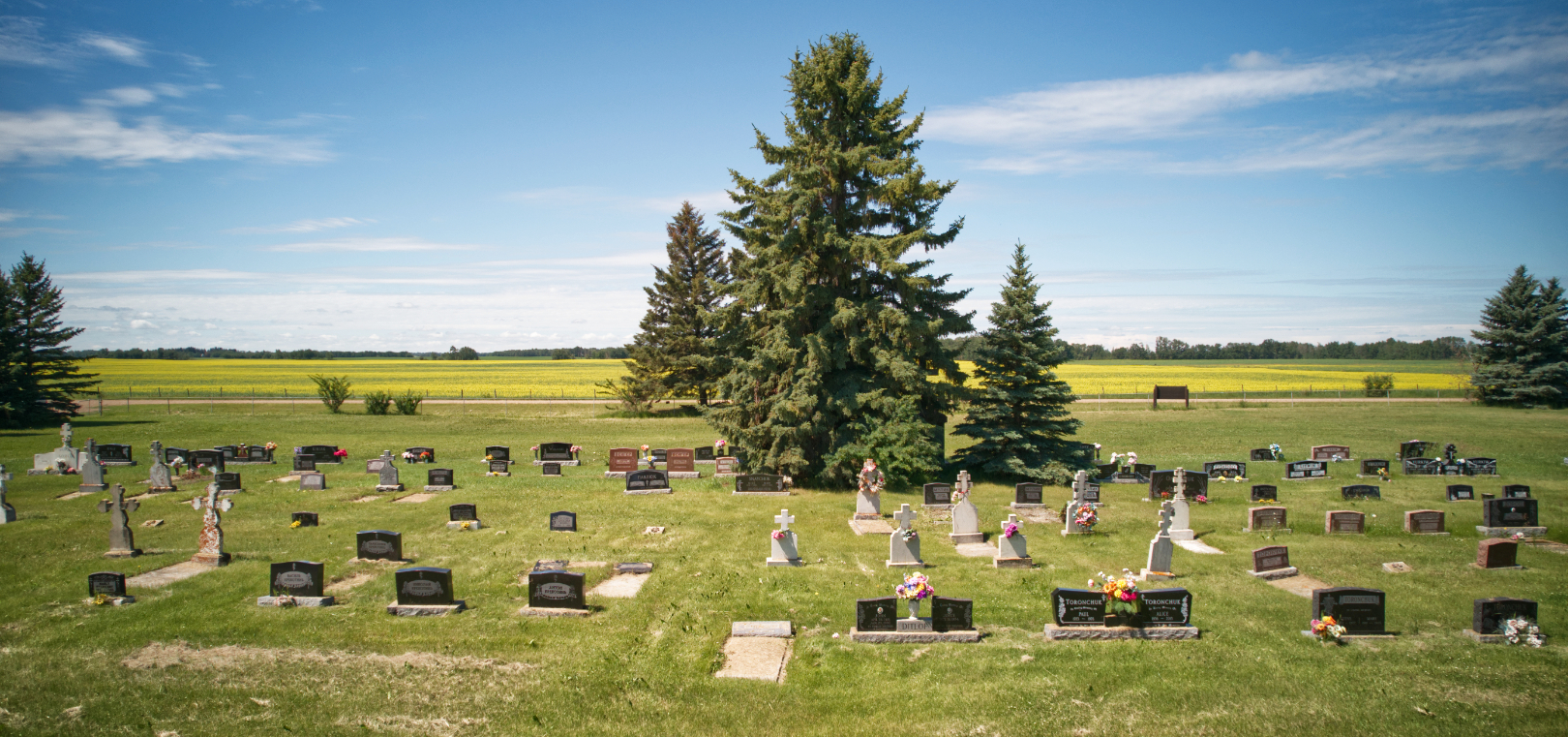
The Cemetery
Situated at NW 29-58-20 W4, ½ mile south of the Village of Radway, it was established in 1927. The first burial was that of Mildred Pysmenny, who died in the spring of 1928.
Play Memory Eternal Chant
GPS Co-ordinates: 54.058674, -112.948718
GPS Cemetery: 54.049941, -112.951009
Affiliation: Ukrainian Orthodox Church of Canada
Holy Ascension Ukrainian Orthodox Church – Radway, AB
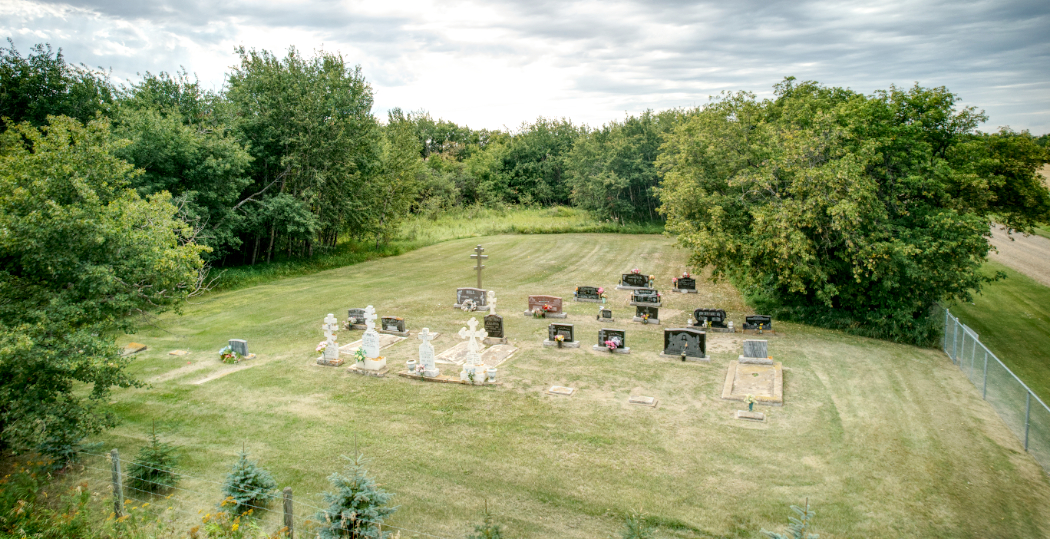
The founders of Holy Ascension Church were the pro-Ukrainian members of St. Dymytria Church when it was still under the jurisdiction of the Russian Orthodox Mission. As far back as 1920, Ukrainophile members of the Luzan Church had invited Father Dmytro Stratychuk to celebrate a liturgy in their sanctuary. However, the majority was opposed to having a priest from the newly organized Ukrainian Greek Orthodox Church, and thus a split developed within the community between the more nationally conscious Bukovynian farmers in the district and those who were influenced by the Russophile ideology promoted by the Russian Orthodox clergy.
On February 12, 1921, Rev. Lazar Gherman and Rev. I. Kusey celebrated a Divine Liturgy at the one-room Pruth schoolhouse after they were prevented from using St. Dymytria Church by pro-Russian Orthodox church members. Afterwards, Fr. Kusey appears to have held occasional services over the years at the homes of sympathizers of the UGOC, which continued to gain strength at the expense of the increasingly beleaguered Russian Orthodox Church. In 1930, Fr. Kusey’s successor in the area, Fr. I. Mayba, celebrated two Divine Liturgies in the Pruth district, indicating that the differences within the St. Dymytria congregation had not dissipated with the passing of time. Finally, these differences could no longer be contained, prompting forty-two inhabitants of the Pruth district—not all of whom were members of St. Dymytria church—to initiate a Ukrainian Orthodox congregation at a meeting held on February 13, 1931 at the Yuri Fedkovych National Home. Known locally as the Pruth Hall, the Narodny Dim was then used for church services until a proper place of worship could be built by the members of the new congregation.
Land for a church kitty-corner from the Pruth Hall was purchased soon after from William Prosteby with money obtained from donations, membership fees and loans. Steve and Mary Samoil, who had begun teaching at Pruth school in 1929 and were very active in the Fedkovych Society (where Steve was President, and Mary directed plays), figured prominently in the fundraising and membership drive. By August 1931 sufficient money had been raised to begin construction in the late summer, with volunteers working under the direction of Ivan Mnoholitny, who served as the head carpenter. Those who donated their labour were able to work off their membership, earning a credit of $1.50 for each day put in at the site. Construction was suspended at the end of November because of cold weather, but it resumed early the following year. Gradually, an impressive cruciform structure rose on the site with a large central dome, two small domes over the narthex and sanctuary, and similar-sized domes over twin towers flanking the façade. The first service was held in the church by Fr. D. Stratychuk in May 1932, while work was still proceeding on the interior. The sanctuary was then completed in June, and Archbishop Ioan Theodorovich consecrated the church at a Divine Liturgy celebrated on Ascension Day. The Second All-Alberta Convention of the Ukrainian Orthodox Church was also held on the same weekend, 6-7 August, drawing some 400 delegates and faithful to the gathering and celebration.
When it was being organized the congregation had just seven member families and eighteen sympathizers, though membership later grew to twenty-seven. In 1936, Rev. I. Hykawy reported that Pruth was one of the few better-off congregations in Depression-era Alberta. By 1940, however, the formal membership had been reduced to just eight families, as rural depopulation and the hardships of the Depression began to take a toll. This probably explains why the church interior was never elaborately decorated, the sanctuary simply being walled off and hung with icons to create an icon screen, and the walls and ceiling of the church being left largely unornamented, though stars for a time covered the ceiling (since painted over). To this day, the church does not have electrical power.
In 1952 the congregation reported that it had five services and six paid up members, whereas the following year it indicated that six services were held despite membership having declined to four. Nevertheless, the faithful persevered, and
In 1982 Pruth Church marked its fiftieth anniversary with a Divine Liturgy celebrated by Reverands S. Semotiuk and J. Puk. A plaque was blessed at the time honouring the founding members, two of whom were present – Mrs. Rachel Skakun and Mrs. William Prosteby. In 1990, the congregation was celebrating eight liturgies each year.

Play Memory Eternal Chant
GPS Co-ordinates: 53.744090, -112.133138
Cemetery GPS: 53.744106, -112.121212
Affiliation: Ukrainian Orthodox Church of Canada