Congregational life was initiated in 1904, when funds began to be collected for the construction of a church. In 1910 George Ponich donated some land for a church and cemetery on the crest of a hill, and logs began to be pulled to the site from the Rannock area, seven miles to the east. In the meantime, occasional services were held at the nearby Luzan school grounds, conducted by priests from the Russian Orthodox Mission. Carpenter Eli Antoniuk was hired to oversee the building project, which he did with the assistance of Demenky Kroytor, and with congregation members providing their labour on a volunteer basis. Work proceeded gradually, and the sanctuary was still only partially complete a year later. Nevertheless, as soon as a roof was put on the structure, a service was held in it, followed by a celebration to commemorate this landmark event.
Because many of the people who settled the area came from the Buvkovynian village of Toporivtsi (now in Novoseletsia raion, Chernivtsi oblast), they referred to their place of worship as the "Toporivtsi" church. However, when the Luzan School District No. 2113 was organized in the vicinity on February 8, 1910, the area became better known as Luzan (in Ukrainian, "Luzhany"), after the village that is today in Kitsman raion, Chernivtsi oblast. St. Elias was adopted as the patron saint of church with its construction, the sanctuary henceforth being identified as the Russo-Greek Orthodox Church of St. Elias, Luzan-Toporivtsi.
For more than a decade, only one or two liturgies were celebrated at the church by Russian Orthodox priests. In 1926, Rev. Ambrose Chrustawka began to hold services there on a more regular basis, becoming the community's pastor for the next nineteen years. During his tenure, the interior woodwork on the church was finished by Elzear Moisin, and in 1939 a Mr. Lysakowski was commissioned to do the painting and the ornamental artwork. Icons were also ordered from Greece to adorn the walls. When Reverend Chrustawka joined the Ukrainian Greek Orthodox Church of Canada in 1945 his flock went with him, and thus from that time on the Luzan-Toporiwtsi church came under the jurisdiction of the Consistory in Winnipeg.
In the 1950s the St. Elias congregation experienced a high point in activity, enjoying monthly liturgies when previously services were being held only annually or a few times a year. To better meet the growing needs of their church community, in the early 1950s the members acquired the old Luzan school (which had been closed in 1948 due to centralization) and converted it to use as a parish hall. Subsequently, various improvements also had to made to the sanctuary, and thus Andrew Galichowski was contracted to re-shingle the roof and replace the stone foundation with concrete. A porch and two small rooms (sacristies) were added to the edifice, which in 1960 had its steeple replaced by two domes installed by a member, Metro Logozar. A balcony [choir loft?] was also constructed by Mr. Logozar, and the women of the church purchased and laid a rug in the altar area. Initially part of the Myrnam parochial district, the church was transferred to the Two Hills parish in 1972.
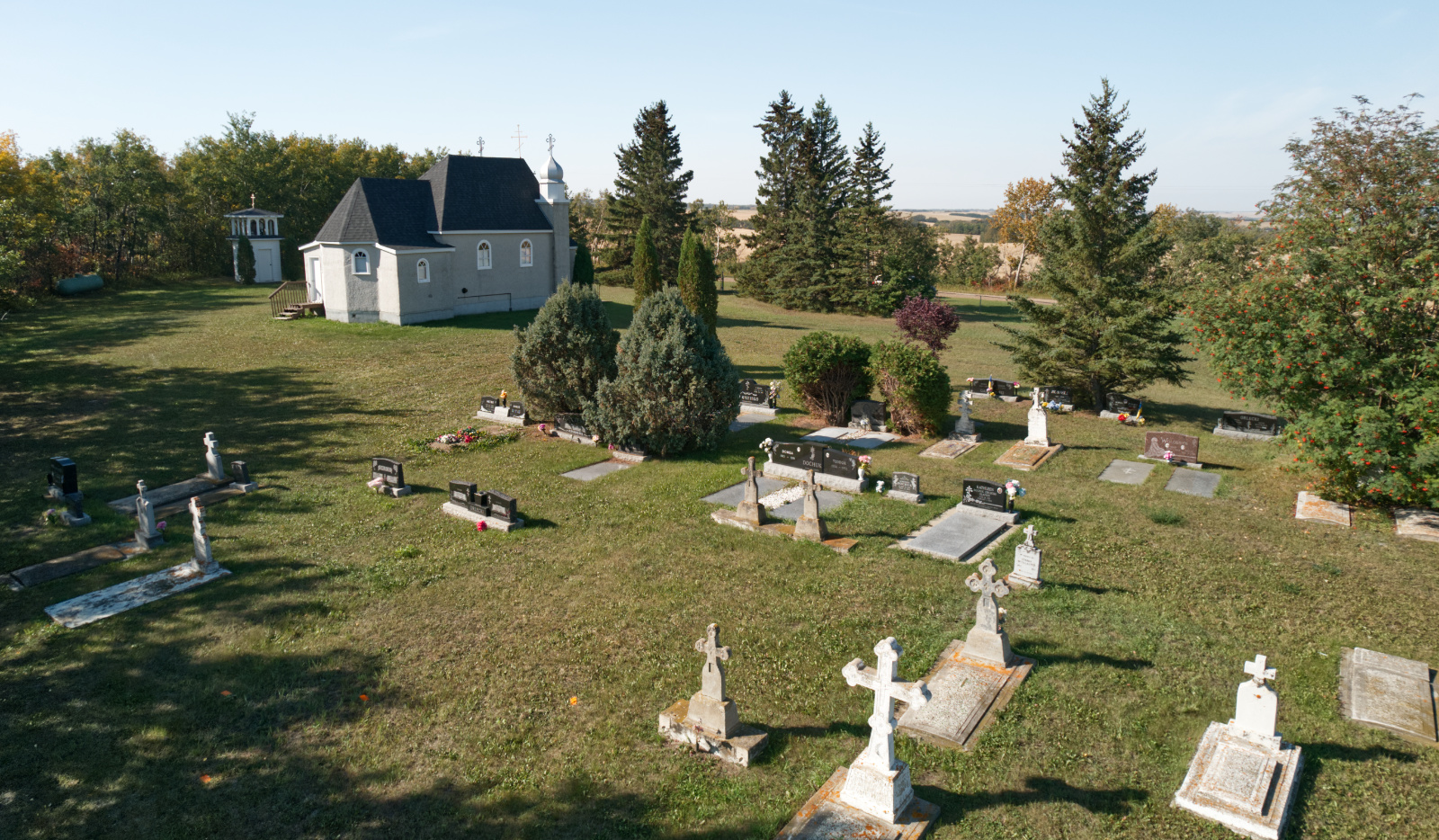
Play Memory Eternal Chant
GPS Co-ordinates: 53.755823, -111.588460
Affiliation: Ukrainian Orthodox Church of Canada


St. Elias Ukrainian Orthodox Church – Luzan, AB
An organizational meeting was held in late 1904, as by December of that year a request had been submitted to the federal government along with a ten-dollar registration fee for a land grant on which to build a church and cemetery. In a letter dated 5 July 1905, the Commissioner of Dominion Lands at the Department of the Interior in Ottawa formally approved the grant, a decision that petitioners Wasyl Makowichuk and Ivan Topechka were notified about on 18 July.
Supporters of the congregation then began raising money and hauling rocks and timber to site where the sanctuary was to be built on a four-acre parcel of land. Work on a log church (24 ft X 32 feet in size) started in earnest in 1906, with congregation members providing the labour. The cruciform structure had a small dome over the sanctuary and was accessed by an entryway on the south side, though this may have been added somewhat. By 1908, when doors and windows were installed and the interior was partially completed, an inaugural service could be held in the new sanctuary with Rev. L. Zubach of the Russian Orthodox Mission officiating.
The congregation applied for provincial incorporation on 7 May 1910, which was approved on 18 May in the name of “The Ruthenian Greek Orthodox Church of Saint Dymytria” at Soda Lake. In 1911-1912 a belfry was constructed of logs, siding was applied to the exterior, and more improvements were made to the interior. In time, the church was painted inside, and an iconostasis installed as time and money became available for the sanctuary's completion. Various Russian Orthodox priests served the community in the early years on an itinerant basis, an arrangement that proved to be increasingly unsatisfactory with some members of St. Dymytria Church.
In 1931 the Ukrainophile faction in the Luzan congregation formally broke away to build their own church, the painful split dividing families and neighbours. The disaffected group subsequently erected their sanctuary one mile west of St. Dymytria, dedicating it to the Feast Day of the Holy Ascension and registering it with the Ukrainian Greek Orthodox Church of Canada. It became known locally as the “New Pruth” Church, to distinguish it from the “Old Pruth” or Luzan church.
In 1960 the congregation reported that it had a membership of 66 families, comprising a total of 211 individuals. Then, tragically, on 5 December 1961, the original St. Dymytria church was destroyed by fire. Quickly rebounding from this disaster, the members set to work building a new sanctuary the following summer [the contractor was apparently Frunchak, from Edmonton], completing a modern three-domed structure with a stucco exterior the following year on the same spot where the old church had stood. This larger edifice was formally consecrated by Archbishop Andrew with Fr. O. Olekshy on the Patron Saint's Day of the parish, 8 November 1970.
In the meantime, in 1966 the congregation had become part of the Willingdon Parochial District and its name was officially changed from the Ruthenian Greek Orthodox Church of St. Dymytria to St. Demetrius Ukrainian Orthodox Church (Luzan).
Over the years various improvements have been made to the sanctuary and church property. The old Pruth School was moved to the site in the mid-1960s to serve as a parish hall, and a new fence and entry gateway have been installed, along with signage for the cemetery, which has also been landscaped. On 26 June 2005 a commemorative cairn and an unmarked graves marker were dedicated in the churchyard by Archbishop John in honour of Alberta’s centennial.
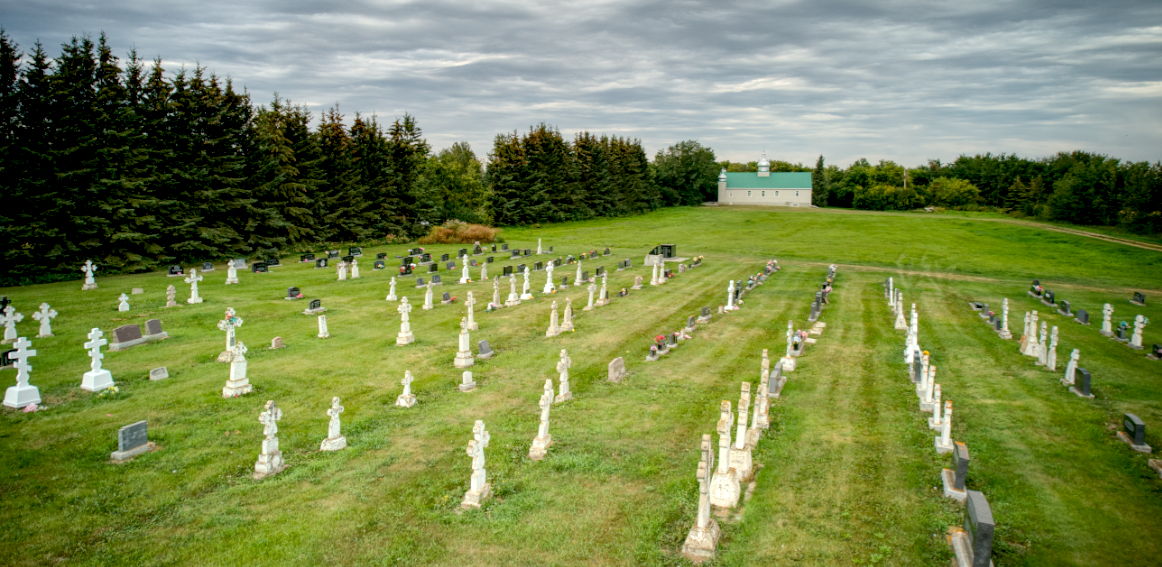

Play Memory Eternal Chant
GPS Co-ordinates: 53.745932, -112.120832
Affiliation: Ukrainian Orthodox Church of Canada
St. Demetrius Ukrainian Orthodox Church – Luzan, AB
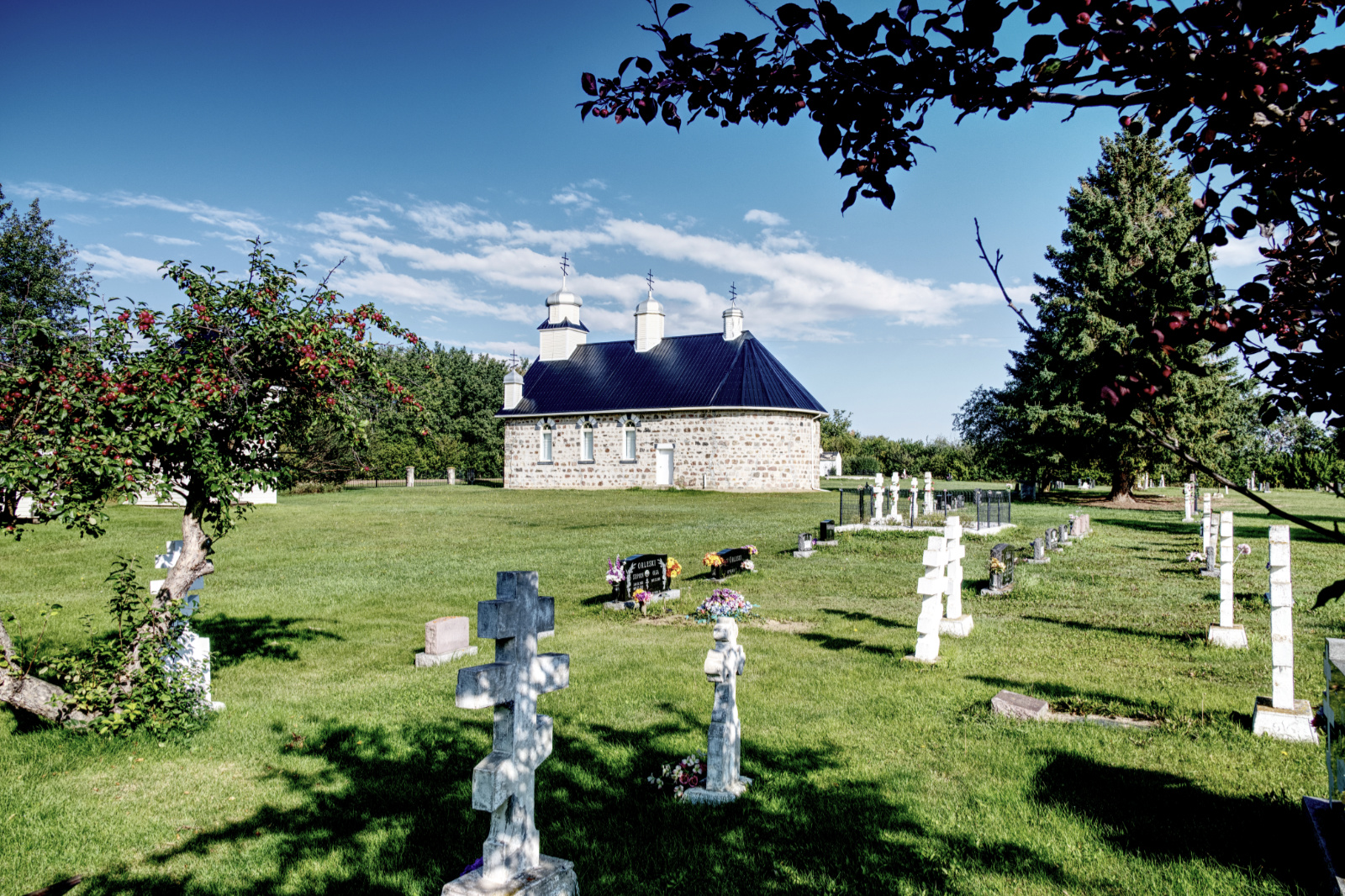
The people of Kaleland have the unique honour of being the first community to organize a specifically Ukrainian Orthodox congregation in Canada. Indeed, the establishment of Saints Peter and Paul Ukrainian Orthodox church in the Two Hills district actually predates the founding of the Ukrainian Orthodox Church of Canada by seventeen months. That is because area residents, at a meeting held on February 19, 1917, unanimously adopted as the name of their new parish "Ukrainian Congregation of the Greek Eastern Orthodox Church." Prior to this time all of the Orthodox churches built in Canada by Ukrainian immigrants had identified themselves as being either "Ruthenian," "Russo," or "Russian" Orthodox. The use of the term "Ukrainian" by the people of the Kaleland district attests to the high degree of national consciousness that had evolved in this rural settlement over the course of the previous years – in some ways paralleling the emergence of the Ukrainian national movement in the political life of Austro-Hungarian and Tsarist Ukraine.
The impetus behind the initiation of the Kaleland congregation was the destruction of the nearby Szypenitz Russo Greek-Orthodox Church by fire in 1916. It was the second time in seven years that the Szypenitz church had gone up in flames under mysterious circumstances, though it is known that growing tensions had emerged between loyal Russian Orthodox and increasingly pro-Ukrainian members of the troubled parish. In the wake of the 1916 fire some parishioners in the latter camp, joined by several patriotically minded Greek Catholics who were disillusioned with their own formation, met to discuss the possibility of organizing a specifically Ukrainian Orthodox Church, with the Ukrainian language being used during worship rather than Church Slavonic.
As a result of these preliminary talks, held in July 1916 at the suggestion of V. Melnychuk, two acres of land for the future church and an adjacent cemetery were generously donated by Nickolai Olynyk and Michael Grekul. Because of the availability of local rocks suitable for construction material, and to ensure that the sanctuary would be less vulnerable to fire, it was decided to build the new church out of fieldstone. That same winter, stones were gathered from the nearby farm of John Orleski. Stonemasons John Shandro and Herbert Lefe started work on the two-foot-thick sanctuary walls in April 1917, after which Nick Hrehirchuk constructed the roof. Harry Osietski, a well-known church builder, put the crowning touches on the edifice by making four domes. On June 20, 1917 the church was registered under the Alberta Societies Act as the Ukrainian Orthodox Church of Saints Peter and Paul, legally enshrining the name. The first service was appropriately held on the patron saints' day the following month (12 July 1917), with Reverend Gregory Soroka of New York officiating at the dedication. The first wedding took place on July 25, 1917, the first funeral and internment in the church cemetery occurring in the spring of 1918 with the death of Ivan Lakusta.
In 1920 Kaleland became the third church in Alberta to hold a service officiated by Rev. D. Stratychuk of the newly established Ukrainian Greek Orthodox Church of Canada. It was thus one of the founding congregations of the Ukrainian Orthodox Church in Alberta. During the mid-1920s, Kaleland was blessed with the full-time services of Father Ivan Kusey, who for several years used the district as the base for his successful missionary endeavours in the region.
On August 19, 1940, Kaleland hosted a visit by Metropolitan Ioan Theodorovich of New York. At this time, the congregation was comprised of twelve members, and was reported to be wavering in its loyalty to the UGOC, probably due to popularity of Fr. Ambrose Chrustawka, the priest at nearby Szypenitz. During his tenure, Fr. Stratychuk had informed the Consistory that the local Narodnyi Dim was dominated by adherents of the ROC, loyal to Fr. Chrustawka. Nevertheless, the issue was resolved a short while later when Fr. Chrustawka joined the UGOC in the fall of 1941.
In 1956 a lightning strike knocked the dome off the church.
In 1960, Kaleland came under the jurisdiction of the Two Hills Parish. In 1965 a new iconostasis was built by Mike J. Chrapko, and painted by Wadym Dobrolige, then blessed on the congregation's feast day by Archbishop Andrew. In 1982 the church was renovated by Zupet Construction of Edmonton. In 1988, to mark the millennium of Ukraine's acceptance of Christianity, parishioner Olga Oreleski painted full-sized portraits of Sts. Volodymyr and Olha, which were hung behind the altar.
Go HERE for more information and history of this parish.
Play Memory Eternal Chant
GPS Co-ordinates: 53.751410, -111.885429
Affiliation: Ukrainian Orthodox Church of Canada
Sts. Peter and Paul Ukrainian Orthodox Church – Kaleland, AB
T
he origins of the Holy Trinity Ukrainian Orthodox congregation can be traced back to a conflict that arose in the second half of the 1920s within the Russian Greek Orthodox Church of Holy Trinity at nearby Sunland. The latter had been established in 1912, when ten acres of land were purchased for a church and cemetery at NW 1-58-16 W4. Among those who worked on the construction of Holy Trinity Russian Orthodox church was Ivan (John) Mnoholitny. He was a local farmer and skilled carpenter who in 1920 was commissioned to build a hall and bell-tower for the sum of $350, and in 1922 was elected as the congregation's secretary.
However, in 1927-1928, a significant number of Sunland adherents decided that they wanted to join the Ukrainian Greek Orthodox Church of Canada. The UGOC was increasingly successful in attracting nationally conscious Orthodox believers who were feeling uncomfortable about being part of a pro-Russian formation. This move divided the Bukovynian and Galician farmers who had homesteaded the area north of Andrew in the early years of the century. Tthe dissension eventually precipitated legal action over the ownership and affiliation of the Sunland church. When the court eventually ruled in favour of those still loyal to Russian Orthodoxy, the pro-Ukrainian group responded by forming in 1929 a Brotherhood comprised of the more nationally aware farmers in the Kahwin district. It appears that the majority of the Holy Trinity congregation sided with the break-away group, as membership in the Sunland church is reported to have fallen to eighteen by 1928, compared to eighty-seven in 1920.
The first goal of the Ukrainian Brotherhood was to erect a place of worship; until that was accomplished, services took place in the homes of area residents and in rented community halls. Then, in 1931 several acres of land were purchased for a cemetery and church just one and a half miles southwest of Holy Trinity at Sunland. Interestingly, the graveyard had been previously established by the Presbyterian-backed Independent Church, which in the teens had an active congregation in the Kahwin district. There was also an Independent grouping in nearby Sniatyn, while the pastor was based in the village of Andrew.
At the time of the original land acquisition, the Holy Trinity Ukrainian Orthodox congregation consisted of twenty paid family members, numbering a total of ninety-eight individuals. One of the founders of the church was the twenty-year-old Ivan (John) Decore. Decore in 1949 and 1953 was elected as a Liberal to federal parliament for Vegreville constituency, and from 1965 to 1979 served as the Chief Judge of the District Court of Northern Alberta. (Justice Decore was also the father of the late Edmonton mayor and provincial Liberal leader, Laurence Decore). Construction of the Holy Trinity Ukrainian Orthodox Church began on 7 June 1932 under the direction of John (Ivan) Mnoholitny. It proceeded so quickly that the exterior was completed by 26 July of the same year. On 21 August 1932 [another source says September] Archbishop Ioan Theodorovich blessed the new church during a visitation that he made to the community.
Tragically, this structure was destroyed the following year by a mysterious fire, necessitating that the fledgling parish start all over again. Undaunted by the setback, members began work on a new place of worship on 21 July 1934, with Ivan Mnoholitney once more overseeing the endeavour. The second Holy Trinity church was a cruciform structure topped by a central dome, with two cupolas on towers that flanked the facade. Its original exterior walls were covered with clapboard. Mnoholitny, who was responsible for building some nineteen churches, was apparently buried after his death in 1962 in Evergreen Cemetery. In 1938 a church choir was established on the initiative of N. Melnyk, who served as its conductor for many years. The choir often sang at services in neighbouring churches, including Andrew, Sachava, and Zawale.
In 1947 and 1948 the Kahwin congregation had eleven registered family members, and reported celebrating five liturgies in the course of the second of these years. In a letter to the Consistory in April 1950, the church secretary complained that not only had no services taken place at Holy Trinity during the Lenten period, but the priest had failed to show up to perform the ritual blessing of the Easter baskets at midnight as promised. Consequently, some parishioners had gone to have their baskets sprinkled by a Russian Orthodox batiushka, while others simply ate their Easter meal without having it properly sanctified. The secretary further expressed concern that the Jehovah's Witness movement and an unspecified "holy roller" sect was starting to make inroads into the local community.
Notwithstanding these problems, in 1951 membership in the congregation grew to fourteen, and it increased by another two families the following year, when a total of eleven services were hosted at Holy Trinity. In 1955, seven liturgies and three feast day commemorations were held in the sanctuary, which by then counted twenty-two paid members and approximately fifteen sympathizers. An article submitted to Winnipeg for publication in the mid-1950s claimed that there were roughly seventy Orthodox families in the vicinity of the Kahwin sanctuary. There was obviously still potential for additional growth, even though the general rural population was gradually declining.
As the 1950s drew to a close the church was hosting eight to ten services annually, and its membership remained constant at nineteen. Unfortunately, a shortage of priests meant that Kahwin (like other small congregations) was only able to arrange for religious services on an occasional basis, and not always at the times preferred by parishioners. Thus, when the Willingdon-based priest was unable to celebrate the annual feast day with the community in 1960, a letter of concern was sent to the Consistory noting that some members were so offended that they had started engaging the Russian cleric who served at Sunland for weddings and baptisms. The hurt feelings quickly dissipated, however, when a new pastor, Ihumen Alexander Shcherban, was assigned to the congregation.
Under Father Shcherban's care, the congregation enjoyed several harmonious and productive years. In 1965 the congregation legally incorporated itself, further consolidating its existence. Nonetheless, the passage of time inevitably sapped the vitality of the congregation, which like other rural parishes was confronted with a slowly shrinking and aging membership. This situation was further exacerbated by the sporadic services which the dwindling congregation received from the overextended priests assigned to look after the Holy Trinity faithful. Although in 1981 the church still reported having a total of thirty individual members, only a half-dozen of these were said to be active. By 1994, just six families remained, and it was becoming increasingly difficult to carry on because all of the members were in their seventies and eighties. Like so many other churches in the Alberta countryside, Holy Trinity seems to have almost no chance of long-term survival.
Over the course of its history, Holy Trinity at Kahwin was renovated several times: during Andrew Andriuk's leadership of the congregation, a basement was dug under the church, the exterior siding was stuccoed, and new asphalt shingles were put on the roof. At some point a storm porch was also added, further refining the appearance of the church. In 1960 the interior was thoroughly remodeled, and a new ikonostasis, made by William Sawchuk of Edmonton, was installed. The outside of the church was also painted at this time, and the roof was reshingled. On 20 August 1972, Archibishop Andrew helped to celebrate the fortieth anniversary of the Kahwin Church.
See HERE for more information and a detailed history of this parish.
Cemetery
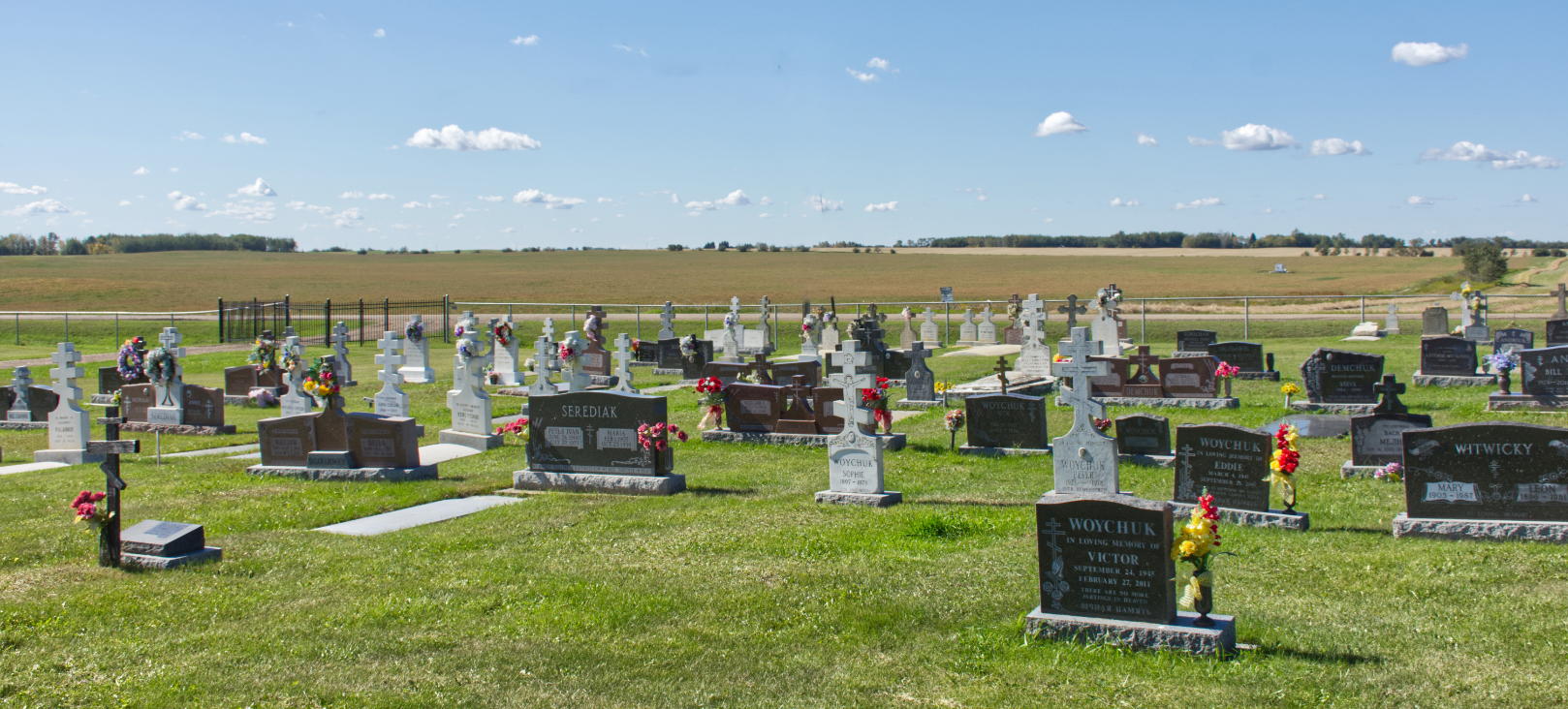
The cemetery is located on the same parcel of land as the church. The first burials date as far back as 1910. Among the early interments were the resting-places of two children in a family that later moved to Edmonton and joined the pro-Communist wing of the Ukrainian community. The graves of these two children were to become a source of considerable controversy when in 1947 family members decided to erect monuments on them that were not deemed to be of a Christian character. The members of Holy Trinity Church opposed the installation of secular markers on consecrated ground, insisting that graves had to be marked with crosses. Unsure if they could forbid the placing of the markers, the church executive wrote to Winnipeg for guidance in the matter. The Consistory cautiously advised the congregation to seek legal advice as to whether or not they had the right to prohibit the erection of the "Communist" memorials, which the patriotically-Ukrainian parishioners viewed as politically offensive. It is not known how this conflict was ultimately resolved.
Play Memory Eternal Chant
Visit this Cemetery
GPS Co-ordinates: 53.983992, -112.281533
Affiliation: Ukrainian Orthodox Church of Canada