TOrthodox congregation was first organized by Bukovynian settlers in Smoky Lake as far back as 1903. The priests were with the Russian Orthodox Mission, not all of whom were highly regarded by the more nationally conscious members of the burgeoning Ukrainian community.
Writing to Ukrains’kyi holos in February 1922, local photographer and businessman, Nicholas Gavinchuk, reported that farmers in the area were becoming increasingly prosperous. They were also showing greater interest in Ukrainian affairs thanks to the work of the Narodnyi Dim, or National Home. He also noted the following about Rev. Ivan Chrustawka, who had been recently assigned to Holy Trinity Russo-Orthodox Church and served as its pastor from 1921 to 1926: “The newly arrived priest, Fr. I. Chrustawka, is also helping a great deal with national work; this is not the kind of priest like the previous ones, who spread katsapism and hooliganism: he is working sincerely for the Ukrainian people.” Notwithstanding this sympathetic portrayal of Fr. Chrustawka’s efforts, the fact that he served with the Russian Orthodox Church ultimately made him unacceptable to those community leaders. They were increasingly determined to establish a Smoky Lake congregation affiliated with the newly created Ukrainian Greek Orthodox Church of Canada. With the growth of national awareness and pride that accompanied Ukraine’s short-lived independence in 1918-1920, influential Smoky Lake Ukrainians like Gavinchuk were committed to building local support for a distinctly Ukrainian Church in Canada.
Thus, in 1924 Rev. Ivan Kusey was invited to celebrate the first Orthodox liturgy in the Ukrainian language at the home of Joseph Danylevych. The historic visit brought about the formation of the nucleus of a congregation on 9 June 1924, the initiatory group henceforth working to recruit new members to the fledgling ranks of Ukrainian Orthodox adherents. Father Kusey subsequently returned to the district in the spring of 1925 to commemorate Palm Sunday (on 21 April), giving further encouragement to those working to establish a Ukrainian Orthodox congregation.
Later that year Rev. Dmytro Seneta settled in the town of Smoky Lake, and began to provide regular services for the Smoky Lake faithful. Initially meeting at the homes of supporters, the congregation eventually used the T. Shevchenko Narodnyi Dim for services until they had built a church for their own purposes. Besides attending to his religious duties and organizing a church choir, Father Seneta also helped to establish a Ukrainian school, a children's orchestra, and an adult secular choir, thereby making an important contribution to the development of Ukrainian cultural life in Smoky Lake.
On 18 October 1925 Archbishop Ioan Theodorovich made a visitation to Smoky Lake, inspiring parishioners in their efforts. The following year the congregation's existence was formalized, at which point it already claimed 32 members. N. Woycenko became the first head of the newly constituted executive, with N. Gavinchuk serving as the secretary, and I. Kinasevich as the treasurer. At the time, the congregation was making use of the Smoky Lake School for services. But problems arose with this arrangement in the fall of 1927 after several Bolshevik sympathizers were elected as trustees and passed a motion prohibiting the use of the school for worship. Consequently, no liturgies were celebrated in Smoky Lake in the winter of 1927-1928.
Undaunted by this setback, in the spring of 1928 members of the congregation resolved to build a church, with William Czumer being appointed to lead the construction committee. Work on the sanctuary proceeded quickly over the summer months, with N. Woycenko overseeing the project assisted by a crew of volunteers, among whom S. Tkach and M. Romaniuk were designated as the head carpenters. The impressive structure, which then became one of the largest Ukrainian Orthodox churches in Western Canada, was completed in the fall, and on 25 November the first liturgy was sung in the new church by Rev. T. Horbay. The following spring, Fr. Horbay, who had been living in the Hamlin district, relocated his family to Smoky Lake, and the town henceforth became the base from which Ukrainian Orthodox priests served congregations in outlying rural districts.
In a letter written 23 May 1936 to the Consistory, N. Gavinchuk requested information about where large-sized icons printed on paper might be found.
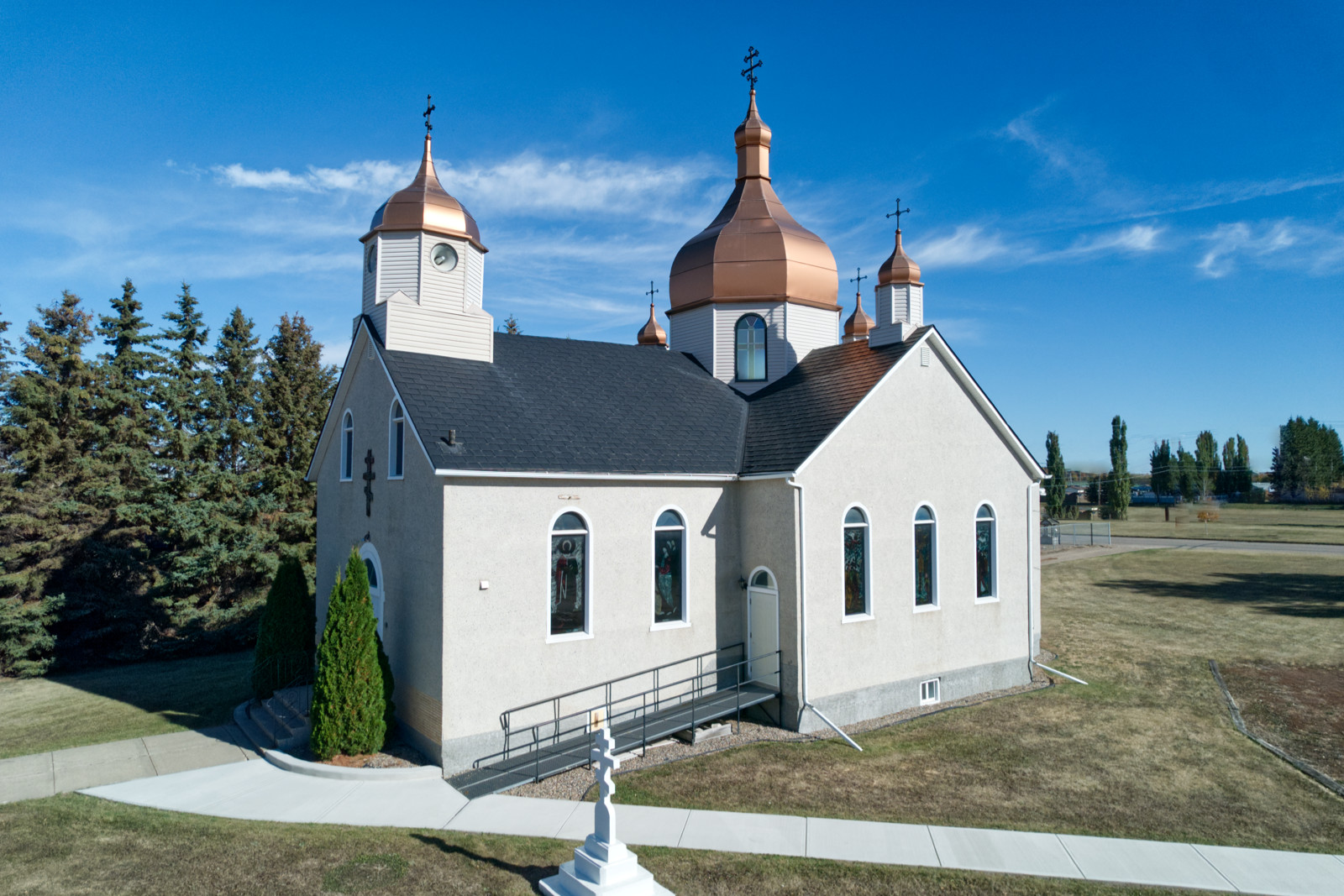
During his tenure as the parish priest, the artistically inclined Father Lorne Kubin was responsible for beautifying the interior of the church with decorative rozpys and stained-glass windows of his own making. The inside of the church is painted in mauve, and boasts an impressive three-tiered iconostasis [apparently also painted by Fr. Lorne]. In 1994 the domes of the church were re-sheathed with copper.
Play Memory Eternal Chant
Visit this Cemetery
GPS Co-ordinates: 54.111020, -112.475374
Cemetery GPS: 54.093943, -112.479304
Affiliation: Ukrainian Orthodox Church of Canada


Holy Ascension Ukrainian Orthodox Church – Smoky Lake, AB

Initiated in 1914, a church was built the same year on land donated by Nick Taschuk and Dmetro Sherstanko. The sanctuary was constructed of logs supplied by members, with Peter Hnatiuk serving as the main carpenter. The building was made of logs on a stone foundation, and covered with a cedar shingled, dome-less roof. One of the logs (which was already squared) was scavenged from the nearby North Saskatchewan River, and dragged to construction site with oxen. The exterior was subsequently covered by wood siding and painted; the interior walls and ceiling were made of v-joint planks and also painted.
Named Holy Trinity Russo Greek Orthodox Church, the Mamesti congregation was served on an occasional and irregular basis by various priests with the Russian Orthodox mission. In the meantime, the parish purchased a bronze bell and hung it outside on a wooden trestle. A few years later, Ignaty Logozar built a bell tower out of logs southwest of the church, and the bell was placed in it.
At a meeting held on 14 January 1942, chaired by John Pundick, parishioners elected to join the Ukrainian Greek Orthodox Church of Canada. Rev. Ambrose Chrustawka then celebrated the first liturgy sung in the Ukrainian language, the congregation subsequently becoming integrated into the lay structures of the Ukrainian Orthodox community.
According to a report by Rev. I. Shwetz, the Brosseau congregation in 1951 consisted of eight members, and was celebrating four liturgies a year. In 1953 church was remodeled, with Walter Gulka of St. Paul serving as the head carpenter and members once again donating material and labour. At this time a new foundation was built, and the church was moved onto it. A porch, altar, and domes were then added to the original structure, while inside, the old ceiling was removed to make way for a dome ceiling. The following year, an iconostasis was installed, featuring altar doors that were hand-carved and donated by Metro Draginda of Hairy Hill. In 1954 the congregation also purchased the old Mamestie school, which had been constructed circa 1910. Closed due to centralization, the school was moved to a site one half mile east of the church at NW 33-11-4 W4, where it was renovated and adapted for use as a parish hall.
Over the years, members of Brosseau church continued to make improvements on both their sanctuary and their parish hall. In 1959, Nickola Karpiuk of Two Hills donated an altar table to the church that he had personally carved by hand. In 1983 the bell tower was replaced by a new one (although the original bell was re-used), and the church roof was covered with fresh shingles. Three years later, the heating system was changed to natural gas. In 1987 new windows were put in, and in 1992 the yard was enclosed with an iron fence. That same year, new icons painted by Brother Simion were obtained for the iconostasis from the Holy Protection Orthodox Monastery in Kansas City.
Meanwhile, in 1971-72 the old porch was removed from the parish hall and a kitchen was added. Electric power was hooked up in 1975, the roof re-shingled in 1980, and a decade later the facility was hooked up with natural gas.
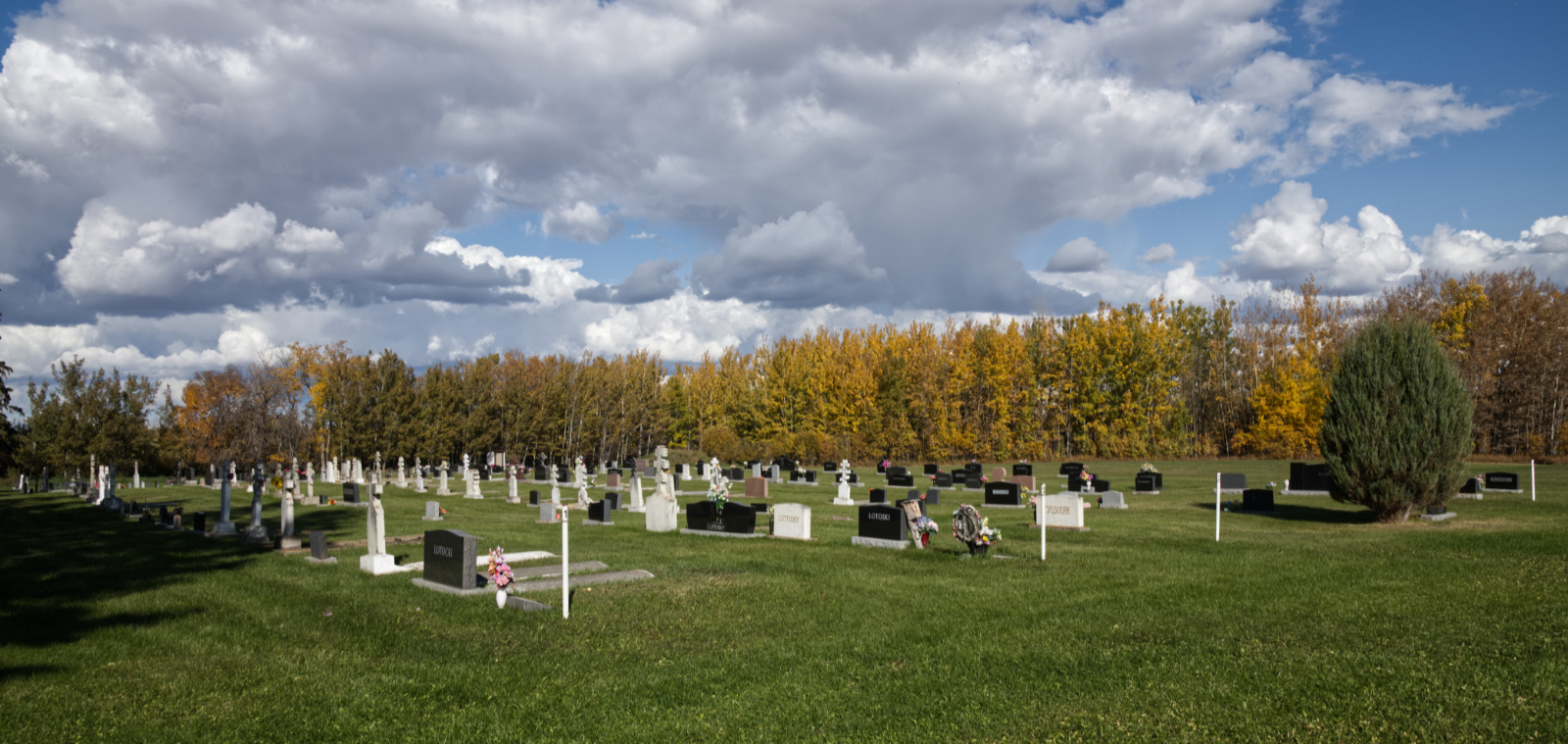
There is a cenotaph at the west entrance to the churchyard. The cemetery is located east of the sanctuary on church property. The first burial was that of Wasyl Oneschuk (d. 16 March 1916).

Play Memory Eternal Chant
Visit this Cemetery
GPS Co-ordinates: 53.802134, -111.602545
Cemetery GPS: 53.80195, -111.60131
Affiliation: Ukrainian Orthodox Church of Canada
Holy Trinity Ukrainian Orthodox Church – Brosseau, AB
The first Ukrainian Orthodox Liturgy was celebrated in Boyle by Fr. M. Fyk at St. Paul’s Anglican Church in 1940. Afterwards, there was a meal followed by a meeting, where twelve families paid memberships to initiate the process of establishing a congregation under the Ukrainian Greek Orthodox Church of Canada. Records indicate that on 5 August 1942, five-dollar fees were collected from six members, and that another service was held at St. Paul’s on 11 October of the same year.
The next documented liturgy in Boyle was officiated by Fr. H. Wasyliw, taking place at the Anglican Church on 4 March 1945. The stronger than expected turnout was an encouraging sign for the executive, which had remained unchanged from 1940. According to minutes from the special meeting following the service, annual dues were collected from nine members. Carl Shevoley was asked to talk to parishioners at the Holy Resurrection Russian Orthodox Church, four miles north of Boyle, about joining together to create a single church for the community.
Organized in 1934–1935 by Ukrainian settlers from Volhynia, the congregation had built a modest place of worship by 1936, but its membership had started to decline during the 1940s. However, the overture was apparently rebuffed. The fortunes of the Holy Resurrection church revived somewhat after the war, though some of its adherents eventually joined the Ukrainian Greek Orthodox Church of Canada. Regardless, three more UGOC services were held in Boyle in the course of 1945.
At a meeting held on 8 July of that year the fledgling congregation resolved to acquire Lots 18, 19 and 20 on Block 7 for a church and parish hall. It was around this time that the new parish was officially admitted into the UGOC and received Certificate of Incorporation from the Province of Alberta, thereby formalizing its existence for legal purposes. At the annual meeting after the Divine Liturgy on 30 December, a motion was passed to adopt the Transfiguration of as the Feast Day of the congregation, celebrated on 19 August.
Early in the New Year, a decision was made to revise the name on the ownership of Lot 20, the site chosen for the hall, from the Ukrainian Club of Boyle to the Ukrainian Association—Taras Shevchenko. At another gathering two weeks later, a discussion was held as to whether to use the funds that had already been collected for either a hall or church. It was decided to proceed immediately with the construction of a church. $255 worth of lumber was then purchased in 1946. That summer the two lots were cleared and broken for a cost of $207.50.
A request to harvest some timber from crown land was also submitted to the Government of Alberta. The request was rejected as the quarter section cited had been designated School Land where cutting allowances were not permitted. A foundation was eventually poured after the ground thawed in the spring of 1948. Work on the sanctuary began in earnest under the direction of a building committee. It was noted in the November 1948 minutes that each member was asked to donate six days’ labour to the project. John Humeny made the cross on the dome. Fred Yaremko made the windows. Even Fr. Wasyl Melnychuk helped out, assisting the members in laying the floor.
At a meeting on 27 March 1949. a motion was passed to change the name of the church from that of the Transfiguration to the Holy Trinity. A decision was also made to finish the exterior of the structure, that was surmounted by a single dome over the narthex. On the Feast of the Pentecost (Trinity Sunday), 12 June 1949, the first Divine Liturgy was celebrated in the partially finished sanctuary. The occasion was made even more joyous as it was followed by the wedding of Joe Radmanovich and Joan Douglas.
That fall, after consultations with their sister congregation in Sarrail, the congregation rented a house in town from S. Nakonechny to provide a temporary accommodation for Fr. W. Melnychuk. Then, at a parish district meeting held in Grassland on 19 February 1950, it was resolved to build a proper manse on the Holy Trinity property in Boyle.
However, at the very same time discussion began about the possibility of locating the parish manse in Lac La Biche instead of Boyle. The issue was subsequently resolved at a district meeting held in Lac La Biche one year later, on 31 August 1952. There, the newly appointed priest, Fr. Peter Zubrytsky, indicated that his feeling was that Lac La Biche was best situated to serve as the base for the parish priest. The fact that water and sewer services were unavailable in Boyle at the time was another factor taken into consideration. A motion was passed to build the parish manse in Lac La Biche.
To mark the fiftieth anniversary of the founding of the UGOC, a celebration was held in Boyle on 28 July 1968 with the participation of Archbishop Andrew and visiting priests Reverends Y. Turzansky (Smoky Lake) and A. Chomiak (Edmonton). The Hierarchical Divine Liturgy drew so many worshippers from communities throughout the Lac La Biche district that the church was unable to accommodate everyone. Many people had to listen to the service outside on loudspeakers, but fortunately it was beautiful day, making for a memorable experience.
The service featured the singing of a well-rehearsed choir from Richmond Park under the direction of Fedir Khrusch, who also performed at a concert presented at the anniversary lunch held in a community hall. In addition to speeches by Dr. Steve Yaremchuk and Kost Telechko of Edmonton, and a keynote address by Archbishop Andrew (who gave part of his talk in English), the program also included recitations of poetry and a performance by a dance group led by teacher Eugene Harasymiw of Lac La Biche.
Of course, throughout the history of Holy Trinity, members have donated all of the accessories and furnishings that are customary in an Orthodox church, including icons and banners, candle holders and votive stands. Thus, the plashchantysia, or burial shroud, was purchased by money collected at the funeral of John Humeny. Alice Hutzal donated the chandelier, Jack Swityk, the censer, Jacob Poleshchuk, the church banners, and Peter and Anne Nikipelo the processional cross, candle holders and cross on the service table. It is thanks to generosity of members and supporters of the church over the years, that Holy Trinity continues to be a beacon of Orthodox faith and a testament to the vision and dedication of its founders.
Visit this Cemetery
GPS Co-ordinates: 54.588347, -112.804970
Cemetery GPS: 54.58745, -112.86575
Affiliation: Ukrainian Orthodox Church of Canada
Holy Spirit Ukrainian Orthodox Church – Boyle, AB
The area north of Boyle was settled by Ukrainians in the late 1920s. Among them were supporters of the Ukrainian Greek Orthodox Church of Canada. Rev. Petro Sametz, one of the founding “Fathers” of the UGOC, was the first priest invited to celebrate Divine Liturgy at Grassland on 4 December 1936. The next liturgy took place on 24 January the following year, with Fr. I. Hykawy officiating. Fr. D. Kisiliuk held the third service in the community on 6 July 1937, but subsequently no detailed information is available on UGOC missionary activity in the area for the next fourteen years.
During this time, however, records indicate that Fathers H. Wasyliw, M Fyk and W. Melnychuk all provided pastoral care to the Grassland faithful, undoubtedly administering the sacraments and celebrating occasional liturgies. In 1951 Fr. H. Wasyliw held a service in the community on Holy Transfiguration Sunday. A long-time activist and future president of the parish, Fred Yakowchuk, first began urging local supporters to consider building a church.
On 19 August 1952, an especially memorable event took place when Metropolitan Ilarion officiated at a Hierarchical liturgy at Grassland’s Anglican Church. It was followed by a dinner and program at a local hall. A Divine Liturgy was again celebrated on the Feast Day of the Transfiguration in 1952. Fr. P. Zubrytsky provided 8 services to the community in 1954. Other documented Divine Liturgies in Grassland took place on Sunday 23 September 1956 (with Fr. A. Teterenko officiating), 21 September 1957 (sung by Fr. Kryshtanowych), and 13 April 1958 (Fr. M. Chomenko). During this period the loosely organized congregation—which belonged to the Lac La Biche parish district—would gather for services at private homes, the Green Pine School and Spruce Valley Hall, or at the Anglican Church, if it was available.
Finally, thanks to the encouragement of Fr. Stetzenko, a founding meeting was held on Wednesday 12 November 1958. A formally elected executive was charged with the responsibility of initiating construction of a church. At this gathering, when the congregation had just $95.03 in its bank account, it was decided to write educational authorities requesting permission to build a sanctuary on the property west of the Grassland school. Then, at the annual meeting on 18 January 1959, building and financial committees were struck and the process of erecting a church began to move forward in earnest. On 15 July of the same year an acre of land was purchased from Mike Duniec for $125. On 11 August the plans for the church received official approval. The sanctuary was to measure 50’ by 28’, and was modelled after Sts. Peter and Paul church in Thorhild, which had been built in 1947. In the meantime, preliminary work had already started on the foundation, but unfortunately the footings were incorrectly oriented on a north-south axis. When Fr. Stetzenko pointed out that the altar should be facing east, the trenches were quickly re-dug before construction proceeded.
By 19 July the foundation had been poured and materials assembled. This enabled members to begin work on the main structure. Construction was largely done with volunteers working under the direction of the chief carpenter, Joe Romanyshyn. While construction slowly progressed, fundraising went into a high gear. The women played a lead role in organizing a variety of activities, including bingos, bazaars, catering at functions, hosting special events and Christmas carolling.
In April 1960 the congregation reported having twelve families as members, or 46 people in all counting the adults and children. Another 6 families were described as “sympathizers.” Correspondence with the Consistory at this time indicates that a decision had already been made to dedicate the new church to the Holy Transfiguration, perhaps under the inspiration of the pivotal services held almost a decade earlier.
That same summer the church was sufficiently ready to be put to use, the first wedding in it taking place on 22 July 1960. Of course, it took several more years, additional fundraising, and some skilled help to fully finish the interior and exterior of the sanctuary. The facade was adorned by three domes, a larger one over the entryway, and two smaller domes atop columns on the corners.
By 1964 the congregation had decreased to nine members, but this did not prevent them from working to improve and beautify their place of worship. Walter Gasiorek of Athabasca was hired to make the ikonostas as well as the three domes that were added to a new façade. These featured two smaller domes on flanking towers and a larger central dome over the entryway. Fr. Stefaniuk lent a helping hand with some of the finishing details. Fr. Kubin, during his tenure, contributed his talents to painting the ikonostas.
Electricity, a gas furnace and other improvements followed, as the church was modernized and made more functional. Although it was later discovered that there had been mix-up in registering the legal ownership of the church property, this was eventually cleared up in 1973. That Grassland had by this time become a key component of the Lac La Biche parish district, is indicated by the fact that by 1972 it was hosting 11 services a year.
During a visitation by Archbishop Andrew on the parish feast day in 1973, Holy Transfiguration Church was formally consecrated with the prayerful assistance of Fathers L. Kubin, E. Stefaniuk, I. Kutash and a. Chomiak. Another highlight in the congregation’s history was the 18 June 1988 commemoration of the Millennium of Christianity in Ukraine at a hierarchical service celebrated by Metropolitan Wasyly and Rev. H. Fil.
Over the years numerous renovations have also been made to the church, including the installation of carpeting and the construction of a covered porch over the main doors. The roof has been re-shingled, rows of spruce trees planted around the lot, and many loads of gravel were spread over the churchyard in an effort to combat problems associated with occasional flooding.
Unfortunately, not long after vinyl siding was put over the original stucco exterior of the church it was promptly damaged in a June 1995 hailstorm, necessitating subsequent repairs. More recently, the churchyard has been fenced and the area in front of the church has been paved, creating an area suitable for parking regardless of the season.
An open bell-stand is conveniently situated adjacent to the entryway stairs, and the front of the church is now flanked by an outdoor cross on one side and an attractive arched sign on the other. The faithful of Holy Transfiguration obviously continue to take pride in their lovingly maintained sanctuary.
Play Memory Eternal Chant
Visit this Cemetery
GPS Co-ordinates: 54.819872, -112.693623
Cemetery GPS: 54.82046, -112.69755
Affiliation: Ukrainian Orthodox Church of Canada