The origins of St. Demetrius church can be traced back to the first years of the twentieth century, or shortly after the arrival of the pioneering Ukrainian homesteaders in the Star-Skaro area. A school established north of Bruderheim in 1906 subsequently gave the district its name. Jaroslaw was chosen in honour of the town near the modern-day city of Przemysl, Poland, the original home of many of the early Ukrainian emigrants to the Beaver Creek area. Shortly after these hardy farmers had settled on their land, they quickly turned to the task of establishing a place of worship.
Work on a modest log church capped by a small dome began in 1902. When the sanctuary was completed some two years later it was registered (on a Certificate of Title obtained 1 December 1904) under the name "Congregation of the Greek Catholic Church at Beaverlake in the District of Alberta, in the North-West Territories of Canada." The community was initially served by Ukrainian Catholic priests of the Basilian Order from Mundare, since its founding members came from the traditionally Greek Catholic part of eastern Galicia, then under Austro-Hungarian rule. In the meantime, the congregation adopted Saint Demetrius the Martyr as the patron and protector of their church, legally changing the name on the Certificate of Title on 29 July 1908.
The first decades of Ukrainian settlement in Canada were not only characterized by physical hardship, but wrought by religious controversy and strife. Catholic, Orthodox and Protestant missionaries vigorously competed for the religious allegiance of the newcomers. These inter-denominational rivalries were further aggravated by political issues affecting the immigrant community. One source of growing friction was the rapid development of Ukrainian national awareness shortly before and during the Great War. The often-bitter disputes had a divisive impact on many Ukrainian settlements across Canada, including the sprawling Beaver Creek colony northeast of Edmonton.
Because of these tensions, members of the St. Demetrius congregation increasingly came into conflict with their more conservative clergy. A major source of antagonism was that Catholic priests at the time tended to be hostile to the pro-Ukrainian movement in Canada. They continued to use the archaic Church Slavonic in celebrating Mass, instead of the modern vernacular. The surge of Ukrainian national feeling brought on by the establishment of a short-lived independent government in revolutionary-era Ukraine, coupled with the founding of the patriotically oriented Ukrainian Greek Orthodox Church of Canada in 1918, had the effect of heightening the political and religious differences among pioneer immigrants.
In Jaroslaw the rifts steadily became wider, and after 1923 the Basilan fathers stopped coming to the community from Mundare. Two years later, Rev. D. Seneta was invited to celebrate the patron feast day liturgy at St. Demetrius church, marking the first time that the Ukrainian language was used in the sanctuary. That same year, on 11 October, Archbishop Ioan Theodorovich visited nearby Bruderheim, undoubtedly contributing to the groundswell of local support for the Ukrainian Orthodox Church that was then percolating through rural communities across the prairies. A founding bishop of the Autocephalous Orthodox Church in Ukraine, Theodorovich was a stirring speaker and a physical embodiment of the rebirth of national Orthodox traditions in the homeland.
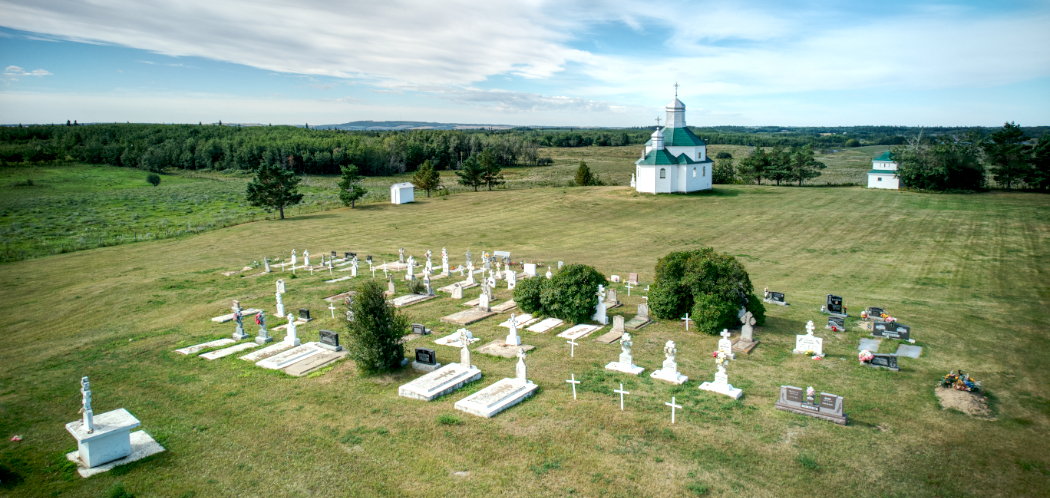
It appears that for several years tensions ran high at the Jaroslaw church as parishioners debated the question of affiliation. The majority of church members wanted to join the recently-established Ukrainian Greek Orthodox formation, while a small number wished to remain within the Catholic fold. An arrangement was therefore made to buy out the minority faction so that they could build their own place of worship, or use the money as they saw fit. The negotiations led to the signing of a formal memorandum of agreement between the two parties on 16 March 1928. The six Catholic loyalists were granted $400 for their share in the original construction and maintenance of St. Demetrius Church. At the same time, ownership of a strip of land on the north side of the church property (commonly known as the "old graveyard") was to be given to the Catholic parishioners, who had to quit the congregation and surrender all claims on the church. While the graveyard strip was legally transferred on 20 March 1928, clear title for the church itself was awarded to the Orthodox adherents on 11 March the following year.
As a result of this division of assets, the cemetery continued to be used by both denominations, reflecting the relatively civilized way that an undoubtedly painful conflict was resolved. The fact that St. Demetrius church was never destroyed by a mysterious fire in the wake of this parting of ways – as often happened in similar disputes – is a testament to the wisdom and tolerance shown by both sides. Eventually, the Catholic inhabitants of the Jaroslaw district erected the Holy Spirit Catholic Church on the opposite side of Highway 38, just east of St. Demetrius Ukrainian Orthodox Church.
By the end of the Depression, it was felt that the original sanctuary was old and needed to be replaced. Thus, between 1939-1940 a new Saint Demetrius church was built under the direction and according to the plan of carpenter and executive member George Doskoch. He saved money and symbolically preserved the work of the pioneers by utilizing some of the timber salvaged from the first building. Other logs were donated by Wasyl Rutar, and sawn into lumber by Mike Serink, who along with Anton Tancowny, Hrynko Kochan, George Lewak, Paul Holowach, [Andrei] Nepiuk and [George] Onushko, assisted in the construction. Seventeen-year-old Russ Pysmeny acted as the "gopher" for the all-volunteer work crew. The resulting cruciform structure was crowned by a large dome, and had a storm porch attached to the apse. Although built over the original foundation, for some reason the layout got turned around so that the congregation faced west instead of east, as is customary in the Eastern Church. Be that as it may, the completed St. Demetrius Church was formally consecrated by Archbishop Ioan Theodorovich during a visitation in the summer of 1940. At the time, the congregation lacked regular pastoral care, its needs being tended by priests based in Edmonton and Vegreville.
In 1943 a total of seven Divine Liturgies were celebrated at St. Demetrius, the same number of services that were held in 1947, when the congregation reported having eleven members. The membership shrank to eight by 1951, when eight services took place, these figures only fluctuating slightly over the course of the decade. In 1953, it was suggested in a letter to the Consistory that one priest be designated to serve both St. Demetrius and nearby St. John's church in Peno – which received pastoral care from Vegreville and Willingdon respectively – so as to bolster the Ukrainian Orthodox presence in a region long dominated by Ukrainian Catholic and Russo-Orthodox adherents. With its slowly dwindling membership base, due to deaths and the migration of people from the countryside, the St. Demetrius congregation obviously felt somewhat pressured as to its viability and continued vitality. Nevertheless, in 1959 the congregation installed an iconostasis in the church that it had commissioned from the Edmonton artist, Wadym Dobrolige (1913-73), a major project costing $1200 which was realized through the commitment of the nine families then active at St. Demetrius.
The situation of the congregation remained relatively unchanged over the course of the next two decades. In 1983, at the request of parishioners, responsibility for St. Demetrius was transferred to Radway district on the other side of the North Saskatchewan River. Three years later, St. Demetrius became an officially constituted member of the Ukrainian Orthodox Church of Canada, having never previously fulfilled the procedural requirements called for in accepting the statues of the church.
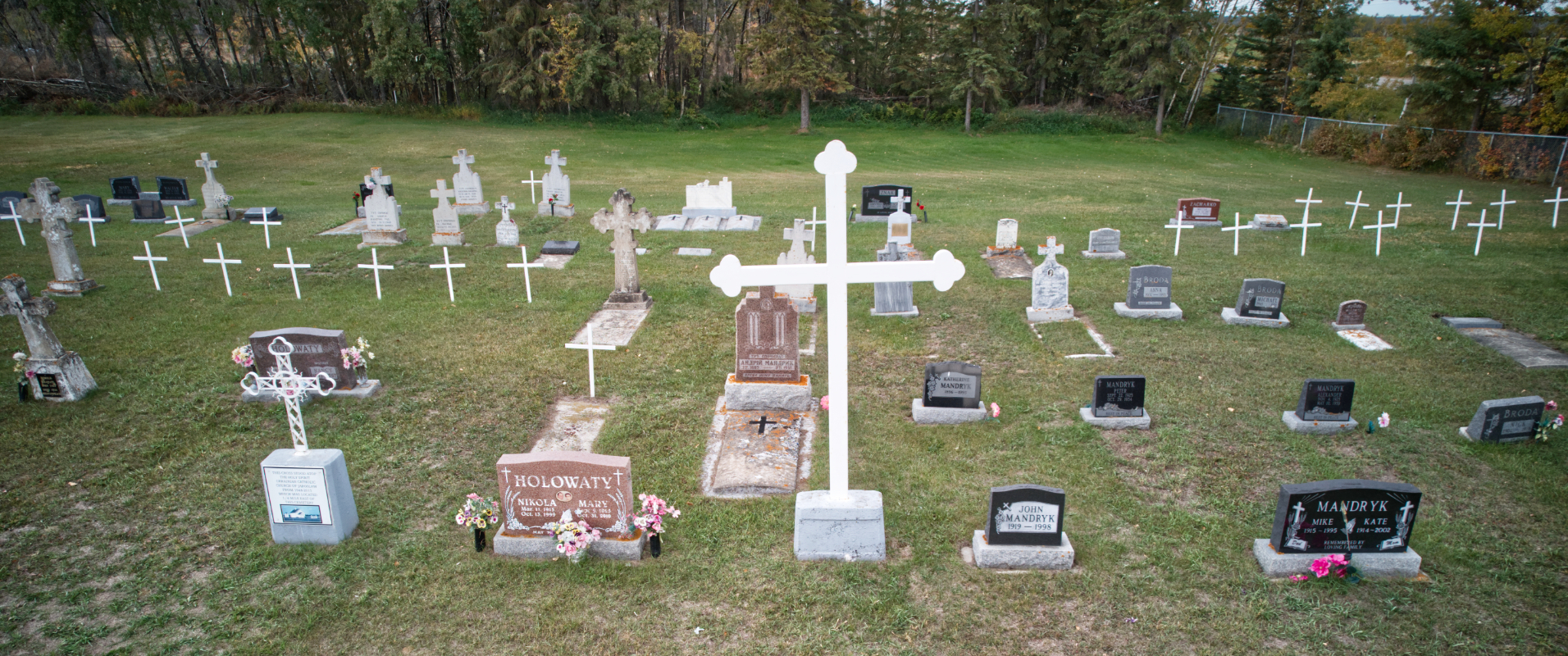
Play Memory Eternal Chant
Visit this Cemetery
GPS Co-ordinates: 53.889251, -112.901779
Affiliation: Ukrainian Orthodox Church of Canada


St. Demetrius Ukrainian Orthodox Church – Jaroslaw, AB
In 1903 a large group of settlers from Ispas, Bukovyna, took out homesteads in the hilly countryside northwest of the present-day town of Two Hills. A cemetery was established at the site of the future Ispas church in 1906. Two years later area residents formally registered their new parish in the name of the “Orthodox Greek Catholic Congregation of Holy Ascension”. The church property was blessed by Father Jacob Korchinsky of the Russian Orthodox Church. In the meantime, services were held in the homes of parishioners. The construction of a small log church, covered with siding, was completed in 1912, and the sanctuary was then consecrated in the name of the Holy Ascension. Furnishings for the church were donated by members or purchased with donations.
For several decades the church was served by priests with the Russo Orthodox Mission. However, as early as September 11, 1924 Archbishop Ioan Theodorovich celebrated a Divine Liturgy in the Ispas district during a visitation to rural east central Alberta. Subsequently, a number of Ukrainian Orthodox priests also provided occasional pastoral care to the Ispas faithful, among them Rev. T. Horbay in the years 1933-1938. It likewise appears that some of the more national conscious Ispas church members played a role in re-establishing the Holy Ghost parish in nearby Brinsley after their original sanctuary was destroyed by fire in 1920, then rebuilt four years later. The ambiguous confessional orientation of the Ispas congregation was undoubtedly further complicated by the fact that some members identified themselves as Romanians. Regardless, the congregation began to be increasingly served by Ukrainian Orthodox clergy after Fr. A. Chrustawka joined the UGOC in the early 1940s, a practice that continued through the 1950s. In 1960 the congregation finally terminated its relationship with the Russian Orthodox Church, formally joining the Ukrainian Greek Orthodox Church of Canada in 1962.
As the congregation grew, it became necessary to build an addition onto the original sanctuary so as to accommodate all of the worshippers. Later, a porch was also added to create what gradually evolved into a tripartite structure. The modest sanctuary has a choir loft and an icon wall adorned with holy pictures, and it is topped with the three small domes on octagonal bases: one central one and two even smaller domes over the narthex and sanctuary. There are eight icons in the church by Peter Lipinski, done in 1930, though not all of them are signed. Seven are on the iconostasis, and one is in the sanctuary behind the altar.
Over the course of its history, the fortunes of the Holy Ascension congregation fluctuated, enjoying periods when it flourished, and years when it gradually became more difficult to maintain an active membership. In a 1965 note to the Consistory it was indicated that membership had been reduced to just five active members. Nevertheless, in 1967 the congregation purchased the former Ispas school and its three-acre property at NW 34-5613 W4 for use as a parish hall. The sum paid to the County of Two Hills was $250. The sanctuary was renovated sometime after 1972. In the late 1980s, the congregation claimed to have more than twenty members, despite the fact that most of the early residents of the Ispas area had moved from the district. In 2014 the church had 10 members. The current president, Morris Ewanchuk, has records for the cemetery dating back to 1917.


Play Memory Eternal Chant
GPS Co-ordinates: 53.889293, -111.837428
Affiliation: Ukrainian Orthodox Church of Canada
Holy Ascension Ukrainian Orthodox Church – Ispas, AB
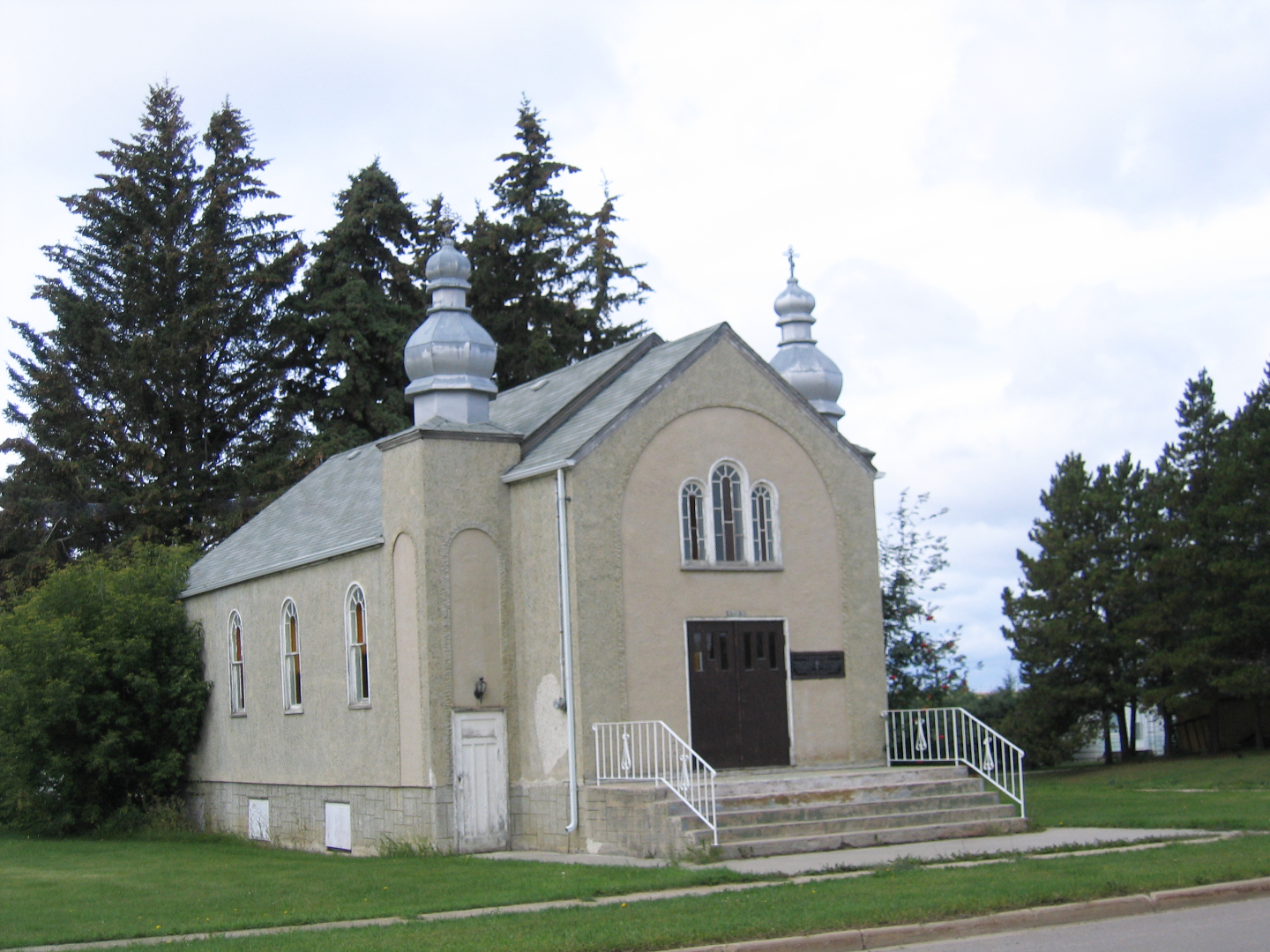

The organization of a parish was first discussed by area residents in November 1947. Congregational life was then formally initiated on May 23, 1948 at a general meeting that was also attended by Reverend A. Chrustawka, Mrs. A. Pidruchny, and lawyer John Decore, subsequently elected as a Liberal member to the House of Commons for Vegreville constituency. By September of that year a lot was acquired for a church on the west side of the town centre, but it was registered in the name of one of the parishioners until after the congregation received its official incorporation on November 27, 1948. The eighteen members of the congregation optimistically hoped to start building their place of worship the following year. In the meantime, services were held in private homes, as fundraising proceeded toward financing a sanctuary. Construction finally began in earnest in 1952. The members themselves worked on the structure, led by P. Harasym and the aged I. Velychko. The first service was held in the partially completed sanctuary on the feast day of St. John the Baptist in 1953, with Rev. M. Flak officiating. Many guests came from the neighbouring communities of Myrnam, Morecambe, Musidora, Two Hills and Vegreville, and there were tears of joy in the eyes of the hard-working St. John's members.
In 1954 the congregation reported having fourteen members, five sympathizers, and hosted eleven liturgies. The next year, it claimed eighteen members and eight sympathizers, but only celebrated seven Divine Liturgies, due to a shortage of priests. After a reorganization of rural districts in 1956, Innisfree was assigned to be part of Vegreville, and promised to have its monthly services restored.
Work on the sanctuary was not fully completed until in 1962. At that time, the congregation had seventeen members, and enjoyed monthly liturgies. Although the circumstances of the parish remained fairly stable for several years, by 1966 the congregation was reporting difficulties maintaining its membership. The situation continued to deteriorate, so that by 1969 there were only nine paid members in the parish. Although two years, the figure had increased to fourteen, the long-term prospects for the parish were hardly encouraging given the steady decline of rural communities. Nevertheless, the faithful continued to struggle to keep their parish alive despite enormous challenges. However, by the late 1980s it was impossible for the congregation to pay its annual levy to the Consistory due to the small number of members trying to keep up with mounting costs of maintaining the church.
GPS Co-ordinates: 53.381473, -111.531492
Affiliation: Ukrainian Orthodox Church of Canada
St. John Ukrainian Orthodox Church – Innisfree, AB
The Hamlin area was originally settled in 1903 by several families from the village of Ispas, in the Carpathian highlands of Bukovyna. In 1910 the pioneering farmers in the district – which was initially referred to as "north Ispas" so as to distinguish it from its counterpart on the opposite side of the North Saskatchewan River – decided to form a congregation that adopted as its feast day the Nativity of the Virgin Mary. The following year, five acres of land atop a knoll, amid rolling hills, were donated by homesteader Maftey Malysh for an Orthodox church and cemetery. An impressive log structure was then built at the site using volunteer labourers working under the supervision of a congregation member, Sydorij Stefiuk. At the time of its inception, the Church of the Nativity of the Virgin had twenty-three members.
During the mid-1920s, Father Ivan Kusey provided for the spiritual needs of the community from his base at St. Peter and Paul Church in Kaleland. On 21 August 1926, Father Kusey used his wagon to convey Rev. Timotei Horbay to Hamlin, where the latter cleric was to reside permanently in a home near the church provided by G. Luchak. Father Horbay had served for six years as a Ukrainian Catholic priest, but in 1926 switched his allegiance to the Ukrainian Greek Orthodox Church of Canada.
At Hamlin he was paid five dollars a service by the financially pressed but extremely generous members of St. Mary's, who also took turns delivering him by wagon to the church at Downing (where he was paid an additional eight dollars for a monthly liturgy) and the railway station at Vilna. Thanks to the support of his understanding and enlightened parishioners, within a year Father Horbay was taking care of Orthodox adherents in Rafe (Glendon), Smoky Lake, Spedden, and Vilna. He later also added Flat Lake, Lessard, La Corey, Bellis, Radway and Egremont to the list of communities which he periodically visited, thereby greatly expanding the territorial reach of the UGOC within rural east central Alberta.
In the spring of 1929 Father Horbay relocated to the town of Smoky Lake, and once again the Hamlin district became dependent upon periodic pastoral visitations. Henceforth, the congregation was ministered to by priests who lived in either Smoky Lake or Willingdon.
As rural depopulation began to occur toward the end of the Depression years, membership at the Nativity of the Virgin Mary Church slowly began to decline. During the Second World War, when six liturgies were being celebrated annually at the sanctuary, the congregation numbered fifteen families, but this figure plummeted to six in 1946, and just five a year later. In 1948 only four Sunday services were held at the church, whose future viability seemed doubtful. However, the situation subsequently stabilized and the membership rebounded, so that by the early 1950s residents of Hamlin were again being allotted a half-dozen liturgies a year.
The Cemetery
Situated on the northeast corner of the church property. The earliest recorded burial is that of George Koroluk, who died in 1913.
Play Memory Eternal Chant
GPS Co-ordinates: 53.946873, -111.897907
Affiliation: Ukrainian Orthodox Church of Canada