Discussions about establishing a church for the Egremont community began in 1926 at the wedding of the daughter of a local farmer named K. Pawluk. Several guests who were involved in establishing a district cemetery dedicated to St. George, resolved to send a delegation to Rev. Dmytro Seneta in Edmonton to ask about the possibility of holding a Ukrainian Orthodox service for Egremont residents, at the same time blessing the site that had been selected for the burial ground. Although the original promoters of the cemetery came from various religious and political backgrounds, it was the pro-Ukrainian Orthodox activists who proved to be most committed to the endeavour, as one their number, Harry Buhay, donated the land for the graveyard.
On August 10, 1926, supporters of a Ukrainian Orthodox orientation met at the Buhay home, where they learned that Rev. Dmytro Seneta was willing to come once the sponsors had officially notified the Consistory and Archbishop Ioan Theodorvich of their intentions.
A formal meeting was then convened at the nearby M. Hrushevsky Hall (constructed in 1921), where a letter was read announcing that Fr. Seneta would hold a service as requested on the Feast Day of the Elevation of the Cross. The first liturgy took place at the home of an area resident, Tom Plupek, on September 27, 1926, when the cemetery was also consecrated.
In the wake of these developments a heated debate arose between the Greek Catholic, pro-Soviet and Orthodox inhabitants of the Egremont district, the former being understandably upset by the direction which events were taking. The controversy was to rage for a period of almost three years, and tensions continued to be strong long after the different factions had gone their separate ways.
In the meantime, however, Ukrainian Orthodox priests conducted regular services at the nearby Hrushevsky Hall, in the process gradually strengthening the position of the Orthodox tendency. Finally, at a dinner following a liturgy officiated by Rev. T. Horbay on July 27, 1929, it was decided to officially organize a Ukrainian Orthodox congregation. The meal featured a talk by Fr. Horbay about the Ukrainian Orthodox Church, and was attended by a large number of people, ten of whom came forward to provide leadership for the initiative. Formal affiliation was subsequently accepted at a meeting on August 9, 1929, when it was likewise decided to make St. John the patron of the future church. At the dinner, the sum of $35.00 was collected for the construction of a sanctuary, but when the old Ingleside School subsequently became available for $350.00, it was purchased (in March 1930) to provide a convenient place of worship.
Moved to a parcel of land on the T. Plupek homestead opposite St. George's cemetery, and appropriately modified for its new function, the structure hosted its first liturgy on April 7, 1930. Testifying to the lingering ill feeling among some opponents of the congregation, all of the windows of the church were broken, and the interior damaged by stones, when the sanctuary was later vandalized by unknown individuals. With the passing of time, however, passions cooled, and calm was restored in the district. An early highlight in the history of the congregation was the visitation of Archbishop Ioan Theodorovich on August 2, 1932, when he celebrated a liturgy with Reverends Horbay and Mayba.
The modified school was utilized until 1938, when it was deemed to be too small and in need of extensive renovation. A decision was therefore made to construct a new place of worship, with parishioners contributing $25.00 each toward this goal. The congregation commissioned two brothers named Kozak with church-building experience in Ukraine to design a brand-new sanctuary, which was then quickly constructed by professional carpenters assisted by volunteer members. The cruciform structure was crowned with a large central dome on an octagonal base, two smaller domes gracing harmoniously proportioned towers that flanked the porch to produce an aesthetically pleasing facade. The interior of the church was painted by Peter Lipinski in 1938 and includes his distinctive faux block walls. The iconostasis appears to have been made by Philip Pawluk.
In 1958, St. John's church, St. George's cemetery, and the M. Hrushevsky Hall were all legally incorporated as a single entity under the ownership of the parish. The congregation celebrated its fiftieth anniversary in 1979, the same year that someone stole its large antique bell, which had originally been brought over from Ukraine. In 2001 a new bell tower was built on the north side of the church to replace the earlier one.
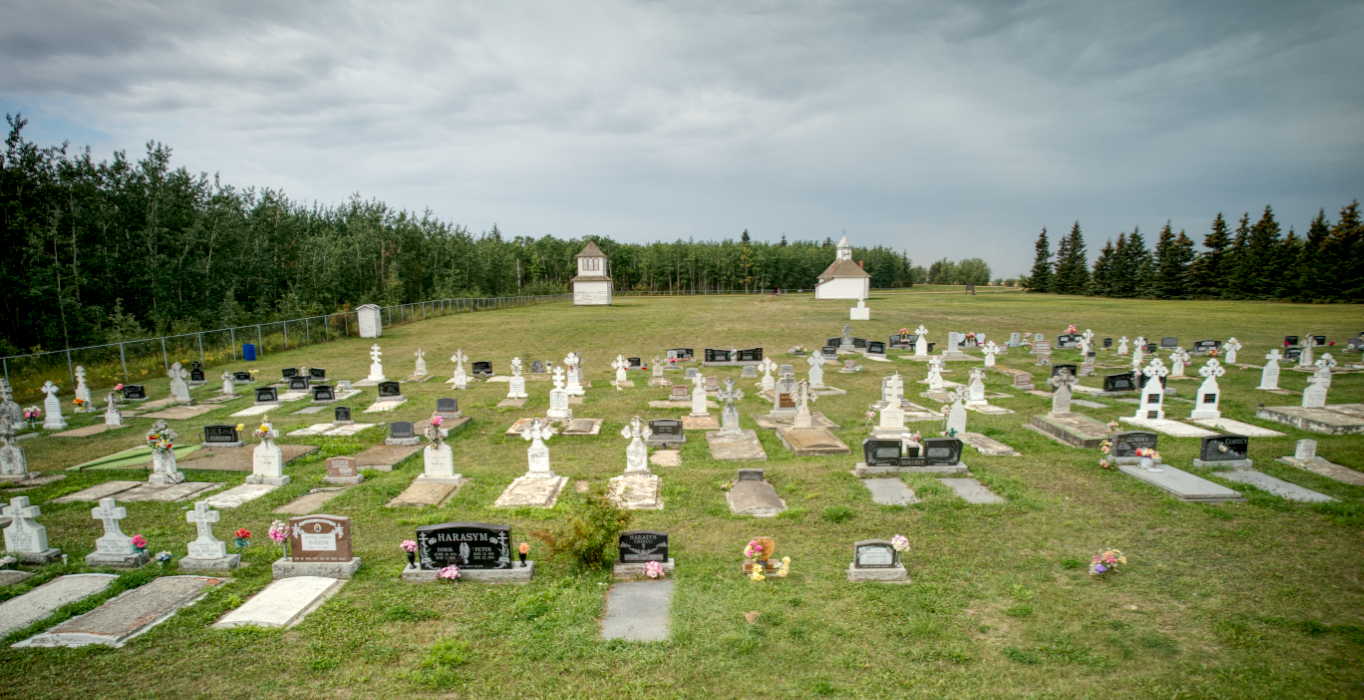
The Cemetery
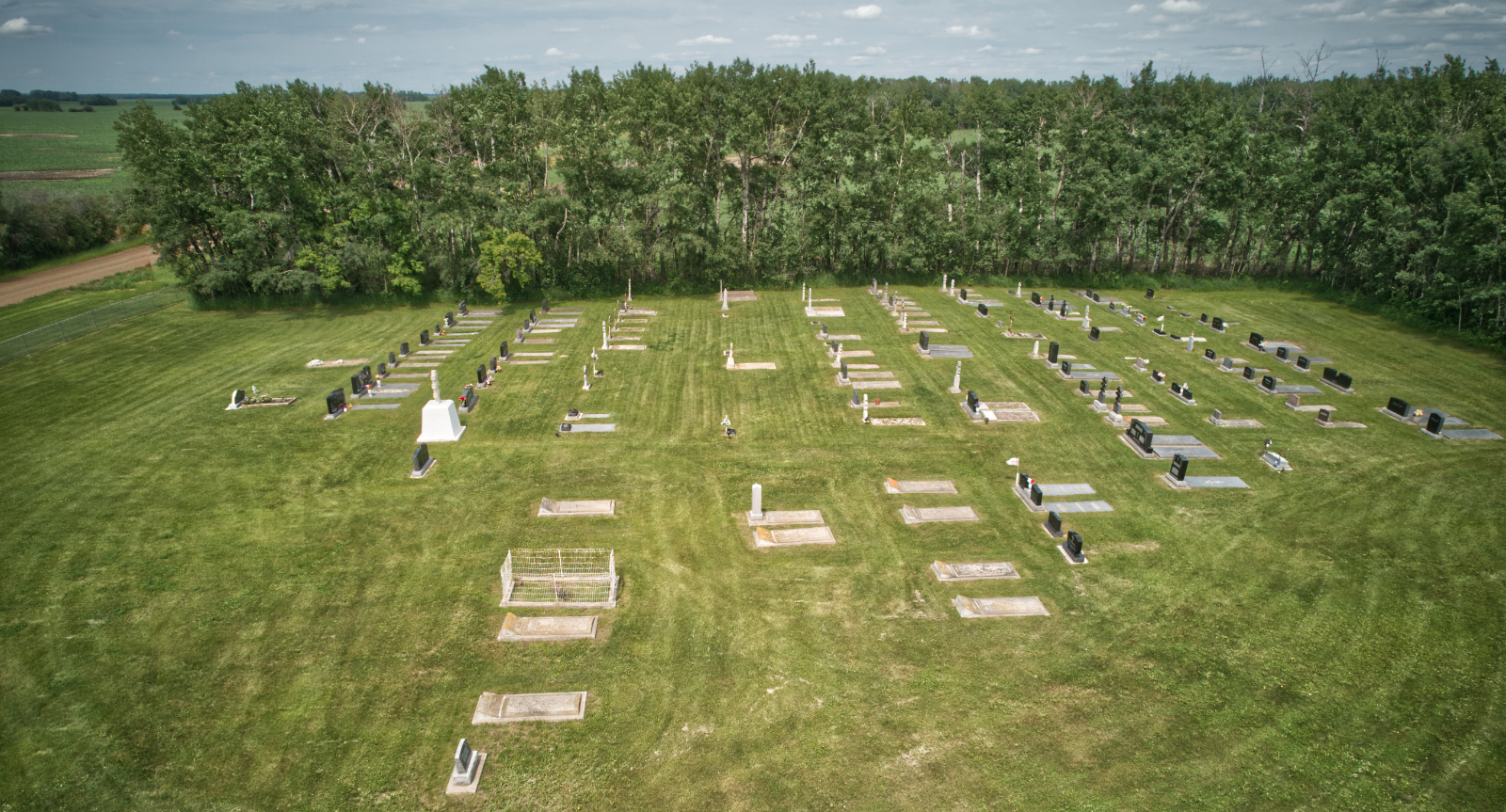
St. George's cemetery was formally established at a meeting of Ingleside School district residents at the Hrushevsky Hall on 12 May 1913. The first burial at the site was that of Mary Stemkowski, on 5 March 1913. Initially, the one-acre parcel of land at SW 6-59-21 W4 was donated by Harry Buhay. However, at a subsequent meeting of the cemetery group held on 12 September 1915, it was decided to pay for the donated acre of land, and to purchase an additional acre from Harry Buhay for the total sum of $13.00.
On 10 April 1916, the cemetery association requested, and eventually obtained, incorporation of the cemetery as a community initiative that was not affiliated with any particular church. Then, on 29 August 1918, the members of the cemetery group voted to have their graveyard consecrated, although they intended for it to retain its non-denominational character. Later, a change in provincial law required that cemeteries be affiliated with a church if they were to remain operational. By then, cemetery association members were ready to come under the auspices of St. John’s Ukrainian Orthodox Church at Egremont. Since Rev. Seneta blessed the cemetery in September 1926, before a church had been constructed and a congregation officially organized, the burial ground was dedicated to St. George rather than St. John.
Play Memory Eternal Chant
GPS Co-ordinates: 54.071060, -113.150709
Cemetery: 54.071923, -113.150451
Affiliation: Ukrainian Orthodox Church of Canada


Saint John's Ukrainian Orthodox Church – Egremont, AB
ARussian Orthodox mission, with a small chapel, was initially established on land immediately south of the present-day Edwand Church around 1903, at the same time that a Russian Orthodox mission was started in Smoky Lake. Congregational life was initiated that same year after the death of a local homesteader made a cemetery an urgent necessity. A site for the graveyard was chosen uphill from the first mission (which enjoyed a commanding view of the White Earth valley). Designated trustees were then dispatched to the Pine Creek Land Titles office to file a claim for a forty-acre subdivision of a quarter section, paid for with donations collected from area settlers.
Construction of a log church began the following year, when stones for a foundation, logs and other materials were assembled on the property by local supporters of the church. Volunteers then slowly worked to erect a log structure under the direction of a head carpenter, Todor Billey (Billy) – a native of Borivtsi, Bukovyna, who originally homesteaded in the Pakan district but subsequently moved to the vicinity of Edwand. In 1906 an itinerant monk is said to have held a service in the partially completed sanctuary.
The formal consecration of the church took place on 14 October 1907, the feast day of St. Mary the Protectress. In the early years, priests from the Russian Orthodox mission provided pastoral care to the Bukovynian settlers of the district. During the 1920s and 1930s liturgies were celebrated two or three times a month, drawing large numbers of worshippers to Edwand who came on foot over rough trails or braved the elements and roads in wagons and buggies. Regrettably, the records of these formative years of St. Mary’s congregation were lost in the 1928 fire that destroyed Holy Trinity Russo-Orthodox Church in Smoky Lake.
It appears that between 1936 and 1943 Father Hryhori Wasyliw of the UGOC periodically served at Edwand during his tenure in Smoky Lake. It is possible that he was occasionally called upon when Russian Orthodox priests were unavailable, or at the request of local sympathizers of the UGOC. In 1958 work began on a parish hall, erected in part with donated material and volunteer labour.
However, following the death of the Fr. Cependa at the age of forty-two, the Edwand faithful were left without regular spiritual care and began increasingly to invite priests with the Ukrainian Orthodox Church to minister to their religious needs. This arrangement apparently prevailed for many years, until parishioners decided to officially join the Ukrainian Orthodox Church of Canada – thanks largely to the efforts for Fr. P. Satsevich – at an annual general meeting held on 11 December 1960. Although the UGOC Consistory naturally welcomed this decision and was willing to quickly issue Fr. Satsevich with a document of acceptance, it was suggested that he wait awhile to ensure that the move was not actively opposed by anyone still loyal to the Russian Orthodox Church.
Obviously, the decision to become part of the Ukrainian Orthodox Church had not been a unanimous one. Whereas Edwand had thirty-five members when it resolved to come under the jurisdiction of the Consistory in Winnipeg, a figure that grew to fifty-two the following year (probably thanks to an influx of UGOC supporters from neighbouring communities), by 1965, the congregation reported having just fifteen members according to correspondence relating to its budgetary assessment. Eventually, members who wanted to remain with the Russo-Orthodox church joined Sts. Peter and Paul congregation at Dickiebush, southeast of Bellis.
There is distinctive bell tower with a square ground floor and octagonal second story (the transition being achieved through the use of four tetrahedrons called "sails") immediately west of the church. Topped by a conical roof, the tower was originally graced by sets of porthole-like openings on each of its sides, but these were replaced in 2005 by louvred openings that can be lowered to permit the sound of the bells to be heard more easily. A parish hall is also located between the church and the cemetery.
Go HERE for more information and history of this parish.
The Cemetery
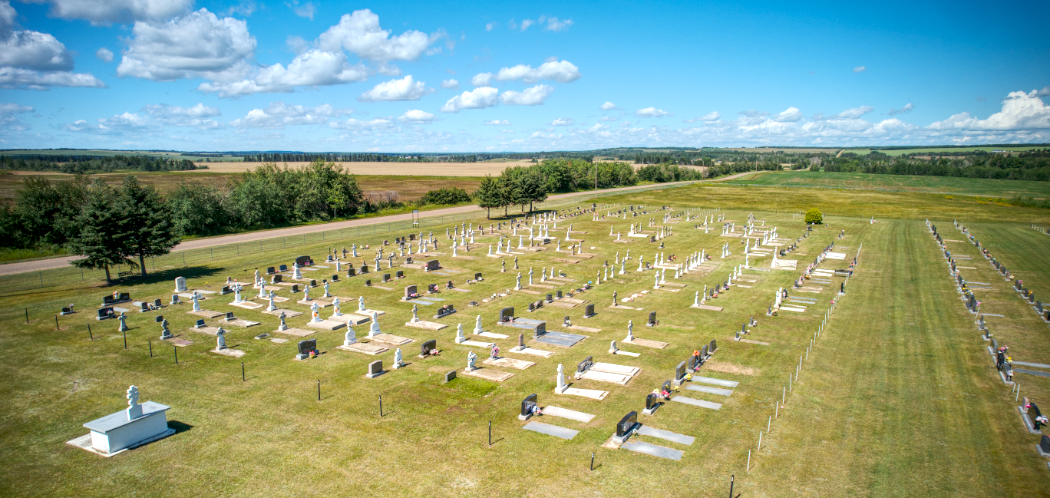
The cemetery is adjacent to the church, having been established in 1903 upon the death of a twenty-two-year-old settler, Wasyl Maskalyk. The builder of the church, Todor Billey (1870-1960), who emigrated to Canada with his wife and two children in 1899, is buried in the cemetery, which is thought to contain close to 700 graves. Unfortunately, some of the burials were never marked, and the wooden crosses on many other early graves have been lost due to fires. The church property and cemetery were enclosed with a fence in 2005.
Play Memory Eternal Chant
GPS Co-ordinates: 54.127093, -112.300339
Affiliation: Ukrainian Orthodox Church of Canada
St. Mary the Protectress Ukrainian Orthodox Church – Edwand, AB
Congregational life was initiated in the community in 1916 (although the church sign dates the founding to 1918, and another source says 1917), when a cemetery was established on six acres of land purchased from Zenovia Kozak at the site of the future church. Work on the sanctuary itself began in 1921, with parishioners donating materials and their volunteer labour.
Completed in 1924, the tripartite sanctuary with two small cupolas over the narthex and sanctuary as well as a central galvanized dome, hosted its first liturgy in June of the same year, with Rev. T. Horbey ostensibly officiating at this joyous occasion. Another memorable event in the early history of the Downing community was the 20 June 1933 visitation by Archbishop Ioan Theodorovich, who formally consecrated St. Paraskeva.
Among the dignitaries who attended episcopal service were Mr. Isidore Goresky, a member of the Alberta legislature, and Michael Luchkowich, a member of federal parliament. A large wooden bell tower was erected in the churchyard in 1948, and a roofed porch was added to the sanctuary in the early 1950s.
Play Memory Eternal Chant
GPS Co-ordinates: 54.034614, -111.984265
Affiliation: Ukrainian Orthodox Church of Canada
St. Paraskewa Ukrainian Orthodox Church – Downing, AB
T
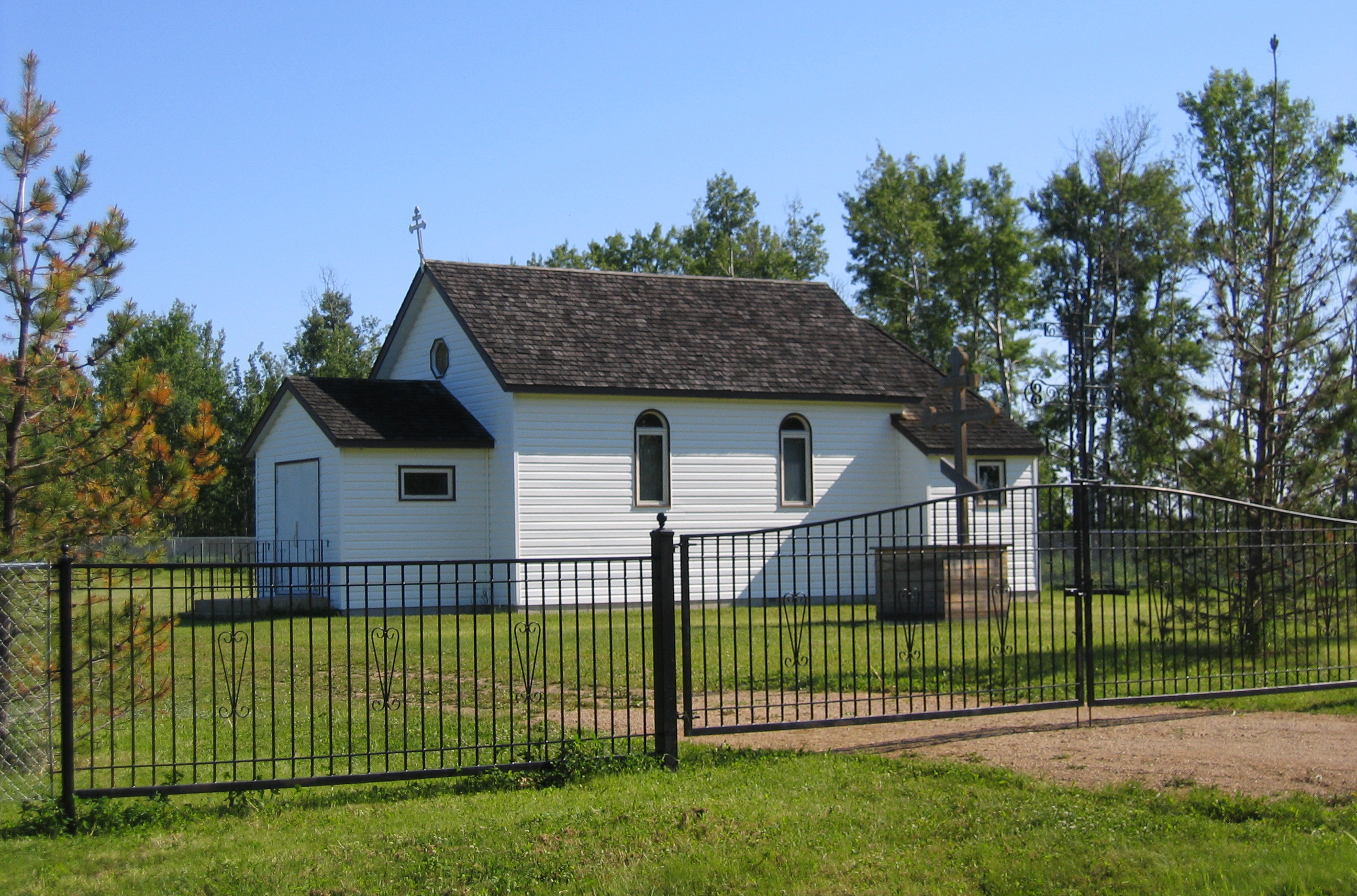
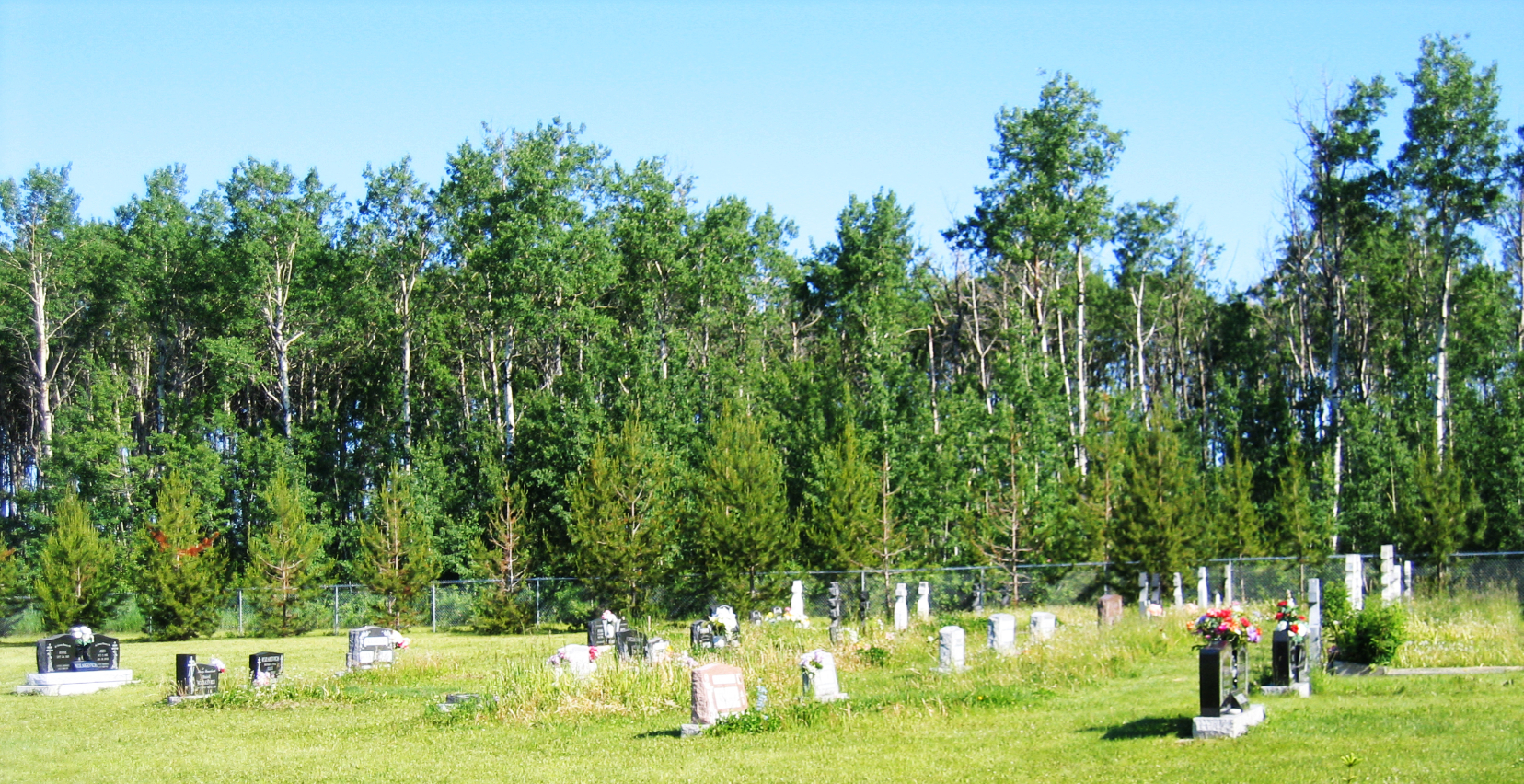
he origins of St. Demetrious congregation can be traced back to the early years of the Great Depression. On 11 May 1931, some 35 Ukrainians (originally from Galicia and Bukovyna) who had pioneered the area in 1928 assembled at the home of John and Jennie Palamaruk to discuss the need to establish a cemetery. Every time an Orthodox Ukrainian died in the community it was necessary to obtain permission from local French Catholic residents to use their graveyard for the interment.
At this inaugural meeting, John Palarmaruk Fred Warawa and John Salahub were chosen to obtain land for a cemetery. Some $45 was collected in donations for this purpose. Afterwards, a two-acre property was (adjacent to the French cemetery) was acquired from Narcisse L. Mouille for use as a burial ground. However, in the process of registering the cemetery with the provincial government, the organizers realized that they wanted to have it affiliated with the Ukrainian Greek Orthodox Church of Canada. Thus, they turned to the Consistory to obtain the necessary documentation, that in turn led to their formal establishment as a congregation.
At a gathering held on 15 January 1933, it was decided to form a congregation named the “Ukrainian Greek Orthodox of Craigend, Alberta,” with the original purchasers of the land being designated as the trustees for the cemetery and the congregation. So as to arrange for the legal transfer of the property from the three individual purchasers to the trustees, in April 1933 a letter was written to the Consistory in Winnipeg asking for admission into the Ukrainian Greek Orthodox Church of Canada. Following an exchange of correspondence explaining the requirements for acceptance, a meeting finally took place at the Craigend home of John Salahub on 4 February 1934. The twelve members in attendance voted to accept all of the Statutes of the Ukrainian Greek Orthodox Church of Canada. Eight days later, on 12 February, the new congregation was formally admitted into the UGOC.
Meanwhile, on occasion the Ukrainian Orthodox faithful of Craigend had to turn for pastoral care to other priests who were available to them in their isolated settlement. Thus, on 10 May 1933, a number of families travelled by horse and wagon to the Venice district, southwest of Lac La Biche, to have their children baptized by the nearest cleric, Fr. Ivan Wachiuk of the Russian Orthodox Church. This situation led to some concerns about the threat of Russian influence in the community. In April 1934 this prompted a member to write the Consistory requesting that a priest be sent to Craigend for services several times a year even if the congregation found it hard to pay for them.
It appears that Fr. Ivan Mayba subsequently came to celebrate a Divine Liturgy at Craigend school on the Sunday following Pentecost. Afterwards he blessed the land that had been acquired for the cemetery. He held another service at the same school on 24 February of the following year. It was around this time that supporters of the congregation apparently decided to build a small chapel on their property, so that it could be utilized in the event of a funeral.
However, just as they were about to embark on this project, they determined that it made more sense to direct their energies toward erecting a modest church. Since money were hard to come by in these difficult first years, volunteers cleared the land and prepared the site. Efforts were made to raise funds by means of bazaars, dances, picnics, teas and other activities – the women often playing a critical role in organizing and hosting these events.
In the spring of 1936, the congregation requested a timber permit from the Provincial Department of Lands and Mines. After harvesting 6,000 ft. of wood on crown land at SW 2-65-13 W4, they immediately set about building a church. Volunteers cleared the site and provided most of the labour, assisted by carpenters who were hired with the available finances. By the fall of 1936 the sanctuary was finally ready to blessed. Fr. H. Wasyliw celebrated the first service in the simple country church in early November. It was dedicated in honour of St. Demetrious.
Because of Craigend’s remote location and limited means, it was often difficult for the congregation to bring in clergy to serve in their community. Thus, in 1937, responsibility for the church was passed from Fr. Wasyliw in Smoky Lake, to Fr. Hykawy, who was based in Willingdon. After coming to a financial understanding with the latter, the parish arranged for a Divine Liturgy on 4 July. They sent a member with horses to the train station in Lac La Biche to fetch him in time for the service. When Fr. Hykawy failed to appear as expected, the faithful of St. Demetrious were understandably upset. It was a 16-mile trip into town and some worshippers had even come to Craigend from as far away as Noral, 25 miles distant.
It was later explained that Fr. Hykawy had to attend a clergy conference in Saskatoon around the same time (and that other personal factors might also have been involved). Poor communications obviously played a role in contributing to the misunderstanding. Interestingly, an analogous situation occurred just two years later, when Fr. Sawchenko paid a visit to the parish as the head of the Consistory. When he showed up in Lac La Biche, he discovered that no one had come to meet him. The letter giving the details of his travelling plans was only received following his arrival.
Regardless, after being conveyed by wagon to Craigend, he celebrated a Divine Liturgy at St. Demetrious Church on 2 August, the Feast Day of the Prophet Illia. He then held a second service the following day at the home of Ivan Salahub. In notes that he made during this trip, Fr. Sawchenko reported that he found the congregation in somewhat fractious state. He attributed this to a low level of enlightenment on the part of some its members. He also noted that the church was small and finished only on the exterior, though the property and cemetery were well kept and enclosed with a fence.
The challenges of providing services to Craigend were illustrated by yet another incident that happened in 1940. When Fr. Wasyliw didn’t make it to a liturgy that he had agreed to perform and thereby again disappointed the expectant congregation. This time, it was heavy rains that proved to be the culprit. The roads were still being quite primitive and therefore unreliable in bad weather. Needless to say, the remoteness of Craigend, along with some of the other settlements in the Athabasca and Lac La Biche regions, continued to complicate efforts to deliver regular pastoral care not only during the 1930s, but well into the 1940s.
Nonetheless, the situation of the parish slowly improved. St. Demetrious congregation gradually worked to furnish and adorn their place of worship. They also built a community hall in 1946. In 1950, the parish reported having 12 members. Only two liturgies were celebrated in the community during the course of the year due to a critical shortage of priests.
In 1954 the congregation excitedly prepared for a visitation by Metropolitian Ilarion. He was going to consecrate the church and bless the cemetery at a hierarchical Divine Liturgy to be celebrated on 15 August. Unfortunately, Metropolitan Ilarion fell ill and was unable to attend, but a service was held with Frs. Kowalishen and Hrycyna concelebrating with Fr. Zubrytsky, accompanied by the church choir from Richmond Park. During the course of this year, a total of 11 services were held at Craigend.
Despite many hardships, the members of St. Demetrious persevered in their efforts. In 1959 they enlarged their church with the addition of a sanctuary. A major renovation of the interior took place in 1959, when new flooring and panelling were installed by volunteers. In 1964 Craigend reported having 8 members. They obviously remained committed to maintaining their place of worship despite their small numbers.
In 1986, the church structure and exterior were the primary focus of improvements. This saw a new foundation, new windows, cedar shingling and fresh siding that significantly upgraded the sanctuary’s weatherproofing and appearance. A monumental cross was built beside the church in 1991. The porch was renovated in 1997, and in 1998 a new altar was crafted for St. Demetrious—all of this work being performed by members. Clearly, the self-reliant spirit of the pioneers continues to live on with today’s generation of Craigend church members.

Play Memory Eternal Chant
GPS Co-ordinates: 54.58761, -111.89659
Affiliation: Ukrainian Orthodox Church of Canada