In early 1927, there were meetings amongst several families in order to discuss the essential need for baptism, marriages and funerals in the Ukrainian language. This would involve the traditions that the Ukrainian settlers were accustomed to, and comfortable with. The Ukrainian Greek Orthodox Church of Calmar was officially established on 13 February, 1927, at a meeting in the home of John Fitzowich. Steve Mryglod served as chairman and Walter Shewkewich served as the secretary.
The founding members of the parish were: John Fitzowich, Max Fitzowich, Dan Karashowski, John Kruk, Serguis Lacz, John Manchak, Steve Mryglod, Steve Olekshy, Bill Pawlyk , John Pyrch, Fred Sych, and George Wasuita. The first executive was: Dan Karashowski, president; John Fitzowich, treasurer; Steve Mryglod, secretary.
It was unanimously decided to construct a Temple. Pledges of $5.00 to $10.00 were taken from members; however, John Fitzowich himself contributed $100.00.
The building committee sought to build a Temple in the town, but land prices were beyond the reach of the parishioners. Therefore, Dan Karashowski donated 2 acres of land, and on February 24, 1927, Mr. W W Carrol of Carrol Agencies completed the legal transaction. All the construction tasks were shared out.
At a meeting in May 1927, it was decided to apply to the Consistory (central office) of the Ukrainian Greek Orthodox Church of Canada for membership and for the provision of regular Sunday services. The first service was held in the home of John Fitzowich on June 2, 1927, the Feast of the Ascension of Christ. The priest who served was the Priest Metro Senata. He named the parish “Holy Trinity Church”. He also blessed the cemetery and administered sacraments. Services continued to be provided at the Fitzowich residence until the construction of the building had proceeded far enough to allow services to be offered in that space.
Construction of the Temple began on August 29, 1927, with Peter Turetsky as the hired carpenter. The construction proceeded apace at first. Later in the year, Bishop John Theodorowych and Father Shewchuk visited the community from Winnipeg. However, the cost of construction was great, and the resources were limited. It therefore took until 1936 to complete the construction and to clear any debt. The Cross on this Temple was made by a local blacksmith.
The parish grew in numbers, which produced the awareness that more room was required in the Temple. On October 10, 1958, there was a general meeting which authorized the construction of a new and larger Temple. The old Temple was dismantled, and a new and rather larger structure was constructed on the same site. The Crosses for this Temple were forged by a local blacksmith, as before.
In June 1960, Archimandrite Alexander (Scherban) served the first Divine Liturgy in the new Temple.
Soon afterwards, a bell was purchased from the Leduc Fire Hall and placed on a metal stand.
See HERE for additional information and history of this parish. 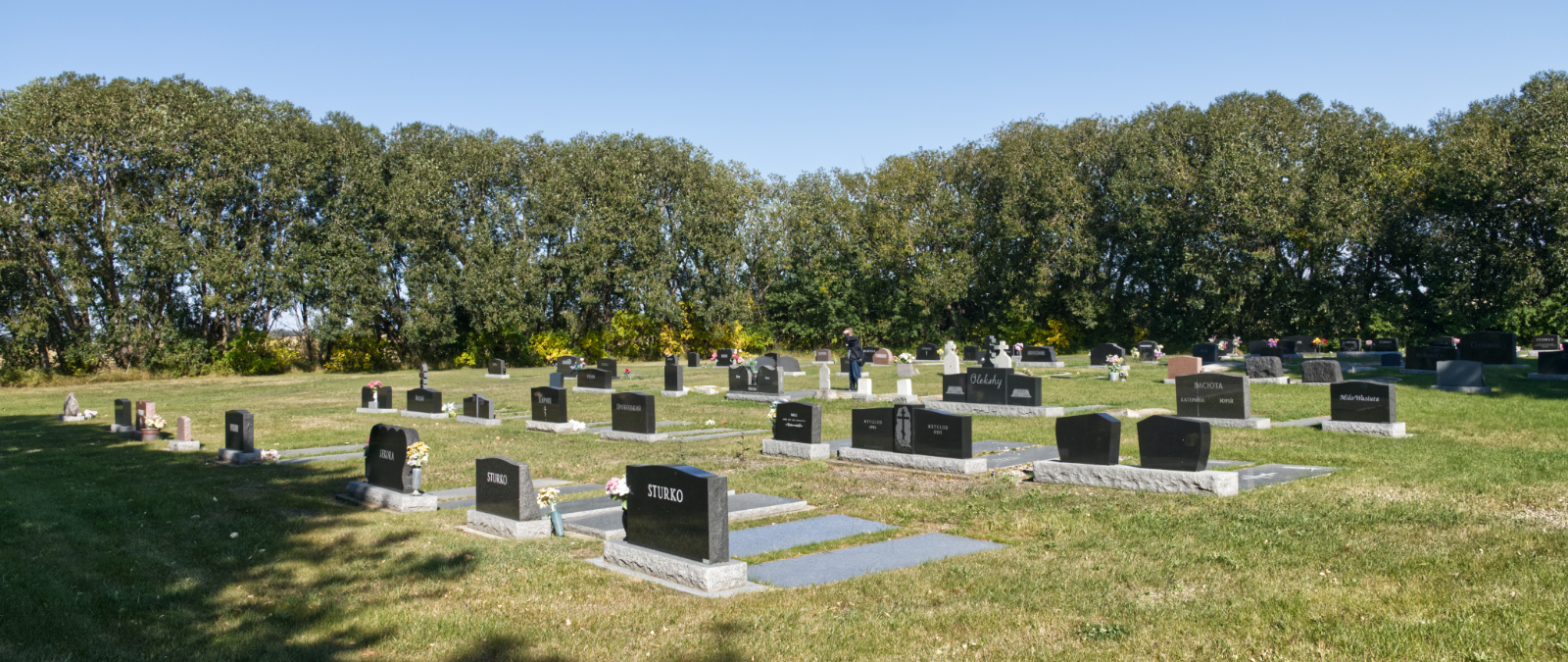
Play Memory Eternal Chant
Visit this Cemetery
GPS Co-ordinates: 53.265485, -113.854082
Affiliation: Ukrainian Orthodox Church of Canada
Holy Trinity Ukrainian Orthodox Church – Calmar, AB
S
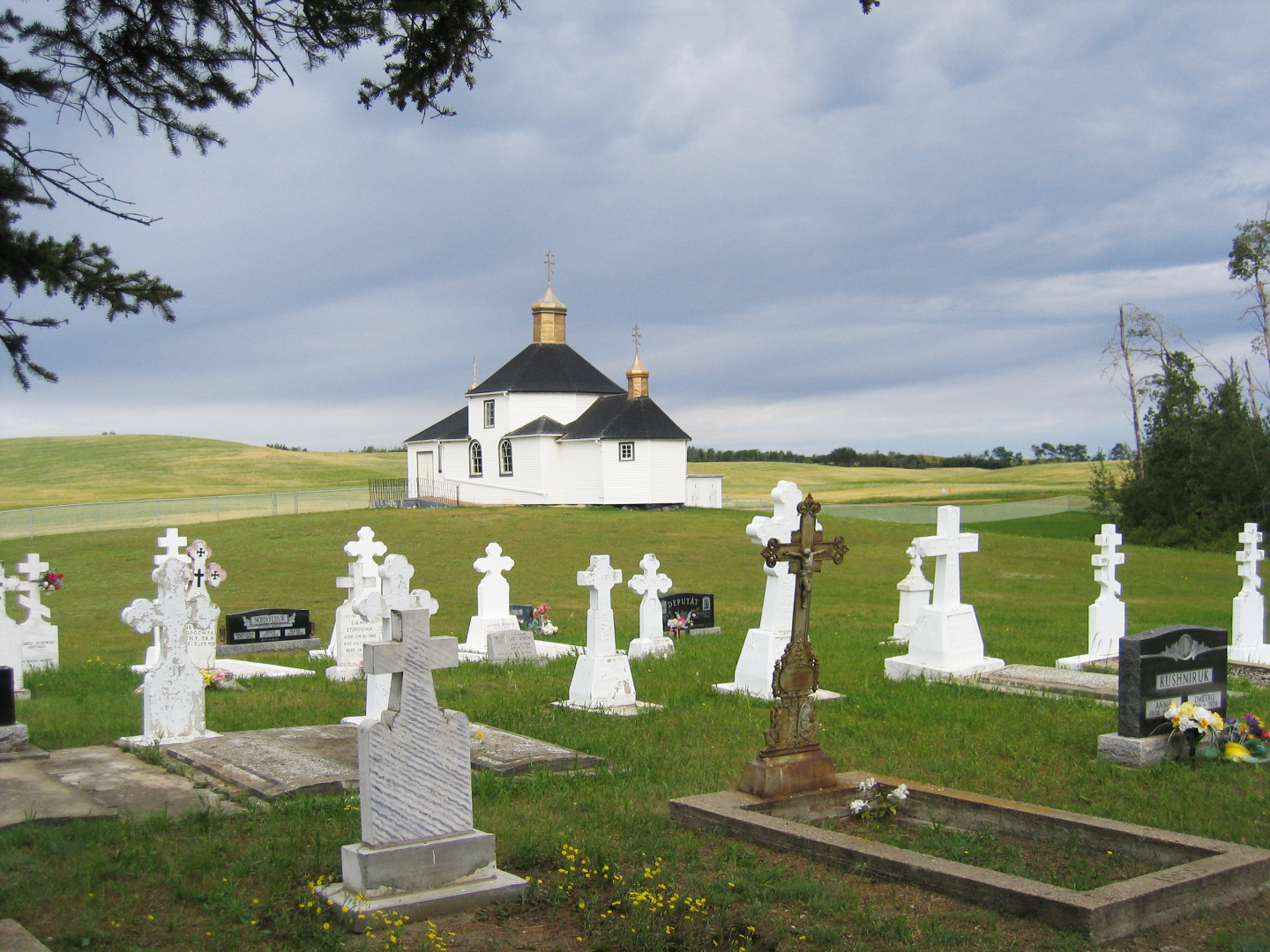
ettlers of the Brinsley area undertook the organization of an Orthodox congregation shortly after getting established on their homesteads. In 1915 they built a church of rough-hewn logs on the corner of a farm owned by John Hackman (Ivan Hekman), but this structure was destroyed by fire in 1920.
A new place of worship was then erected on the same site in 1924 by volunteer workers, with George Deputat serving as the chief contractor. At the same time, the Brinsley congregation renamed their sanctuary the Ukrainian Orthodox Church of the Holy Ghost, having in the meantime joined the ranks of the fledgling UGOC. However, in 1935, when Fr. Horbay fell ill, the congregation again turned to the Russian Orthodox Church for pastoral care, which was provided by Fr. Ambrose Chrustawka. The Brinsley faithful subsequently returned to the Ukrainian Orthodox fold when Fr. Chrustawka joined the UGOC in 1941.
A tripartite structure crowned by a medium-sized central dome on a large octagonal base, the Brinsley church also has smaller domes over the narthex and sanctuary. A clapboard belltower is situated northwest of the church. In 2008 the belltower contained 2 banners with Romanian inscriptions, whose icons were unsigned but appear to have been painted by Peter Lipinski. Inside the church there in 2014 there was a signed icon by Lipinski dated 1929. In 2008 the belltower’s windows were broken, exposing the interior and its contents to the elements, but now seem to have been fixed.
Play Memory Eternal Chant
 Visit this Cemetery
GPS Co-ordinates: 53.890256,-111.786451
Affiliation: Ukrainian Orthodox Church of Canada
Holy Spirit Ukrainian Orthodox Church – Brinsley, AB
This congregation was inaugurated during the tenure of Fr. Ivan Mayba in Smoky Lake, and subsequently remained part of the Smoky Lake Parish District. According to a letter sent to Consistory on 23 November 1933, by this time an initiative group of local residents was in the process of purchasing a four-acre parcel of land for a church and cemetery from the Great West Life Company in the Boyne Lake district. However, for the land ownership to be transferred it was necessary for the new congregation to be legally registered with a church. Consequently, a formal founding meeting of the Boyne Lake faithful was then held at the nearby Conrad School on 23 December 1933, when an application for incorporation as the Congregation of the Holy Cross was submitted to the UGOC in Winnipeg.
Approved on February 3, 1934, the land acquisition was then finalized a short while later. In June the Consistory was informed that the property had already been fenced in and had a cross placed on it, which it was hoped to have blessed that fall. At this time, it was indicated that plans were being made to begin assembling materials for the construction of a sanctuary in the coming winter. The Consistory was also informed that the new congregation was comprised of 20 members, some of whom were former Greek Catholics.
A modest rectangular church, 20’ by 24’ in size, was subsequently erected at Boyne Lake, with two small domes adorning towers flanking the entryway. Unfortunately, little information is available about the congregation’s existence in the latter years of the Depression and the 1940s. In 1951, five liturgies were reported to have been celebrated at the church, when the congregation consisted of just five members. Five years later the paid membership had grown to eleven families, and six Divine Liturgies were celebrated in the sanctuary over the course of the year, a figure that remained fairly constant in subsequent years. In 1958, the financially struggling congregation informed the Consistory that it could not afford to contribute its allocation to the UGOC budget and expressed concerns that it might fall apart. In 1960, just three Liturgies took place in the church, though membership was said to number 16 families.
In the mid-1960s it seems that the congregation decided to adopt Sts. Peter and Paul as its patrons. However, it subsequently reverted back to its original feast day and name, the Elevation (Vozvyzhennia) of the Holy Cross.
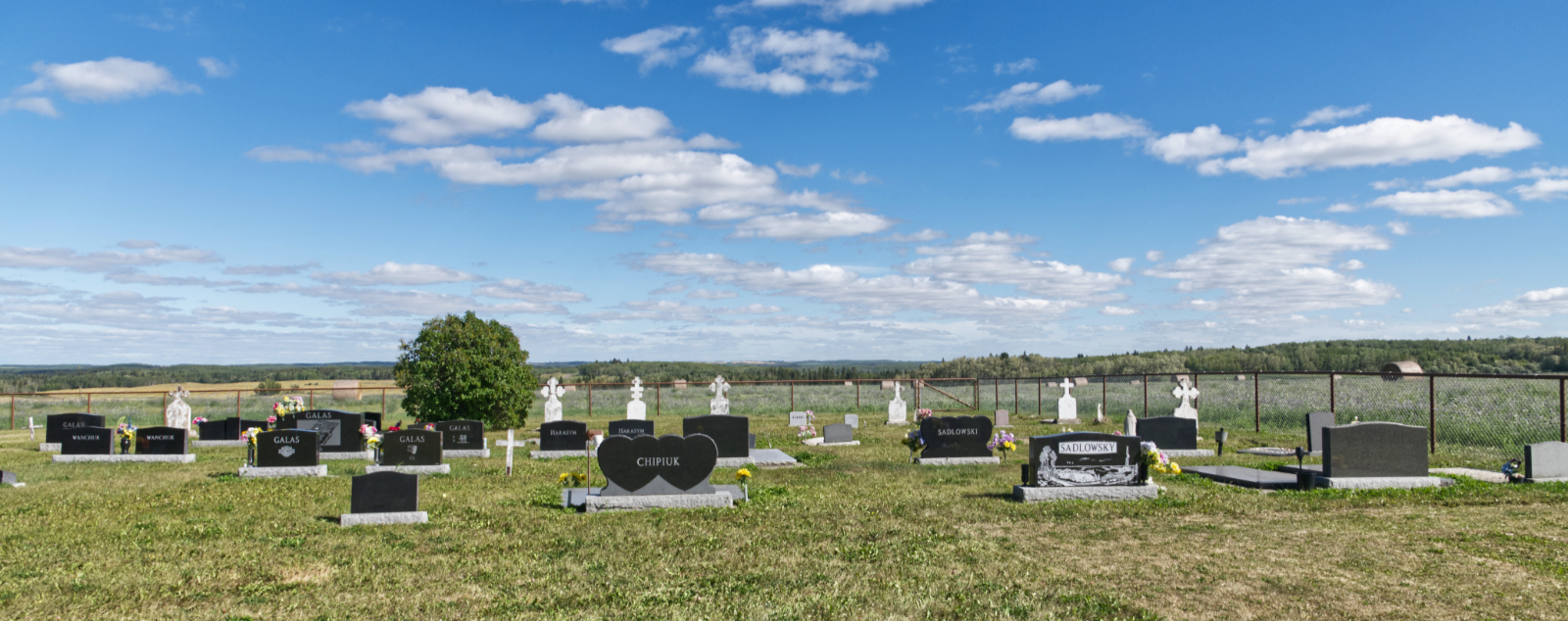
In July 1980, on the occasion of Alberta’s 75th anniversary, a cairn was erected on the church property with a plaque dedicated to the founding members of the church. By the first half of the 1990s, the church was being supported by little more than a handful of families, who nevertheless continue to lovingly maintain and worship in their sanctuary.
There is a hall behind the church, as well as metal bell tower.
Play Memory Eternal Chant
GPS Co-ordinates: 54.238197, -111.677424
Affiliation: Ukrainian Orthodox Church of Canada
Holy Cross Ukrainian Orthodox Church – Boyne Lake, AB
The genesis of the Borowich congregation can be traced to the selection of a cemetery site by area homesteaders in 1902. That same year, a special Dominion land grant (No. 1179) was issued to the Russo-Greek Catholic Orthodox parish of Shandro, for the purpose of establishing a church and cemetery to serve the Borowich district. A Russo-Orthodox congregation had been organized at Shandro in 1900 and was then in the process of constructing its' own place of worship, St. Mary's Church. In 1903, thirty-five local settlers met in the home of Hryhory Kowalchuk to discuss building a sanctuary on the twenty acres of land that had recently been acquired, also electing an executive and trustees to initiate this undertaking.
Because no large trees were available nearby, the parishioners had to obtain them from woods that were twenty miles away, north of the Andrew townsite. During the winter of 1903-1904, suitable trees were harvested from this timber stand (northeast of the Kysylew Russo Orthodox Church), after which the logs were hauled by sleigh to old Andrew for squaring at the Oliver sawmill.
Construction began in the summer of 1904, with Oleksa Morris hired to supervise the project and Dionysy Lastiwka serving as his assistant. The 26’ x 44’ log structure rose slowly on a stone foundation, the work proceeding whenever parishioners had some free time to help the builders. In 1906 Michael Zukiwski put on siding to seal the exterior walls, and that winter he worked with Peter Gudsovaty and other members to finish the interior and build the altar. In the meantime, Reverend Antony Pechinsky, assisted by Reverends Kryskha, Gregory Soroka and Alexander Peza of the Russian Orthodox Mission blessed the church at a service held on 14 October 1906, the feast day of St. Mary the Protectress—who was adopted as the patron of the sanctuary. Subsequently, a series of Russian Orthodox priests provided pastoral care for the congregation in the decade that followed.
Although the Borowich Church had essentially been completed by the winter of 1906-1907, clear title to it was only obtained in 1910, once the structure had been examined by a government inspector. In 1908 a clarion set of four bells was donated to the congregation by member Nikolai Lukian, who spent a week hauling the bells from Fort Saskatchewan by an oxen-drawn sleigh. Records indicate that in 1911 the parish had 33 members, many of the founders having originally emigrated from the Ukrainian village of Borivtsi.
Not long after Fr. Ivan Kusey was posted to Alberta in June 1920, the congregation resolved to join the newly established Ukrainian Greek Orthodox Church of Canada. Apparently, Reverend Dr. Lazar Gherman subsequently helped to celebrate the first UGOC liturgy at Borowich, probably while visiting the Willingdon area in February 1921. The faithful of the Borowich community were thus pioneers in establishing a truly national Orthodox church among the Ukrainians of rural east central Alberta. Indeed, their sanctuary, having been built and consecrated in 1906, has the unique honour of being the oldest church structure belonging to the Ukrainian Orthodox Church in the province of Alberta.
With the construction of the CPR rail line through the very heart of the historic Ukrainian bloc settlement in 1928, the town of Willingdon sprang up along the tracks while Borowich was left in the countryside northeast of the new townsite. Almost immediately, residents of Willingdon began discussing building a church in town, but a full decade was to pass before the community was in a position to actually begin constructing what became the Holy Ghost Ukrainian Orthodox Church. Completed and blessed the following year, the church in Willingdon naturally became a focus of religious activity for much of the surrounding district, a situation that could only work to the ultimate detriment of St. Mary the Protectress church. Still, long-time members of the Pokrova congregation continued to remain loyal to their family sanctuary, and the Borowich cemetery became the burial ground used by many of the faithful in nearby Willingdon.
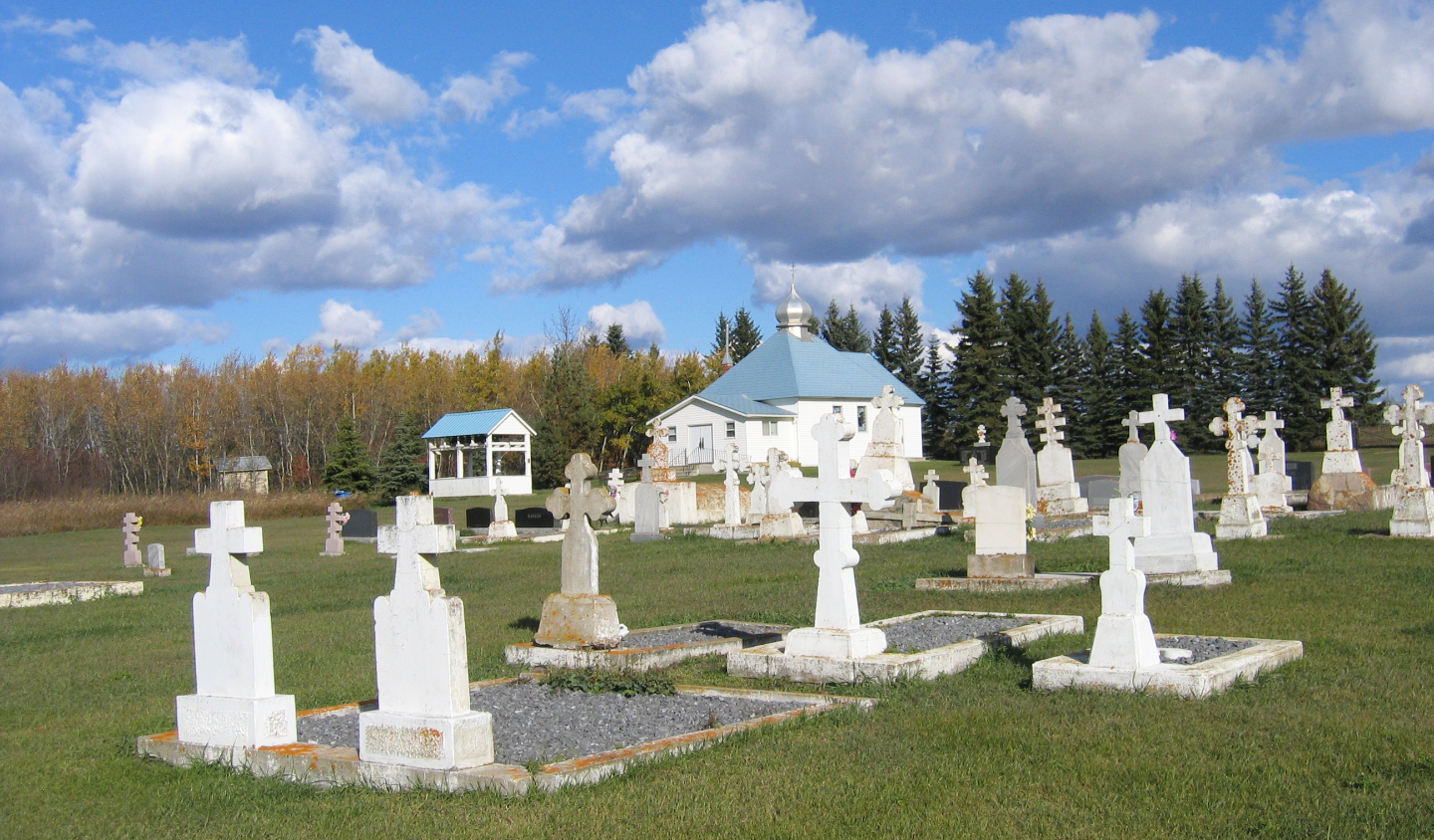
The Cemetery
Established in 1902 at the site of the future church, the first burial was that of John Tarangul, who died when he was kicked by a horse that he was shoeing.
Play Memory Eternal Chant
GPS Co-ordinates: 53.845508, -112.110012
Affiliation: Ukrainian Orthodox Church of Canada