The origins of the Bellis Orthodox community pre-date the 1918 founding of the Ukrainian Greek Orthodox Church of Canada. They can be traced to the establishment of a cemetery during the pioneer era on the North Bellis farm of Andrew Klymchuk, who subsequently became a founding member of the future All Saints congregation. On November 25, 1927, this cemetery was legally incorporated as the property of St. John's Ukrainian Orthodox Church, indicating that a more formal congregation had come into existence by this time.
Its members were served on an occasional basis by Reverend Timotei Horbay from 1926 to 1932. Religious services during these years were held in the newly built hall of the Ivan Franko Educational Society of Bellis (erected in 1926). This local Prosvita or "enlightenment" association had been founded in 1921. It provided an important focus for the development of Ukrainian cultural, political, and spiritual life in the district. Prior to 1926, some liturgies may also have been celebrated in the homes of area residents, since it is known that that Reverend Ivan Kusy visited Bellis as early as 1923. There is also a report that residents of the Bellis area travelled to the Wahstao area to attend a liturgy celebrated by Rev. L. Gherman of the UGOC in early 1921, several of whom gave confession for the first time in years.
The first documented election of a president for the Bellis congregation occurred at a meeting following a church service on January 25, 1931, when Anani Kovaluk apparently defeated two other nominees for the post. However, correspondence with the consistory in March of the same year indicated that Krizon Chornovliuk (Choronoluk) was the head of an executive comprised of entirely different members. Regardless, from that point on the Bellis congregation was in communication with the Ukrainian Greek Orthodox administration in Winnipeg.
On January 5, 1932, the members of the Bellis hromada purchased land for a church from the CNR. Although the $100 they paid for the property left them with only 5 cents in their bank account, they boldly proceeded with construction of a sanctuary the following year despite the difficult economic circumstances accompanying the onset of the Depression. The structure was consecrated on May 5, 1933, by Reverend Ivan Mayba, who had succeeded Father Timotei Horbay as the Bellis community pastor. The historic date was inscribed on a cross that still stands in front of the eastern wall of the church. At the time of the church's blessing, it was dedicated to St. John of Suchava, after a popular Bukovynian saint whose feast day is annually commemorated on June 15th.
The Depression years were hard on the Bellis congregation. The briefly suspended holding services at the beginning of 1936 because members could not afford to pay for them. The situation was exacerbated by problems with the harvest later the same year, as on September 12 a heavy snow fell when most of the crop was still on the ground. Nevertheless, two weeks later a joyous event took place in the community, as on September 27, 1936, Hryhory Wasyliw was ordained as a deacon of the Ukrainian Orthodox Church. He was subsequently consecrated as a priest in Smoky Lake two weeks later, afterwards assuming pastoral duties in the Smoky Lake District for the better part of a decade.
Sometime in the late 1940s St. Demetrius was adopted as the patron saint and protector of the church, though contradictory records exist concerning the official designation in the first decades of the congregation's existence. Be that as it may, on January 25, 1956, the Bellis Ukrainian Orthodox Church (as correspondence was frequently signed) requested that it henceforth be known as the All Saints Ukrainian Orthodox Church of Bellis, permission for this change subsequently being granted by the UGOC primate, Metropolitan Ilarion.
Among the proud achievements of the Bellis congregation was that it produced a priest for the Ukrainian Orthodox Church of Canada. Father Ihor Kutash, the son of Bukovynian immigrants, Yuri and Anna Kutash (who settled in the Bellis area in 1924), was ordained as a priest in 1969.
Go HERE for more information and history of this parish.
The Cemetery
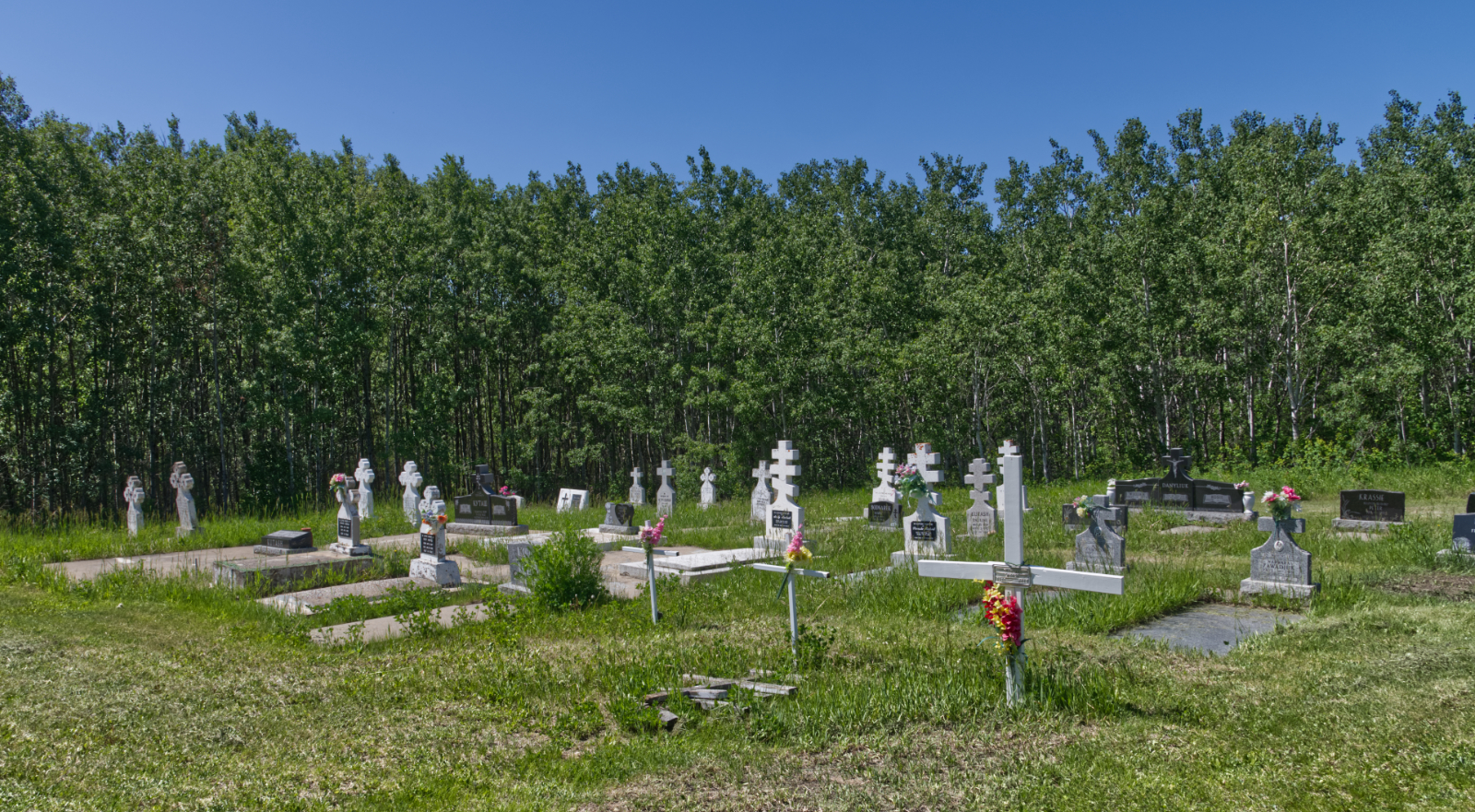
Established on the North Bellis farm of pioneer homesteader Andrew Klymchuk at NE 9-60-15 W4, it was legally registered on 25 November 1927 as belonging to St. John's Ukrainian Orthodox Church. According to records of the Alberta Genealogical Society, a second cemetery was apparently established by the congregation at SE 3-60-15 W4, and is registered as belonging to All Saints Ukrainian Orthodox Church. In 1992 it had 39 burials. A third cemetery is listed as belonging to St. John’s Ukrainian Orthodox Church at the same site as the second, but the number of burials is given as 81 in 1992.
Play Memory Eternal Chant
GPS Co-ordinates: 54.143117, -112.148241
Cemetery GPS: 54.153133, -112.152434
Affiliation: Ukrainian Orthodox Church of Canada

All Saints Ukrainian Orthodox Church – Bellis, AB
Congregational life was inaugurated in Andrew itself by a small group of activists in the summer of 1936, at which time four acres of land were purchased in the village for the site of a future sanctuary. An official organizational meeting was then held at the home of William and Mrs. Melenka on November 23, of the same year (the hosts being among the six persons in attendance at the gathering), a formal certificate of admission subsequently being issued by the Consistory of the Ukrainian Greek Orthodox Church of Canada on July 28, 1941. Reverend I. Hykawy, the resident priest at St. John of Suchava, celebrated the first liturgy in Andrew while the congregation was getting organized. Archbishop Ioan Theodorovich also visited the community during one of his periodic tours of east central Alberta. The building of the sanctuary began on July 4, 1939, with volunteers working under the supervision of Ivan (John) Mnoholitny, a farmer from the nearby Kahwin district who oversaw the construction of numerous Ukrainian churches locally and in other parts of rural western Canada.
Judging from a photograph taken of the congregation standing outside the church after it was first used for a service by Rev. Stephen Symchych in September 1940, it took several years to properly finish the structure. The completed sanctuary boasted a large central dome topped by a cupola, set amid four additional cupolas, three of which adorn the facade. The basement of the church was gradually developed as a multipurpose hall that could accommodate meetings, dinners, and a wide variety of parish functions. Similarly, an iron bell-stand was later erected adjacent to the entrance to the church, the bell having been donated by members of the Zawale congregation (most likely in the 1980s) after their own sanctuary had been abandoned.
In 1939, when the congregation was mobilized behind the construction of the church, it was comprised of twenty-eight members. However, within a year, the initial wave of enthusiasm had apparently waned to the point where only half the original membership was still active. From 1941 to 1946 the congregation was relatively stable, fluctuating between twelve to fourteen members and their families.
In 1948, Saints Peter and Paul church hosted thirteen services, and reported having sixteen paid members. A letter to the Consistory the following year announced that over sixty children were attending Sunday school, indicating parish life was extremely vibrant in the immediate postwar period. By 1951, membership in the church had grown to twenty-four families, and steady increases in the congregation's size were registered for the next four years. This expansion was probably attributable to a combination of factors, including the impact of the postwar baby boom and the rising importance of rural towns with the gradual decline of the farming population living in the surrounding countryside.
The church was formally consecrated by Metropolitan Ilarion during a visitation made on June 12, 1952. Around this time, the members of Saints Peter and Paul began discussing the possibility of installing an iconostasis, an issue that apparently divided the congregation. A vote taken at a meeting held in 1953 revealed that while fourteen members were keen to press on with the project, a dozen were opposed due to financial concerns. The will of the majority eventually prevailed, and it was reported in a 1954 article in Ridna nyva that work was about to proceed on the construction of an icon screen, the exterior of the church having recently been stuccoed. These and other positive developments signaled the maturation of parish life and were made possible by the increasing prosperity of the Andrew Orthodox community.
In 1952 the congregation consisted of thirty families, with another forty families being identified as sympathizers (the total number of the latter was said to be 210 individuals in the annual report to the Consistory for 1954). In the early 1950s, the church hosted an average of thirteen services over the course of the year, a figure that has remained fairly constant until the present day. The congregation reached a peak in size during the mid-1950s, benefiting in part from an influx of retirees from outlying farms, and partially from a concomitant decline in activity at St. Michael's Church in Zawale. As services became increasingly infrequent at the latter in the fifties and sixties, the dwindling Zawale membership joined Saints Peter and Paul Church, contributing to its vitality and viability.
An especially proud moment in the history of the congregation was the July 1972 ordination of Rev. Henry Lakusta in the church, a son of a former member, John Lakusta. A second son, Victor, had earlier been ordained in Winnipeg, and is currently serving at St. Andrew's Sobor in Edmonton.
Over the years, some of the land originally purchased for the church was sold for residential development, so that the congregational property today consists of less than two acres. The roof of the Saints Peter and Paul has been re-shingled on two occasions, and the structure received a major facelift in the 1970s. Its original windows have been replaced, and its cupolas and dome have been repainted. The congregation is a co-owner of a manse in Willingdon, along with the eight other area churches comprising the Willingdon parish.
Go HERE for more information and history of this parish.
The Cemetery
A one acre parcel of land was acquired for a church cemetery in 1925 at NW 28-56-16 W4 on the southern approaches to the town, on the east side of Secondary Highway 855. The earliest burial was that of William Lesick (d. 31 December 1952), the founding president of the church. Several local dignitaries such as the first mayor of Andrew (Tom Matichuk) and the first Justice of the Peace (Gregory Moisey) are interred in the church graveyard.

Play Memory Eternal Chant
GPS Co-ordinates: 53.881432, -112.335769
Cemetery Co-ordinates: 53.869420, -112.331297
Affiliation: Ukrainian Orthodox Church of Canada
Sts. Peter and Paul Ukrainian Orthodox Church – Andrew, AB
Click or tap on the church name below to see a photo or video, short history, cemetery links and more information on each parish.
1. Ukrainian Orthodox Churches (UOC) in Alberta, Canada
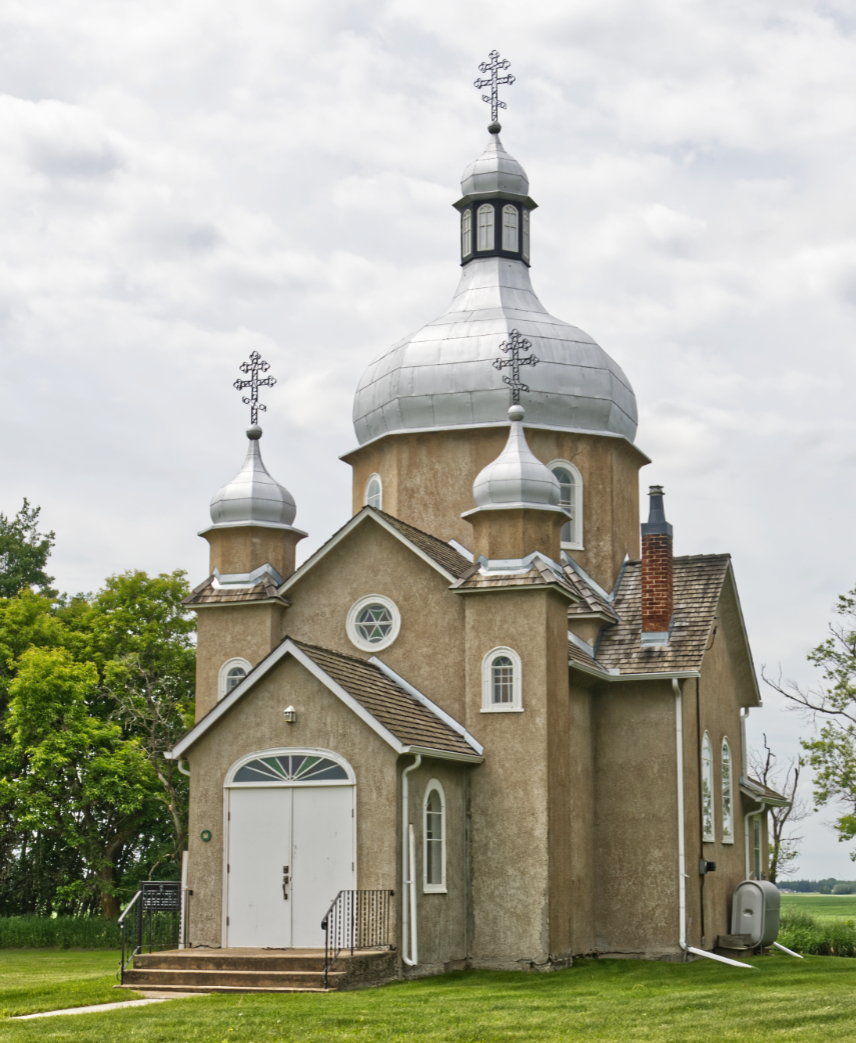
1.1 Andrew – Sts. Peter and Paul Ukrainian Orthodox Church
1.2 Athabasca – Saints Peter and Paul Ukrainian Orthodox Church UPDATED *
1.3 Bellis – All Saints Ukrainian Orthodox Church
1.4 Big Meadow – St. John the Baptist Ukrainian Orthodox Church UPDATED
1.5 Bonnyville – St. Elias Ukrainian Orthodox Church UPDATED
1.6 Boriwtzi – St. Mary the Protectress Ukrainian Orthodox Church
1.7 Boyle – Descent of the Holy Spirit Ukrainian Orthodox Church
1.8 Boyne Lake – Holy Cross Ukrainian Orthodox Church
1.9 Brinsley – Holy Spirit Ukrainian Orthodox Church
1.10 Brosseau (Mamaestie) – Holy Trinity Ukrainian Orthodox Church
1.11 Calmar – Holy Trinity Ukrainian Orthodox Church
1.12 Craigend – St. Demetrius Ukrainian Orthodox Church UPDATED
1.13 Downing – St. Paraskewa Ukrainian Orthodox Church
1.14 Edwand – St. Mary the Protectress (Pokrova) Ukrainian Orthodox Church
1.15 Egremont – Saint John's Ukrainian Orthodox Church
1.16 Elk Point – St. Volodymyr Ukrainian Orthodox Church UPDATED
1.17 Fedorah – Saint John the Baptist Ukrainian Orthodox Church
1.18 Gifford – Sts. Peter and Paul Ukrainian Orthodox Church UPDATED
1.19 Glendon – Holy Trinity Ukrainian Orthodox Church UPDATED
1.20 Grassland – Holy Transfiguration Ukrainian Orthodox Church
1.21 Hamlin – St. Mary's Ukrainian Orthodox Church
1.22 Innisfree – St. John Ukrainian Orthodox Church UPDATED
1.23 Ispas – Holy Ascension Ukrainian Orthodox Church
1.24 Jaroslaw – St. Demetrius Ukrainian Orthodox Church
1.25 Kahwin – Holy Trinity Ukrainian Orthodox Church
1.26 Kaleland – Sts. Peter and Paul Ukrainian Orthodox Church
1.27 Lac La Biche – All Saints Ukrainian Orthodox Church
1.28 Luzan – St. Demetrius Ukrainian Orthodox Church
1.29 Luzan Toporiwtzi – St. Elias Ukrainian Orthodox Church
1.30 Morecambe – St. John the Baptist Ukrainian Orthodox Church
1.31 Musidora – Dormition of St. Mary Ukrainian Orthodox Church
1.32 Myrnam – Holy Trinity Ukrainian Orthodox Church
1.33 Newbrook – Dormition of St. Mary Ukrainian Orthodox Church UPDATED
1.34 Noral – St. Mary the Protectress Ukrainian Orthodox Church UPDATED
1.35 Onoway – Sts. Peter and Paul Ukrainian Orthodox Church
1.36 Peno – St. John the Baptist Ukrainian Orthodox Church
1.37 Pruth – Holy Ascension Ukrainian Orthodox Church
1.38 Radway – Holy Ascension Ukrainian Orthodox Church
1.39 Redwater – Holy Trinity Ukrainian Orthodox Church
1.40 Richmond Park – Holy Trinity Ukrainian Orthodox Church UPDATED
1.41 Sachava – St. John Ukrainian Orthodox Church
1.42 Sandy Rapids (Iron River) – All Saints Ukrainian Orthodox Church UPDATED
1.43 Sarrail – Sts. Peter and Paul Ukrainian Orthodox Church
1.44 Sich-Kolomea – Holy Assumption of St. Mary Ukrainian Orthodox Church
1.45 Slawa (North) – All Saints Ukrainian Orthodox Church UPDATED
1.46 Slawa (South) – Holy Assumption of St. Mary Ukrainian Orthodox Church
1.47 Smoky Lake – Holy Ascension Ukrainian Orthodox Church UPDATED
1.48 Spedden – Holy Trinity Ukrainian Orthodox Church
1.49 St. Paul – All Saints Ukrainian Orthodox Church UPDATED
1.50 Stry – Holy Spirit Ukrainian Orthodox Church
1.51 Szypenitz – St. Mary Ukrainian Orthodox Church
1.52 Thorhild – St. Peter and Paul Ukrainian Orthodox Church
1.53 Two Hills – Holy Trinity Ukrainian Orthodox Church
1.54 Vegreville – St. Vladimir Ukrainian Orthodox Church
1.55 Wandering River – St. Elias Ukrainian Orthodox Church UPDATED
1.56 Waskatenau – St. Volodymyr's Ukrainian Orthodox Church
1.57 Westlock – St. Volodymyr Ukrainian Orthodox Church
1.58 Zawale – St. Michael's Ukrainian Orthodox Church
NOTE: Some of the churches may not have videos (yet). This is because we have not done the drone photography of them, or they are in towns where there may be restrictions placed on flying drones. Videos of these and additional churches will be added if and/or when the photos become available.
* UPDATED More photos were posted in the Photo Galleries for these churches.
CREDITS: We thank and acknowledge Jars Balan for providing us with the histories of the Alberta Ukrainian Orthodox parishes. Additional photographs of some of the churches are courtesy of Fred Alexandruk and Sterling Demchinsky (See his website.)
Church affiliations and links
UOC = Ukrainian Orthodox Church of Canada
OCA = Orthodox Church of America
UCC = Ukrainian Catholic Eparchy of Edmonton
RGO = Patriarchial Parishes of Russian Orthodox Church in Canada
ROC = Romanian Orthodox Diocese of Canada
RCC = Catholic Archdiocese of Edmonton